
Inventory decision-making across multi-tiered supply chains is a big challenge. Too much stock ties up cash, while too little leads to costly stockouts and unhappy customers.
That’s why AI adoption in inventory management is accelerating fast, rising from $7.38 billion in 2024 to $9.6 billion in 2025, with forecasts pointing to $27.23 billion by the end of the decade.
AI helps improve forecasting and balances stock across all echelons. It also supports smarter replenishment decisions. This article talks about how AI enhances multi-echelon inventory decision-making.
You’ll learn how it boosts efficiency, reduces costs, and strengthens your supply chain. Let’s dive in!
Challenges in Traditional Multi-Echelon Inventory Planning
Traditional multi-echelon inventory planning struggles because the system itself was never designed to handle today’s complexity. So, the challenges that you might come across during traditional planning include:
1. Demand Variability
Traditional planning systems rely heavily on historical averages, which smooth out these differences instead of responding to them. As a result, inventory gets pushed to the wrong places at the wrong time.
This is why businesses often experience real causes for network-wide stockouts in high-demand locations while excess inventory sits idle elsewhere.
2. Lead-Time Uncertainty
Lead times are rarely fixed, even when suppliers promise they are. Weather delays, capacity constraints, and transportation disruptions all introduce variability. When one node in the network is delayed, the impact cascades downstream.
Traditional planning assumes stable lead times, so it cannot adjust inventory decisions in real time.
3. Limited Visibility
In many organizations, inventory data lives in separate systems for plants, distribution centers, and downstream locations.
This fragmented view leads to decisions that optimize one echelon while harming another. According to industry research, lack of end-to-end visibility is one of the most common reasons inventory plans fail to execute as intended.
4. Excess Stock
You’d be surprised to know that inventory carrying costs typically range between 20–30% of inventory value per year. Moreover, this problem becomes even more pronounced when stock is held in the wrong parts.
This misplaced inventory creates the illusion of safety while failing to support locations where demand is actually occurring.
How AI Differs from Rule-Based and Heuristic Approaches
Traditional rule-based and heuristic methods rely on fixed formulas or past experience to make inventory decisions. While simple, they cannot adapt to rapidly changing demand or complex supply chain interactions.
AI, on the other hand, learns from large volumes of historical and real-time data. It can adjust recommendations dynamically, detect hidden patterns, and optimize inventory across multiple echelons.
This flexibility allows companies to achieve more accurate predictions and reduce misplaced inventory, enabling efficient inventory planning that reacts to real-world conditions instead of rigid rules.
Key AI Capabilities Relevant to Inventory Decisions
AI brings several capabilities that improve inventory management:
- Advanced Forecasting: Predicts demand with higher accuracy using historical and real-time data as well as internal/external causal factors that had/would have impacted the demand.
- Scenario Simulation: Models the impact of different decisions and uncertainties.
- Prescriptive Analytics: Recommends optimal stock placement and replenishment strategies.
- Network Optimization: Balances inventory across multiple echelons to minimize costs and stockouts.
The Role of AI in Multi-Echelon Management
AI plays a critical role in managing inventory across multiple echelons. By integrating data from all levels, companies can achieve supply chain optimization and ensure that the right products are available at the right time.
1. Multi-Echelon Inventory Optimization (MEIO)
Multi-Echelon Inventory Optimization (MEIO) uses AI to optimize stock placement and quantities across all echelons. By considering demand, lead times, and interdependencies, AI driven inventory optimization helps to reduce excess inventory while improving service levels. This ensures efficient inventory management throughout the network.
In fact, Sophus has already helped a Pharmaceutical giant bring inventory into balance by using AI driven inventory optimization. After the pandemic,the company saw their inventory double from ~100 to over 200 Days of Supply. They were making decisions based on legacy rules, fragmented spreadsheets, and disconnected assumptions across APIs.
However, after partnering with us, we helped build an end-to-end, AI-driven inventory model that connected testing cycles, lead times, service targets, and production constraints across all echelons. The result was tens of millions released from working capital.
2. Operational Decision Support
AI provides actionable recommendations for replenishment, transfers, and safety stock adjustments. Planners can simulate different scenarios and quickly choose the best course of action. This guidance supports supply chain optimization and reduces human errors.
3. Demand and Lead-Time Intelligence
AI improves demand forecasting by analyzing historical and real-time data. It identifies patterns, seasonality, and location-specific trends that humans might miss.
AI also evaluates lead-time variability, helping planners understand where delays may occur. Together, this intelligence allows companies to maintain optimal inventory levels and minimize disruptions.
4. Continuous Learning and Adaptation
AI systems continuously learn from new data. They adapt to changing demand patterns, supplier performance, and market conditions. This ensures that inventory decisions remain accurate and aligned with business goals.
Tangible Benefits of AI for Businesses
Let’s explore how AI helps reduce stockouts across multiple locations and improve inventory management with ease.
1. Fewer Stockouts and Excess Inventory
AI-driven multi-echelon management helps companies maintain optimal inventory across all locations. By predicting demand more accurately and adjusting stock placement dynamically, businesses can significantly reduce both stockouts and overstock.
This leads to fewer lost sales and lower carrying costs. Misplaced inventory is minimized, ensuring resources are used efficiently, and supply chains remain resilient.
2. Higher Service Levels and Working Capital
Better forecasting and inventory optimization directly improve service levels. Customers receive products when and where they need them. At the same time, companies free up capital tied in excess stock, allowing for smarter allocation of resources.
Inventory turns increase, costs decrease, and operational efficiency rises, giving businesses a measurable financial advantage.
3. Adaptive and Autonomous Networks
Modern AI systems enable inventory networks to become adaptive and self-correcting. Decisions that once required manual intervention are now automated, adjusting in real time to demand changes, lead-time variability, and supply disruptions.
This shift toward autonomous operations allows businesses to respond faster, plan more accurately, and build a more resilient and agile supply chain.
Upgrade the Way You Make Inventory Decisions
If you are managing inventory across multiple locations, the goal is not just to forecast better, but to make smarter decisions. AI enables you to move beyond isolated planning, helping you balance service levels, costs, and risk across every echelon.
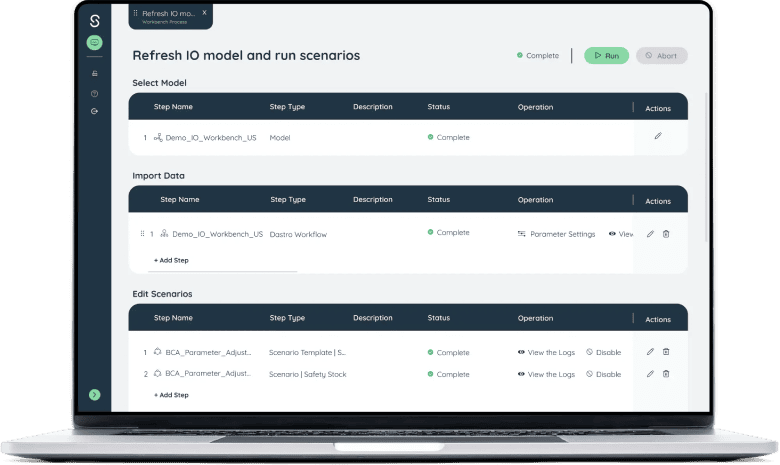
However, it becomes way easier when you use tools like Sophus alongside. It is built specifically for advanced inventory planning, using AI to support multi-echelon decision-making. With it, you can replace guesswork with intelligent inventory decisions.
Request a free demo today to make inventory planning a breeze!
FAQs
1. Can AI help forecast demand during unexpected events or market shifts?
Yes. AI can incorporate external data like market trends, promotions, weather, and economic indicators to adjust predictions. This makes it more resilient than traditional methods during sudden demand changes.
2. How does AI improve collaboration between different supply chain partners?
AI platforms can share real-time inventory and demand insights with suppliers, distributors, and retailers. This transparency reduces delays, prevents overstock, and ensures smoother coordination across the network.
3. Is implementing AI in multi-echelon inventory management expensive or complicated?
While initial setup requires investment in technology and data integration, modern AI tools are increasingly user-friendly. Many solutions offer cloud-based platforms and modular implementation, making adoption faster and less disruptive.