AI in supply chain has become one of the most talked-about technologies. For years, companies have heard promises about how AI could transform forecasting, inventory planning, and logistics. Yet, many leaders still struggle to see where the real value begins and the hype ends.
The potential is undeniable. The global AI in logistics market is expected to reach $20.8 billion by 2025, and more than 75% of supply chain executives say AI has already improved planning accuracy and decision-making speed. From predicting demand to optimizing routes, AI is making supply chains faster, leaner, and more resilient.
But not every story is a success. Studies show that most AI initiatives never move beyond the pilot stage, often because teams overestimate what AI can do or underestimate the data and process readiness required. This gap between expectation and execution is where many organizations get stuck.
For supply chain decision-makers, the next step is clear: move beyond experimentation toward AI-driven supply chain optimization that delivers measurable, repeatable results. Understanding what AI should do and what it shouldn’t is the key to turning potential into progress.
The Shift from Traditional to AI-Driven Supply Chain Optimization
Supply chains are undergoing a major transformation from manual, reactive operations to intelligent, AI-driven ecosystems that adapt in real time.
This represents a complete change in how organizations plan, collaborate, and respond to volatility across their global networks. Let’s see how AI in supply chain redefining the foundations of supply chain management.
Reactive vs. Proactive Decision-Making
Traditional supply chains operated in hindsight. Planners relied on monthly or quarterly reviews to react to disruptions such as supplier delays, demand surges, or shipment bottlenecks. This reactive cycle often resulted in late interventions, excess costs, and missed service-level targets.
With AI-driven supply chain optimization, decision-making becomes predictive and preventive. Machine learning models analyze live data from suppliers, logistics partners, and external signals like weather patterns or political events to forecast risks before they materialize.
Manual vs. Automated Planning
In legacy environments, planners spent hours reconciling spreadsheets, adjusting production schedules, and coordinating procurement with logistics.
Such manual planning was slow, error-prone, and heavily dependent on human judgment.
AI replaces these repetitive tasks with self-optimizing algorithms that automatically adjust plans based on real-time data.
Instead of planners manually running what-if models, the system continuously recalibrates production, replenishment, and transportation as new information arrives.
Key leadership advantages include:
- Speed: Decisions that took days can now be made in minutes.
- Accuracy: AI considers thousands of data points simultaneously, reducing forecasting errors and overcorrections.
- Scalability: Automated models can optimize across global supply networks, far beyond what human planners can manage manually.
Limited Visibility vs. End-to-End Insight
Most supply chains still struggle with fragmented systems procurement uses one platform, logistics another, and manufacturing a third. This fragmentation creates blind spots where disruptions often go unnoticed until they escalate.
AI in supply chain solves this by providing end-to-end visibility through integrated data pipelines and connected dashboards, often called AI-powered control towers.
Static vs. Dynamic Optimization
Traditional planning models were built for stability, not speed. They relied on fixed assumptions, routes, lead times, production capacities and were updated only periodically.
But modern supply chains face constant change: fluctuating demand, port delays, or geopolitical shocks.
AI introduces dynamic optimization, where systems continuously adapt to new inputs and constraints.
For example:
- If a truck is delayed, AI automatically reroutes other shipments or reallocates stock to maintain service levels.
- If regional demand spikes unexpectedly, AI rebalances inventory and triggers expedited replenishment only where needed.
Leadership Perspective
For supply chain leaders, this evolution is more than a technology shift; it’s a strategic transformation.
AI-driven supply chain management empowers organizations to:
- Anticipate and mitigate risks before they occur.
- Operate with real-time intelligence instead of lagging indicators.
- Reallocate talent from manual tasks to strategic innovation.
- Build resilience and agility as a core competitive advantage.
Strategic Areas Enhanced by AI in Supply Chains
AI is redefining supply chain operations across key areas. It combines predictive analytics, automation, and advanced visibility to help supply chain leaders make faster and smarter connected decisions. This directly impacts service levels, cost efficiency, and resilience.
AI-Based Demand Forecasting
Demand forecasting is the foundation of every supply chain. Yet traditional models often fall short when faced with sudden market shifts, incomplete data, or new product launches. AI-driven demand forecasting changes that by integrating advanced algorithms, advanced data, and continuous self-learning to improve accuracy and responsiveness across all planning horizons.
Multivariate Demand Forecasting and Automatic Tuning
AI and machine learning models don’t rely only on historical sales data. They analyze hundreds of internal and external variables such as weather trends, regional events, promotions, economic conditions, and customer sentiment to detect subtle demand signals traditional models miss.
Unlike most machine learning systems that require users to manually choose forecasting methods, AI autonomously tests and tunes the best model for each product or market segment. This ensures that forecasting accuracy continually improves as the system learns from new data, freeing planners from repetitive parameter adjustments and giving them deeper insight into true demand patterns.
What-If Simulations and Planning
AI takes forecasting beyond prediction by enabling rapid supply chain scenario planning. Planners can instantly simulate how changes in pricing, marketing, or supply constraints might affect demand.
This capability becomes especially valuable when historical data is unavailable, such as for new product launches or market entries. AI can generate synthetic forecasts by grouping similar SKUs or regions to estimate initial demand, helping businesses make confident production and procurement decisions.
AI-Powered Inventory and Supply Planning
Inventory and supply planning are at the heart of operational efficiency. Too much inventory ties up working capital, while too little leads to stockouts and dissatisfied customers. AI brings precision to this balance by learning from real-time data, continuously identifying optimal stock levels, and aligning supply with actual market demand.
AI Powered Factor Analysis for Inventory Planning and Optimization
Traditional inventory models depend on fixed rules such as reorder points or average lead times. These rules overlook the many changing factors that influence stock levels, including supplier performance, transportation delays, production rates, and seasonal demand.
AI learns from multiple variables at once and determines which factors have the most impact on inventory performance. It then adjusts stocking parameters automatically to keep inventory aligned with real-world conditions. This allows leaders to base inventory decisions on data rather than assumptions, improving service levels while reducing carrying costs.
Smarter Distribution and Allocation
AI not only determines how much inventory is needed but also decides where and when it should be positioned across the network.
AI can rebalance inventory by transferring products from slower-moving areas or triggering faster replenishment. These intelligent allocation decisions reduce shipping costs, improve delivery speed, and strengthen responsiveness across the entire supply chain.
Production and Sourcing Recommendations
AI-driven supply chain optimization connects production, sourcing, and supply decisions within a single intelligent framework. It evaluates production capacity, supplier reliability, and lead times to recommend where and when to produce or source materials.
If a supplier faces a delay, AI can identify alternate vendors or shift production to another facility that meets cost and schedule requirements. This ensures inventory targets are met while operations stay flexible and cost efficient.
AI in Logistics and Transportation
Logistics is where AI creates some of the most visible and measurable improvements in supply chain performance. It helps organizations move goods faster, at lower cost, and with greater predictability. By combining data from routes, fleets, and shipments, AI transforms how logistics teams plan, operate, and respond to real-time challenges.
Route Optimization and Smart Scheduling
AI improves routing decisions by analyzing a wide range of variables such as traffic conditions, fuel costs, delivery time windows, and driver availability.
Using optimization algorithms, it determines the most efficient routes for every trip while balancing delivery speed and cost. This leads to fewer empty miles, reduced emissions, and improved on-time delivery rates.
Predictive Fleet and Asset Management
AI also enhances the maintenance and reliability of fleets. It uses sensor data, operating hours, and repair histories to predict when a vehicle or asset is likely to need maintenance.
This allows teams to schedule repairs before breakdowns occur, avoiding unplanned downtime and costly delays.
Predictive maintenance improves asset life cycles, keeps fleet capacity stable, and helps logistics leaders plan operations with greater confidence.
Advanced Visibility and Response
AI-powered control towers give logistics teams a real-time view of shipments, inventory, and routes across the entire network.
When disruptions occur, such as weather delays or port congestion, AI systems immediately identify the impact and recommend corrective actions. These advanced insights allow organizations to maintain transparency, reduce customer uncertainty, and protect service levels even in volatile conditions.
AI-Driven Supply Chain Optimization Solutions
AI solutions today connect planning, execution, and visibility into one unified system. They help organizations turn fragmented data into actionable insights and enable faster, more coordinated decision-making across the network.
Integrated Optimization Platforms
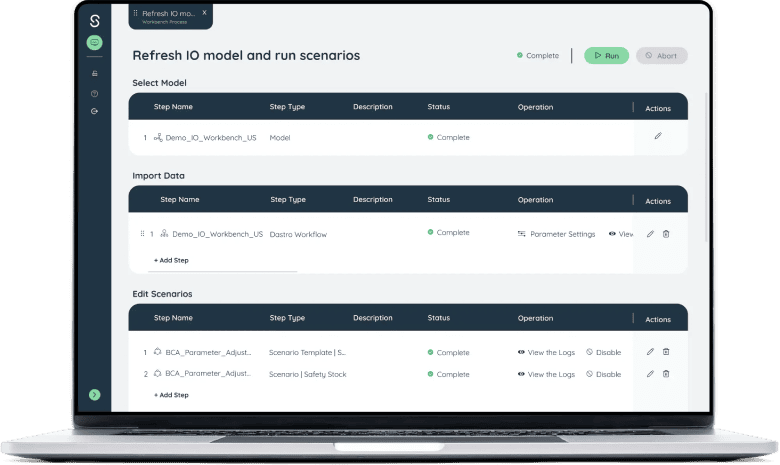
Sophus X brings forecasting, planning, and optimization together under a single data model. This unified environment helps teams test multiple scenarios, evaluate outcomes, and implement data-driven strategies with speed and confidence. It eliminates silos between functions and gives leaders a complete, connected view of the supply chain.
One example of this approach in action can be seen in how test.sophus.ai/ helped a global pharmaceutical company bring its inventory back to balance.
By connecting fragmented data sources and applying its AI-driven optimization model, Sophus enabled the company to move from weeks of manual coordination to an end-to-end, transparent inventory system.
AI analyzed factors such as batch sizes, release cycles, and service levels, helping planners identify the right inventory targets across all product stages.
The result was a faster, more data-driven decision process that reduced excess stock and improved product availability across the network.
Digital Twins and Simulations
Supply chain digital twins create a virtual replica of the physical supply chain for testing and planning. AI strengthens these models by running real-time simulations that predict how network changes or disruptions will affect performance. This helps organizations plan proactively and make decisions backed by data rather than assumptions.
AI Control Towers
AI control towers provide end-to-end visibility across suppliers, warehouses, and transport networks. They monitor live data, detect exceptions, and recommend corrective actions instantly.
This ensures that leaders can manage disruptions effectively and maintain service continuity even in fast-changing conditions.
Implementation Challenges and Considerations of AI-Driven Supply Chain Management
While AI brings clear value, successful implementation depends on strong data foundations, skilled teams, and strategic adoption. Leaders need to approach it as a long-term transformation, not a quick fix.
Data Quality and Integration
AI depends on reliable, connected data across all systems. Poor or incomplete data will lead to poor outcomes, the classic “garbage in, garbage out.”
Companies must invest in data preparation and integration before deploying AI models. Supply chain ETL solutions can automate this process, ensuring cleaner data pipelines and better results.
Skills and Training
AI adoption requires teams who understand both data and business context. Upskilling planners and analysts in AI tools is essential for long-term success.
Equally important is having a user-friendly interface, because complex tools often fail to gain adoption. If users cannot easily navigate or explain results to leadership, the perceived value of AI quickly fades.
Change Management and Adoption
Introducing AI changes how decisions are made, which can meet resistance from teams used to manual control. Building trust in AI recommendations starts with transparency and measurable outcomes.
Leaders should begin with pilot projects that demonstrate real benefits and gradually expand adoption as confidence grows.
ROI and Scaling
Many organizations invest heavily in AI projects that never yield returns due to long deployment cycles and limited usability. A phased approach works best — start small, prove value, and scale gradually.
test.sophus.ai/ delivers a faster time to value by providing quick, optimized results and the fastest speed to answer, allowing teams to measure ROI early and build momentum for broader implementation.
Conclusion – Why Now Is the Time?
Legacy supply chain processes are too slow for today’s pace of business. Manual planning, fragmented systems, and delayed insights make it difficult to respond quickly or accurately. AI and optimization solves this by enabling real-time visibility, faster decisions, and adaptive planning.
The benefits are clear: greater agility, lower operational costs, and a stronger competitive edge. Yet these results only come when AI systems are accessible, easy to use, and widely adopted across teams. Technology alone is not enough — it must empower people to act quickly and confidently.
This is where test.sophus.ai/ stands out. Built for usability and speed, it provides the fastest speed to answer, helping organizations make accurate, data-driven decisions in minutes instead of weeks. For leaders looking to move from analysis to action, test.sophus.ai/ offers the most practical and scalable way to unlock the full AI advantage and build a smarter, more resilient supply chain.