

Supply chain disruptions are a regular part of operations. Geopolitical tension, climate risks, demand swings, and supplier failures are all happening simultaneously, and the numbers reflect it. Nearly 80% of organizations faced at least one supply chain disruption in the past year, and global disruptions increased by 38% year over year. Major disruptions lasting weeks still occur every few years and many companies are dealing with repeated hits before they have fully recovered from the last one. The pattern is clear: disruption is constant, not occasional. Reactive planning is no longer enough.
Supply chain scenario planning is the discipline that changes that equation. By mapping risks before they materialize, stress-testing your network against realistic disruption scenarios, and having response strategies ready to activate, your team stops chasing crises and starts staying ahead of them.
✓
Without scenario planning, your first encounter with a disruption is also your first attempt at solving it.
✓
The difference between a supply chain that bends and one that breaks often comes down to whether teams had modeled the situation before it happened.
✓
Scenario planning turns uncertainty from a threat into a variable your team already knows how to handle.
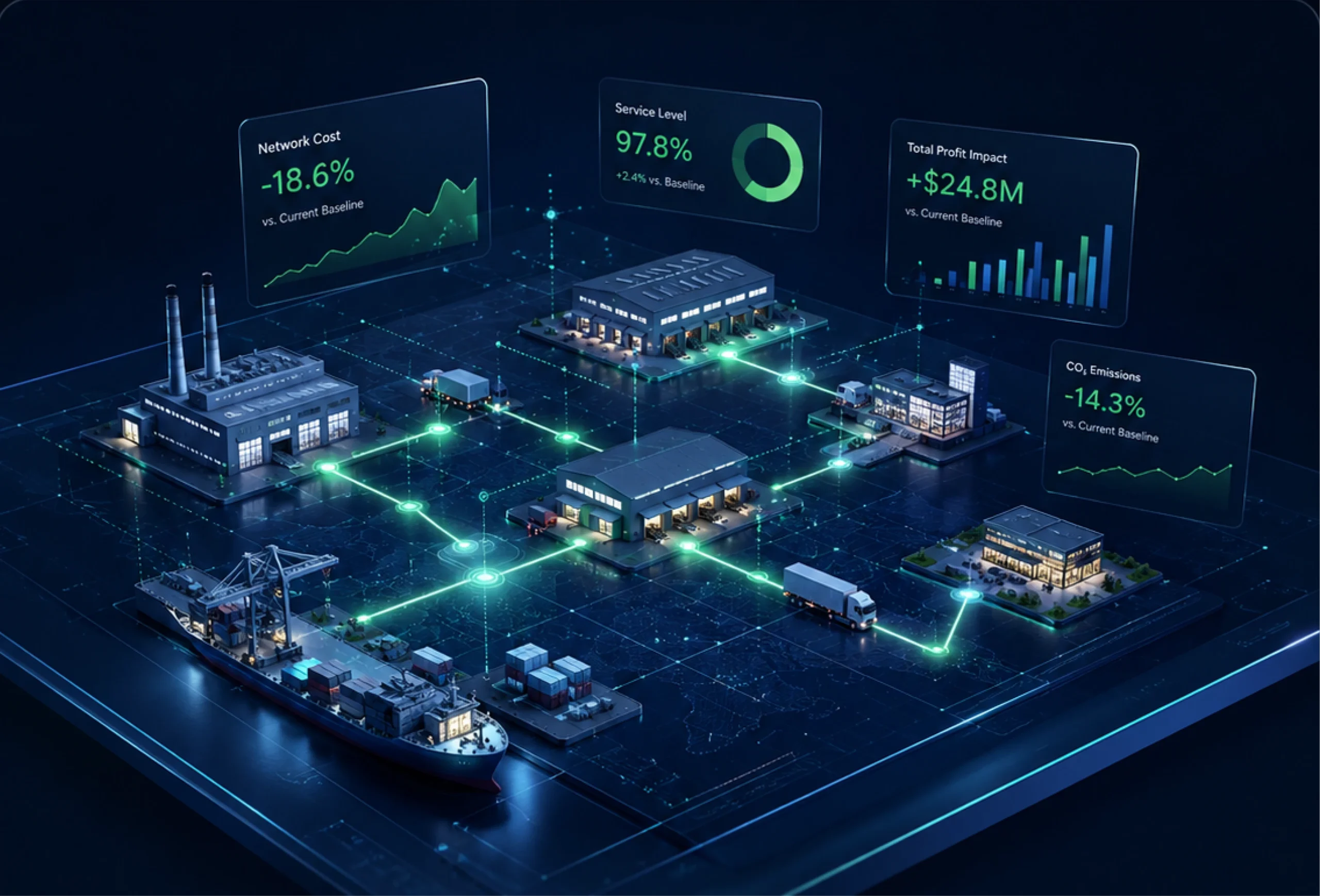
This guide covers the complete framework: the types of scenarios to model, a six-step process your team can follow, the technology that makes it scalable, and the real operational impacts on cost, service, inventory, and carbon.
What is Supply Chain Scenario Planning?
Supply chain scenario planning is all about getting ready for what might happen in the future. It is like preparing for different possibilities and making plans in advance, just in case. This way, if something unexpected does occur, you are already prepared and know what to do.
In short, scenario planning in supply chain network design helps a company determine what could go wrong in its supply chain. This could be anything from transportation delays to suppliers going out of business or even global emergencies like pandemics.
But by thinking ahead and devising strategies, businesses can manage these risks and keep things running smoothly, no matter what comes their way.
Types of Supply Chain Scenario Planning
Scenario planning in supply chain network design does not have a one-size-fits-all approach.
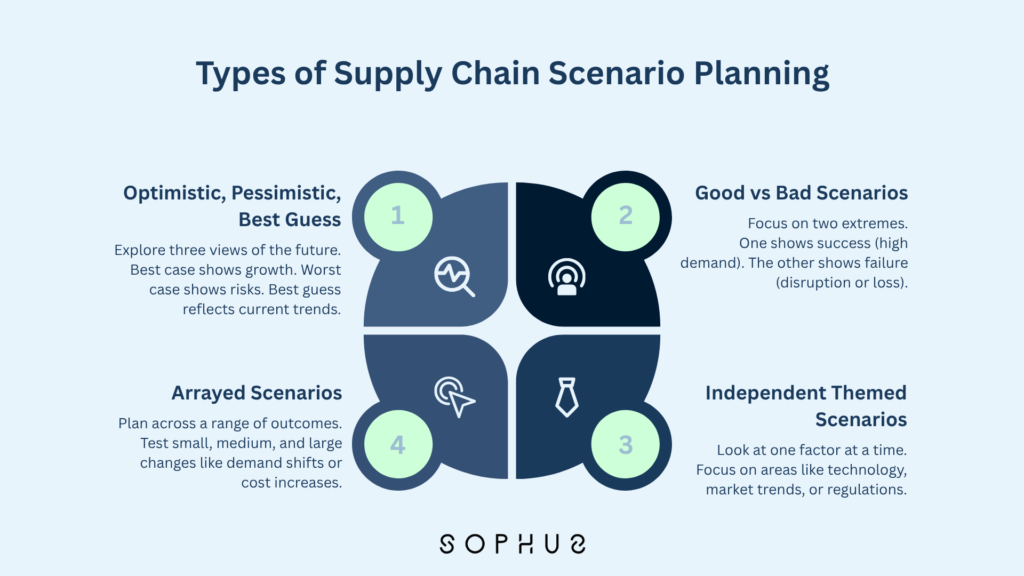
There are various types, each with its unique focus and methods:
- Optimistic, Pessimistic, and Best Guess Scenarios: This involves creating three scenarios: optimistic, pessimistic, and best guess. Optimistic scenarios consider the best outcomes, like a sudden demand surge. Pessimistic scenarios explore potential pitfalls, like a market crash. Best guess provides a balanced view based on current trends.
- Good vs. Bad Scenarios: This focuses on extremes, considering the most optimistic (good) and pessimistic (bad) scenarios. For instance, a good scenario might be a successful product launch, while a bad one could be a product recall.
- Arrayed Scenarios: This method is quantitative, looking at a range of alternatives based on specific criteria. For example, an energy company might plan for slight, moderate, or severe fluctuations in oil prices.
- Independent Themed Scenarios: This strategic approach focuses on individual categories of change, like technology, the environment, or market trends. For example, a tech company might consider scenarios for breakthroughs in artificial intelligence or quantum computing.
Significance of Supply Chain Scenario Planning
Supply chain scenario planning is like having a crystal ball for businesses. It helps them foresee and understand possible risks. Here is why it is essential:
- In-depth analysis: Scenario planning lets businesses look closely at different outcomes, helping leaders make smart choices.
- Proactive problem-solving: By spotting issues early, scenario planning helps businesses avoid problems and deal with challenges effectively.
- Fostering diversity of thought: It encourages different viewpoints, which leads to creative problem-solving and avoids groupthink.
- Challenging the status quo: Scenario planning encourages businesses to think outside the box and consider new ideas.
- Early warning system: It helps businesses catch potential problems before they escalate, enabling early intervention.
- Contingency planning: Scenario planning helps businesses create backup plans so they can take quick action if unexpected problems arise.
- Future-proofing: Unlike traditional forecasting, scenario planning helps businesses prepare for the future by adapting to changes in their environment.
Benefits of AI-driven supply chain scenario planning
Traditional scenario planning built on spreadsheets, manual assumptions, and quarterly review cycles is too slow for the pace of disruption modern supply chains face. AI-driven platforms change the equation in four critical ways:
- Speed at scale: AI can generate and evaluate hundreds of scenarios in minutes, compared to the days or weeks it takes analyst teams working manually. This means decisions can be made in real time, not after the disruption has already hit.
- Forecast accuracy: Machine learning models reduce demand forecast error by identifying patterns in historical data, external signals, and market conditions that human planners routinely miss. Sophus also names the factors driving each number, so planners can challenge a forecast instead of accepting it..
- Real-time data integration: AI-powered platforms connect live feeds from suppliers, logistics partners, and demand channels — so your scenarios always reflect current reality, not last month’s snapshot.
- Decision confidence: AI ranks scenarios by probability and business impact, giving leadership a clear view of which situations to plan for and which levers to pull.
Sophus uses an AI-driven supply chain optimization engine, including its Quantum Solver, to run complex supply chain scenarios with speed and precision.
How Digital Twins Improve Supply Chain Scenario Planning Accuracy
A supply chain digital twin is a real-time virtual replica of your physical network including every node, lane, supplier relationship, inventory position, and demand signal, mirrored in a live model.
Rather than planning against static assumptions, teams can run scenarios against an accurate, always-current picture of how their supply chain actually behaves.
This makes a fundamental difference in scenario quality. Static spreadsheet models use averages and estimates; a digital twin uses actual network topology and live data. When you model a supplier disruption, the twin shows you the real ripple effects like which downstream nodes are affected, how inventory buffers respond, where costs spike instead of a theoretical approximation.
Digital twins also enable continuous monitoring. Rather than running a quarterly scenario review, the model is always live, automatically flagging when conditions approach a scenario threshold. This turns scenario planning from a periodic exercise into an ongoing operational capability.
Sophus’s Supply Chain Network Digital Twin gives teams a live model of their network to run scenarios against real data.
How Automated Demand Forecasting Integrates with Scenario Planning?
Demand is the primary input to most supply chain scenarios. A sudden spike, an unexpected collapse, or a regional shift in buying behavior changes everything downstream like production schedules, inventory positioning, supplier orders, and logistics capacity.
When demand forecasting is manual or point-estimate based, scenarios inherit that uncertainty.
Automated, ML-based demand forecasting replaces single-point estimates with probabilistic demand curves, a range of likely outcomes with associated confidence intervals.
These feed directly into scenario models, so instead of asking ‘what happens if demand drops 20%,’ planners can run ‘what is the impact across the full distribution of likely demand outcomes.’
The result is scenarios that are both more realistic and more actionable. Sophus’s AI Demand Forecasting returns probabilistic demand curves per SKU and channel, so scenarios run against a range instead of a single number.
Essential Components of a Supply Chain Scenario Planning Framework
A strong scenario planning framework is more than a process. It is a system with clear parts, and each part has a role. When you understand these components, it becomes easier to see if your current setup is truly effective or just a complex spreadsheet.
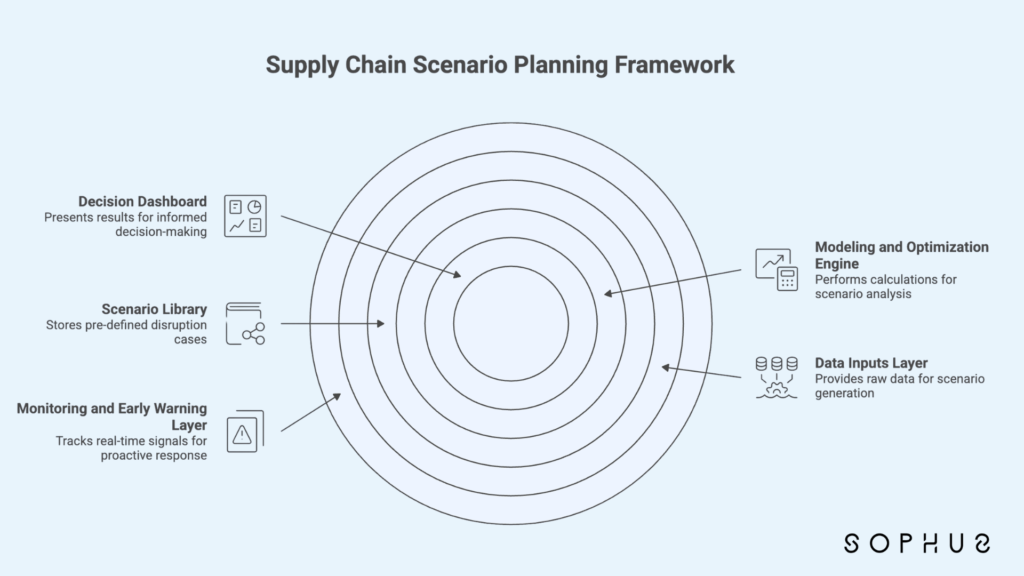
1. Data Inputs Layer
Every scenario depends on data. This layer brings in demand signals, supplier capacity, logistics performance, inventory levels, and external risks like geopolitical events, price changes, climate issues, and regulations. Without solid data, scenarios are based on guesses instead of facts. Building that layer is usually the slowest part of the exercise. Teams that automate the data build have a working baseline in hours instead of weeks, which is what makes running scenarios frequently practical at all.
2. Scenario Library
A scenario library stores ready-to-use disruption cases. Teams do not need to start from zero each time. They can use common scenarios like supplier failure, demand spikes, transport delays, or policy changes. This helps teams respond faster and build knowledge over time.
3. Modeling and Optimization Engine
This is where the calculations happen. The engine runs the numbers when a scenario is tested. It looks at cost, service levels, inventory, and other constraints together. In a manufacturing network that means holding production capacity, plant-to-DC allocation and sourcing cost in one model, which is what supply network planning does. Modern tools can handle large and complex supply chains much faster than manual analysis.
4. Decision Dashboard
Results need to be easy to understand. A good dashboard shows scenario comparisons, key metrics, and trade-offs in a clear way. It helps teams make decisions quickly. It should also support different views so planners and leaders can focus on what matters to them.
5. Monitoring and Early Warning Layer
This layer connects planning with real operations. It tracks signals like supplier delays or demand changes and alerts teams early. This allows teams to act before a disruption becomes serious, instead of reacting after it happens.
Six Steps of the Scenario Planning Process
The scenario planning process in supply chain network design follows six clear steps. Each step builds on the previous one, moving from strategy to real-world execution.
- ✓
Set a clear goal (cost, service, or growth) - ✓
Map possible outcomes of your decisions - ✓
Identify key risks and influencing factors - ✓
Build realistic assumptions using data - ✓
Evaluate impact on cost, service, and operations - ✓
Track early signals to act faster
1. Define Your Objective
Start with a clear goal. This could be a long-term vision, a cost target, or a service level improvement. Make sure it aligns with your overall business strategy. Think about where your organization should be in the next three to five years. A clear objective gives direction to the entire process.
2. Analyze Potential Outcomes
Next, look at how your current decisions could play out. Explore different outcomes based on various assumptions. Consider how each scenario affects operations, costs, service levels, and stakeholders. This step helps you understand both risks and opportunities.
3. Identify Influencing Factors
Identify the key factors that can impact your supply chain. These include internal changes and external risks.
For supply chain teams, common disruption scenarios include:
- Geopolitical events such as tariffs, trade restrictions, and policy changes
- Climate and weather events like floods, droughts, and storms
- Supplier issues such as capacity loss or business failure
- Demand shocks including sudden spikes or drops
- Logistics bottlenecks such as port congestion or transport delays
- Regulatory changes affecting sourcing or operations
Listing these is the easy part. Each one needs a probability and a cost attached before it is worth modeling, and that is what supply chain risk and resilience software does: it scores every node, lane and supplier against the disruptions it is actually exposed to, then ranks them by what a failure would cost you.
4. Assess Conditions, Assumptions, and Probabilities
Now define the assumptions behind each scenario. Build realistic versions of how the future might look. Focus on the most likely scenarios when planning resources. Your base case is usually the annual plan, so build it in annual operating plan software against real capacity and cost, not last year’s actuals plus a percentage. A weak base case makes every scenario measured against it weak too.
In manufacturing, this step needs extra care. You must consider production limits, material lead times, workforce availability, and switching costs. A disruption in one plant can affect multiple downstream nodes.
Modern tools can support this step by using data to estimate probabilities. This reduces guesswork and improves accuracy.
5. Evaluate Scenario Impact
Assess how each scenario affects your business. Look at cost, service levels, inventory, and overall performance. Identify risks and opportunities. Understand the trade-offs and define actions to handle each situation. This step helps you prepare practical response plans.
6. Develop Early Indicators
Finally, define early warning signals for each scenario. These can include demand changes, supplier delays, or logistics issues. These signals help you act early instead of reacting late. With clear indicators, your team can stay flexible and respond quickly to change.
Impact of Scenario Planning for the Known
Decision making has become more complex than ever, particularly when it involves significant operational changes such as shutting down a production line or altering the replenishment frequency from plants to warehouses. Both decisions belong in one plan that covers every factory and DC, because changing one line changes what every other line has to absorb.
1. Impact on Cost
Reducing the number of production lines or altering replenishment strategies can lead to significant cost savings in terms of reduced operational expenses and lower labor costs. Those savings and those costs land in different years, which is why the scenario only closes once you put it into the annual plan it has to be funded from.
2. Impact on Service
Changing the frequency of replenishments can affect service levels. A reduced frequency might lead to savings in transportation costs but could risk stockouts, affecting customer satisfaction. Conversely, increasing replenishment frequency might improve service levels but at a higher cost. Through scenario planning, organizations can find the sweet spot that optimizes both service levels and costs.
3. Impact on Inventory Levels
Altering production and replenishment strategies directly affects inventory levels. A reduction in production might lower inventory costs but could also lead to a lack of product availability. Scenario planning allows for a detailed analysis of inventory needs versus costs, ensuring that inventory levels are optimized for both efficiency and market demand.
4. Impact on Carbon Emissions
Today’s businesses are increasingly accountable for their environmental impact. Changing operational strategies can have significant effects on carbon emissions. For example, reducing replenishment frequency might lower emissions by decreasing the number of transportation trips required. Scenario planning provides insights into how operational decisions align with sustainability goals, helping organizations make environmentally responsible choices.
Features to Look for in Supply Chain Scenario Planning Software
Not all planning tools handle scenarios equally well. When evaluating a platform, these are the capabilities that determine whether a tool will genuinely support your scenario planning process or just add a ‘what-if’ label to a spreadsheet:
- Multi-scenario comparison: The ability to run multiple scenarios simultaneously and compare their outputs side-by-side across cost, service, inventory, and sustainability KPIs. Without this, scenario planning becomes a sequential exercise rather than a decision-making tool.
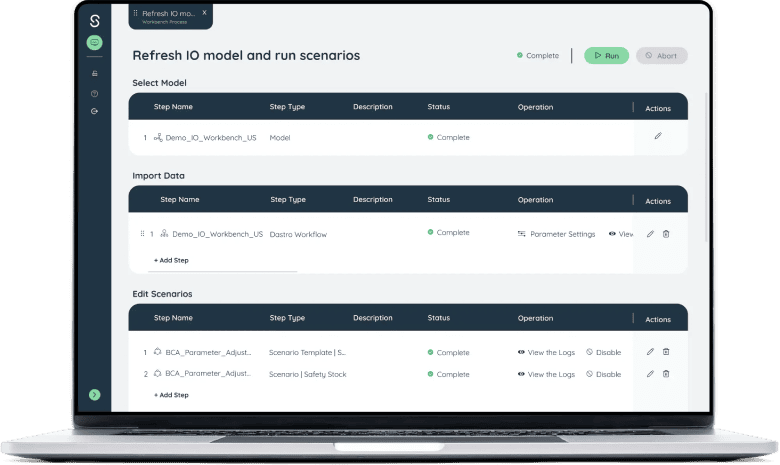
- Adjustable levers and what-if modeling: Planners should be able to change assumptions — supplier lead time, demand volume, replenishment frequency, carrier capacity — and see the downstream effects instantly. The best tools allow this without requiring an IT or data science team.
- ERP and WMS integration: Scenario inputs should pull live data from your existing systems. A platform that requires manual data uploads will always lag behind reality.
- Real-time data connectivity: Beyond ERP integration, leading platforms connect to external data feeds like commodity prices, logistics market rates, weather risk signals. This way, scenarios reflect the world as it is, not as it was when your last data export ran.
- Collaboration and workflow features: Scenario planning is a team sport. Look for the ability to share scenarios across functions, track who changed what assumption, and manage the approval workflow when a scenario triggers a decision.
- Customizable dashboards: Different roles need different views. A supply planner needs operational detail; a logistics manager needs service and capacity views; a CFO needs cost and margin impact. Role-based dashboard customization determines whether leadership actually uses the tool.
Customizing Scenario Planning Dashboards for Supply Managers
A scenario planning dashboard is only as useful as the decisions it enables. The goal is to surface the right information to the right person at the right time.
For supply managers working at the operational level, the most important dashboard elements are: a scenario comparison view showing the top three to five scenarios ranked by likelihood and impact, KPI deviation highlights (how far each scenario moves cost, service, and inventory from baseline), confidence interval indicators showing the range of outcomes rather than a single number, and alert thresholds that flag when live conditions approach a scenario trigger point.
For VP-level supply chain leaders, the dashboard shifts to strategic trade-offs: cost vs. service curves that show the frontier of feasible options, carbon emission projections for each scenario, capital requirement comparisons, and a summary action view showing which decisions need to be made and by when.
The best platforms allow teams to build and save these role-based views without custom development, making scenario insights accessible to every stakeholder, not just the analysts who built the model.
Why Scenario Planning Defines High-Performing Supply Chains
Supply chain disruption is no longer a rare event that organizations recover from. It is now a constant part of the operating environment. The teams that perform better are the ones that have already modeled scenarios, tested their network, and prepared a plan they can activate quickly.
The six-step scenario planning process gives supply chain teams a clear and repeatable way to move from reactive problem solving to proactive decision making.
Modern AI-driven tools remove the manual effort that once limited scenario planning to large teams with long timelines. With the right platform, any supply chain team can run complex and realistic scenarios quickly and make decisions at the pace the business demands.
If you are ready to move beyond spreadsheet-based scenario planning, see how Sophus enables scenario modeling, digital twin simulation, and AI-driven optimization for supply chain teams.
FAQs About Supply Chain Scenario Planning
What is the difference between scenario planning and demand forecasting in supply chains?
Demand forecasting estimates what is likely to happen based on past data and trends. Scenario planning looks at what could happen and prepares for different outcomes, including unexpected ones. Forecasting is one input. Scenario planning goes further by testing how changes affect inventory, production, logistics, cost, and service.
How is supply chain scenario planning different from traditional risk management?
Traditional risk management identifies risks and tries to reduce their impact. It focuses on prevention and response. Scenario planning is more practical. It shows what happens if a disruption occurs and gives clear actions to take. Instead of a risk list, you get a plan you can use.
How do you build a supply chain scenario planning framework from scratch?
Start with a clear goal. Define the decision or uncertainty you want to address. Gather the right data such as demand, suppliers, logistics, and external risks. Build a set of common scenarios like supplier failure or demand spikes. Use a model that can test trade-offs across cost, service, and inventory. Create dashboards that show results clearly. Add early warning signals so your team knows when a scenario is starting to happen.
What is the role of AI in supply chain scenario planning?
AI improves speed and accuracy. It can run many scenarios in minutes instead of days. It also uses data to estimate probabilities and reduce guesswork. This helps teams build better scenarios and make faster decisions.
How does a supply chain digital twin support scenario planning?
A digital twin is a live model of your supply chain. It reflects real data across suppliers, inventory, and flows. When you test a scenario, you see how your actual network reacts. This makes results more accurate and useful. It also helps track changes in real time and flag early risks.
What should I look for when evaluating supply chain scenario planning software?
Focus on six things. The ability to compare multiple scenarios. Easy what if changes without IT help. Integration with ERP and WMS systems. Access to external data like prices and risks. Collaboration features for teams. Dashboards that show the right view for each role.
How is supply chain scenario planning different for manufacturing vs retail?
Manufacturing focuses on production limits like capacity, materials, and labor. It looks at how disruptions affect production and supply. Retail focuses on demand and inventory across locations. It looks at how changes in demand affect stock and replenishment. The process is the same, but the inputs and decisions are different.