
Inventory problems rarely show up as one clear issue. You see stockouts in one location, excess inventory in another, and planners stuck reacting instead of improving outcomes. What makes this worse is that most networks are still managed in pieces.
But this is where things start to click. When Multi-Echelon Inventory Optimization (MEIO) works together with replenishment optimization, and both are powered by digital twins, inventory decisions stop being just assumptions.
You are able to test outcomes, and your inventory finally learns how to behave. However, if you’re still confused about how it works, let’s explore more about it ahead.
Why Inventory Misbehaves in the First Place
Inventory problems, like misplaced inventory, usually come from how decisions are made inside the supply chain. To understand why stock levels feel unpredictable or constantly out of sync, you need to look at three structural issues, including:
1. Making Decisions Locally
Most inventory decisions are made locally. Every location protects itself, but no one is looking at how those choices affect the rest of the network. As a result, extra stock piles up in some places, while other areas still face shortages.
In fact, companies that work this way often hold 20% to 30% more inventory than they truly need at their locations.
2. Planning Focused on Locations
Most planning tools are built around individual locations. They measure how well a warehouse performs or how much inventory a plant holds. However, they don’t show how inventory moves from one point to another.
This is where MEIO is meant to help, by looking at the whole network. Yet, without replenishment optimization and digital twins, those insights stay theoretical instead of practical.
3. Disconnected Replenishment
Replenishment rules are often set once and rarely updated. This means the order sizes, lead times, and reorder points are based on averages and not reality.
Due to this, inventory looks fine on paper, but in practice, teams scramble. It’s also proven by reports that show that major supply chain disruptions now happen every 3.7 years, which makes static replenishment rules a risky bet.
Where MEIO Changes the Game for Companies
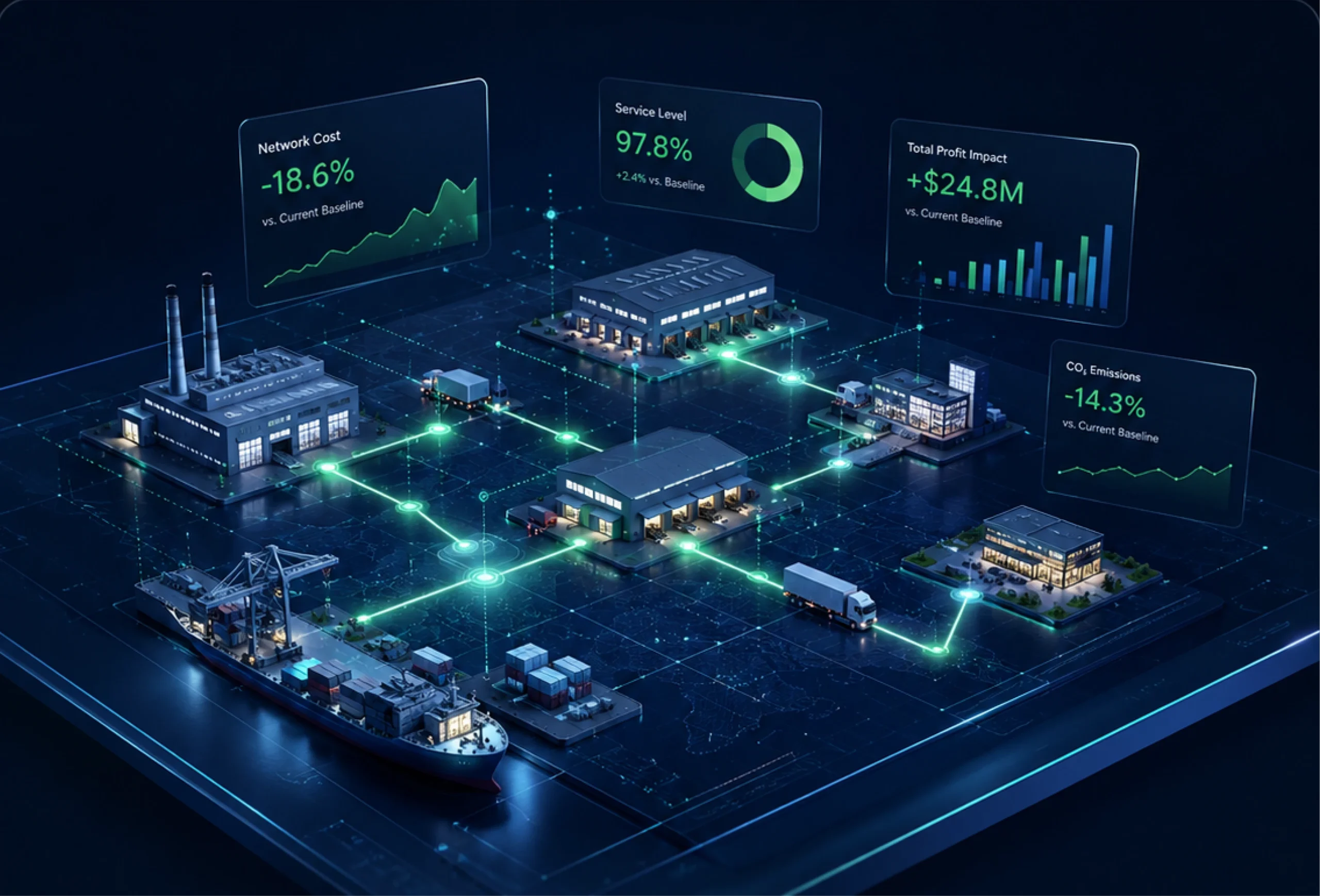
This is the point where inventory planning starts becoming intentional. Instead of treating replenishment as a series of disconnected decisions, MEIO looks at the entire supply network as one system through digital twins.
MEIO defines what the network should look like, meanwhile digital twins help you see how it truly operates.
Together, they make it possible to identify pressure points across suppliers, the distribution center, and stores before those issues turn into stockouts or excess inventory.
Optimizes the Entire Network
Digital twins mirror real demand patterns, lead-time variability, and replenishment behavior. When MEIO uses this live, realistic view, it becomes much easier to decide where inventory should absorb risk and where it should move faster.
For example, instead of adding safety stock everywhere, the model can reveal which nodes stabilize the network when stocked properly.
Why MEIO Alone Is Not Enough
While MEIO sets the right structure, it still relies on models. And models only work as well as the assumptions behind them. This is where many organizations hit a new limit.
MEIO can tell you where inventory should be placed, but it cannot always predict how the system will behave when reality does not follow the plan. As a result, the replenishment plans that looked perfect on paper start to break.
This is why MEIO alone cannot fully control inventory behavior. It defines the right strategy, but it needs a way to test that strategy against real-world conditions. That is the gap digital twins are designed to fill.
When MEIO and Digital Twins Power Replenishment Together
Bringing MEIO and digital twins together is like giving your inventory a brain. When these two work in tandem, replenishment optimization stops being guesswork and becomes way more coordinated.
Here’s how both of these help to level up your inventory:
1. Aligns Strategy with Reality
When MEIO identifies optimal inventory positions and replenishment priorities, it is working from a mathematical view of the network. That is a huge improvement over static rules, but it still relies on averages and assumptions.
That’s why companies are now learning towards digital twins. For people who don’t know, a digital twin is a virtual replica of your physical supply chain that lets you simulate how your system will behave under different conditions.
So, by combining MEIO with digital twin simulations, you can:
- Test how a new replenishment policy performs under demand fluctuations
- Evaluate the impact of supplier delays on inventory levels
- See how seasonal demand patterns affect lead times and service targets
2. Adaptable Replenishment Strategies
Most traditional replenishment plans rely on static reorder points and safety stock rules. These rules do not adjust in real time, and they break down as variability increases. Digital twins allow you to build strategies that help you see how little changes in the network affect it as a whole.
As a matter of fact, companies that use digital twins improve their delivery reliability by up to 20% and reduce labor costs by 10%, as per McKinsey.
These gains come from seeing and testing how replenishment actions impact inventory levels across the full network before decisions are made.
3. Coordinated Replenishment
By combining MEIO with supply chain digital twins, replenishment decisions naturally align with evolving conditions. Instead of making decisions based on outdated patterns or static rules, planners can:
- Compare multiple “what-if” scenarios
- Test replenishment policies against actual network behavior
- Adapt plans quickly as data changes
In this setup, inventory moves intelligently, supported by systems that learn from data and help in supply chain optimization.
What This Means for Supply Chain Leaders
The combination of MEIO, replenishment optimization, and digital twins allows leaders to stop managing inventory location by location. You gain clarity on where inventory should sit, how much to hold, and how replenishment decisions ripple across suppliers.
This was the exact problem that a leading MRO spare parts distributor faced. To avoid downtime for customers, they stocked parts across many regional hubs. Over time, this created high safety stock, tied up capital, and still caused stock-outs.
It was when Sophus jumped into the scene.
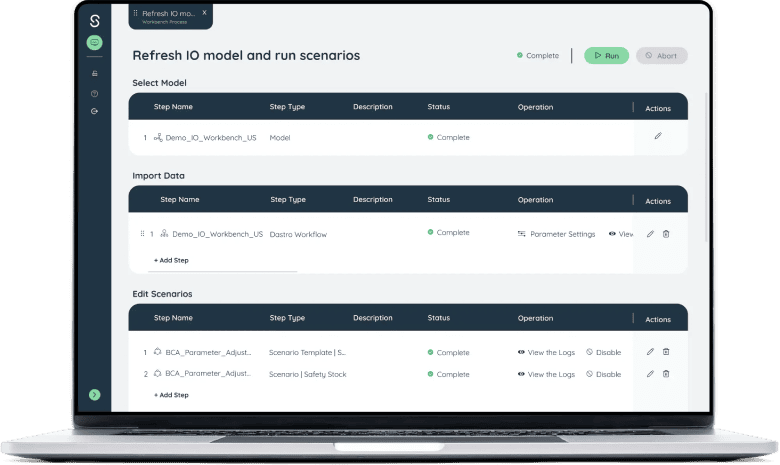
We used MEIO, powered by the supply chain digital twin, to recreate the full inventory and replenishment behavior.
As a result, even with a 15% increase in transportation cost, centralizing slow movers reduced aggregate safety stock by 25%. Service performance also improved, reaching a 98% service level with less total inventory.
Take Control of Your Inventory with MEIO
Using MEIO combined with digital twins helps you align replenishment decisions across suppliers, DCs, and stores. This approach reduces waste, improves service levels, and balances costs effectively.
So, if your inventory is misbehaving, consider using Sophus as your dedicated partner. We provide advanced multi-echelon inventory optimization that identifies the right stock levels and replenishment strategies for each SKU.
Ready to turn cost insight into measurable profit?
and see how fast you can move from analysis to action.