

Supply chains today operate at a scale and complexity that traditional optimization tools struggle to manage. Networks now involve thousands of SKUs, hundreds of facilities, multiple transport modes, and constantly changing demand patterns.
During our recent webinar, Sophus introduced a major step forward in solving these challenges: the Sophus Quantum Solver, a new optimization technology designed to dramatically increase the speed and scope of supply chain decision-making. The session explored how this innovation combines artificial intelligence with advanced mathematical optimization to help organizations solve problems that were previously too large or too complex to handle.
Below are the key highlights from the discussion about Sophus Quantum Solver.
Why Traditional Optimization Is Reaching Its Limits
Most supply chain optimization engines today rely on classical solving techniques such as branch-and-bound algorithms within Mixed Integer Linear Programming (MILP). While these methods are mathematically powerful, they face practical limits when models become extremely detailed.
As supply chains grow more complex, companies increasingly encounter problems that take hours, days, or even weeks to compute. In many cases, planners must simplify their models just to make them solvable.
That trade-off creates a problem: the more you simplify the model, the less accurately it reflects the real world.
The goal of the Sophus Quantum Solver is to remove that constraint.
Introducing the Sophus Quantum Solver
The Sophus Quantum Solver represents a new approach to optimization. Instead of relying only on traditional mathematical exploration of solution trees, the solver incorporates AI agents trained on historical solving patterns.
These AI agents help guide the optimization process toward promising solution areas, allowing the system to bypass computational bottlenecks that slow down traditional solvers.
In simple terms, the solver does not just search blindly through millions of possible combinations. It learns where the best answers are likely to be and moves there faster.
This hybrid approach combines the precision of mathematical optimization with the adaptive AI agents .
A Major Leap in Solving Performance
One of the most important outcomes of this architecture is speed.
In internal benchmarks, the Quantum Solver has demonstrated performance improvements of roughly 50 to 100 times faster compared with traditional market-leading solvers.
This level of acceleration creates several important benefits:
- Large optimization models can be solved much faster.
- More scenarios can be evaluated during planning cycles.
- Organizations can work with higher model detail without sacrificing performance.
For planners and executives, this means decisions that once took days can increasingly happen within the same planning session.
Solving Problems That Were Previously “Unsolvable”
Speed alone is not the only improvement. The new solver also expands the size and complexity of models that can realistically be optimized.
Many companies today face optimization problems that are theoretically solvable but practically impossible due to computing limits. Examples include highly granular network planning or large SKU-level inventory decisions.
The Quantum Solver helps address this challenge by allowing organizations to work with models that were previously too detailed for traditional systems to handle.
This opens the door to entirely new types of decision support.
Expanding Optimization Beyond Strategic Planning
Historically, supply chain optimization tools were mainly used for strategic network design projects performed once or twice per year.
With faster solving speeds, optimization can now support decisions across multiple planning horizons.
Strategic Planning
At the strategic level, companies can evaluate highly detailed scenarios such as:
- Store location optimization
- SKU-level inventory allocation for e-commerce networks
- Network footprint design across regions
These models can now be built with much greater granularity than before.
Tactical Planning
At the tactical level, the solver enables integrated supply network planning, where decisions across sourcing, production, and distribution can remain aligned across time periods without heavy manual adjustments.
This helps organizations ensure consistency between strategic design decisions and mid-term operational plans.
Operational Decision Making
Perhaps the most exciting possibility is at the operational level.
Faster optimization makes it feasible to support decision adjustments in environments such as:
- Warehouse operations
- Retail replenishment
- Shift-level logistics planning
In situations where conditions change rapidly, such as delayed shipments or unexpected order surges, optimization can help identify the best response during the same operational window.
Product Roadmap for the Quantum Solver
Sophus team also shared the upcoming roadmap for the new solver.
Version 1 — March 2026
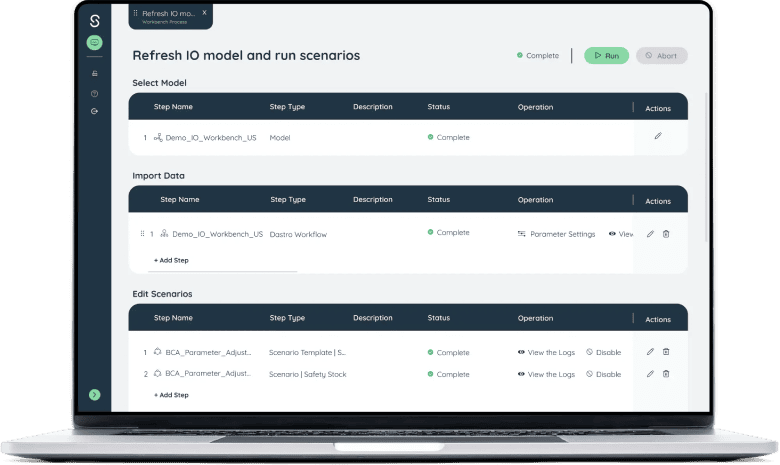
The first version is currently rolling out and will become generally available this month. It will be offered as an add-on capability within the SophusX platform.
Version 2 — June 2026
The next release will introduce product conversion capabilities, enabling deeper optimization for end-to-end manufacturing supply chains.
Version 3 — Late 2026
Future updates are expected to introduce additional innovations aimed at expanding the role of optimization across planning and operations.
Current Sophus customers will also have access to a trial period, allowing them to evaluate the solver’s value within their own optimization models.
What This Means for the Future of Supply Chain Decision Intelligence
The introduction of the Quantum Solver reflects a broader shift in how organizations approach supply chain decision making.
Instead of running occasional optimization studies, companies are moving toward continuous optimization environments, where strategic design, tactical planning, and operational decisions are supported by the same analytical engine.
By combining AI guidance with advanced optimization mathematics, the Sophus Quantum Solver represents an important step in that direction.
As supply chains become more dynamic and interconnected, the ability to solve complex problems faster and at greater scale will increasingly determine how quickly organizations can respond to change.
And in today’s environment, faster decisions often mean stronger competitive advantage.