
Choosing the wrong supply chain network design software can mean 6-month implementations, poor solver performance, and strategic decisions made on bad data. With supply chain complexity only increasing in 2026, the stakes of getting this choice right have never been higher.
Companies using dedicated network design software reduce logistics costs by 10–25% on average but only when they pick a platform that matches their network complexity, team capability, and pace of change.
Here’s how the top 5 platforms actually compare on solver speed, modeling depth, ease of use, and total cost of ownership.
What you’ll find in this guide
- A breakdown of the 5 best supply chain network design software platforms in 2026
- A side-by-side comparison of solver speed, ETL integration, deployment options, and pricing tier
- A buying criteria framework to help you match the right network design tool to your network complexity
- A clear recommendation for who each platform is best suited for
What is Supply Chain Network Design Software?
Supply chain network design software helps companies model, analyze, and optimize the physical structure of their supply chain where facilities should be located, how inventory should flow between them, which transportation lanes to use, and how the whole network should respond to changes in demand, cost, or disruption.
Unlike ERP systems, which manage day-to-day transactions, network design software works on strategic and tactical time horizons.
It answers questions like:
- Should we open a new distribution center in Eastern Europe?
- What happens to our cost-to-serve if we consolidate three warehouses into one?
- How does our network need to change if we lose a key supplier?
The best platforms combine mathematical optimization engines with scenario modeling capabilities. So instead of gut-feel decisions or basic spreadsheet analysis, your team can run hundreds of network configurations in hours and arrive at a data-backed recommendation.
Network design software vs. ERP: what’s the difference?
ERP systems (SAP, Oracle, Microsoft Dynamics) manage what’s happening in your supply chain right now — orders, inventory levels, shipments, invoices.
Network design software models what your supply chain should look like in the future — facility locations, flow paths, inventory positioning, and total cost trade-offs.
Most companies need both, but they solve completely different problems.
Supply Chain Network Design Software: Side-by-side Comparison (2026)
Here’s a side-by-side comparison table of supply chain network design software (2026):
| Tool | Data Integration & Transformation | Scenario / What-if | AI, Optimization & Simulation | Visualization | Ease of Use | Budget / TCO |
|---|---|---|---|---|---|---|
| Sophus X | Highly efficient automated ETL (“Dastro”); integrates with data lakes, ERP, and other sources | Strong — fast what-if modeling (DC open/close, production shifts, lead time changes, demand spikes) | Strong AI + optimization; limited simulation (inventory & production) | Interactive maps, dashboards, fast scenario comparison, custom BI | Very business-friendly — no coding required | Best value; mid-market to enterprise fit |
| Coupa Supply Chain Design | Good ETL via DataGuru (desktop limitations) | Strong multi-variable scenario planning | Strong optimization + limited simulation | Good reporting, scenario map comparisons; limited BI | Moderate — enterprise-friendly, less beginner-friendly | High cost; enterprise pricing |
| AIMMS SC Navigator | No embedded ETL; Excel/database-driven | Strong but requires coding expertise | Strong optimization & simulation; complex to use | Good visuals; some UI requires coding | Difficult at scale — requires OR background | Medium–high cost; large org focus |
| Optilogic Cosmic Frog | No embedded ETL; Excel/database-driven | Strong but requires some coding | Optimization + limited simulation | Clean dashboards; intuitive visuals | Moderate — some OR/coding needed | High cost; enterprise pricing |
| anyLogistix | No embedded ETL; Excel/database-driven | Limited; requires coding | Strong simulation; limited optimization | Good reporting; strong flow animation | Difficult — requires advanced skills | Mid-range; learning edition available |
1. Sophus X – Best Overall for Complex Network Design
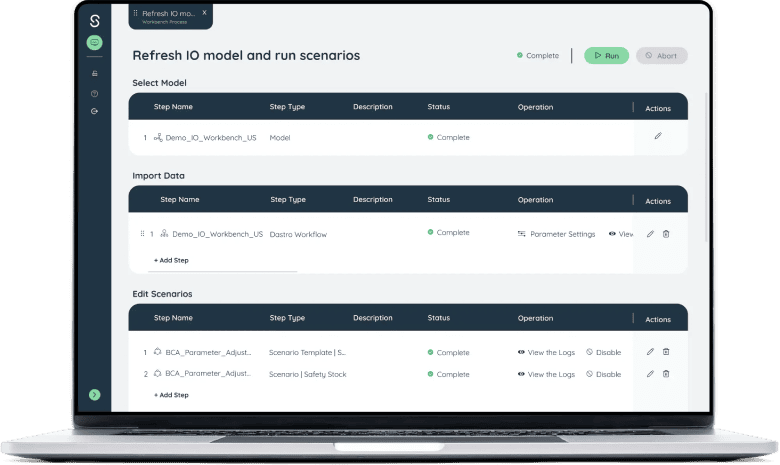
Sophus X is built from the ground up for supply chain network design. It combines a proprietary solver engine, fully embedded ETL integration, and an intuitive interface designed specifically for supply chain professionals. The result is a platform where analysts spend their time on decisions, not on data wrangling or waiting for models to run.
Core capabilities:
- Automatic data validation on import, catches errors in seconds, not after a failed model run
- Rapid baselining, build an as-is model in days, not the 6–8 weeks typical with legacy tools
- Greenfield and brownfield site selection, identify optimal facility locations based on cost, distance, and service level factors
- Aftermarket spare parts network design models complex service parts distribution across multi-echelon networks
- Omni-channel supply chain network design integrates DTC, retail, and wholesale flows in a single model
- Multi-echelon inventory optimization, optimize stock levels across every tier of the network simultaneously
- GHG emission modeling, include carbon costs as an optimization objective alongside cost and service
- M&A network integration, model how merged or acquired supply chains fit together before day one
- On-premise and private cloud deployment, for teams with data security or firewall requirements
- Custom BI generation, build reporting dashboards directly inside the tool without exporting to another system
- Fully embedded ETL, connect to your ERP, WMS, or TMS data sources without a separate integration layer
Why Sophus X Stands Out
Speed is the clearest differentiator. Sophus X runs optimization models up to 20x faster than comparable legacy tools which matters enormously when your team is running scenario analysis under time pressure. A network redesign that took a competitor’s tool overnight now runs in under an hour.
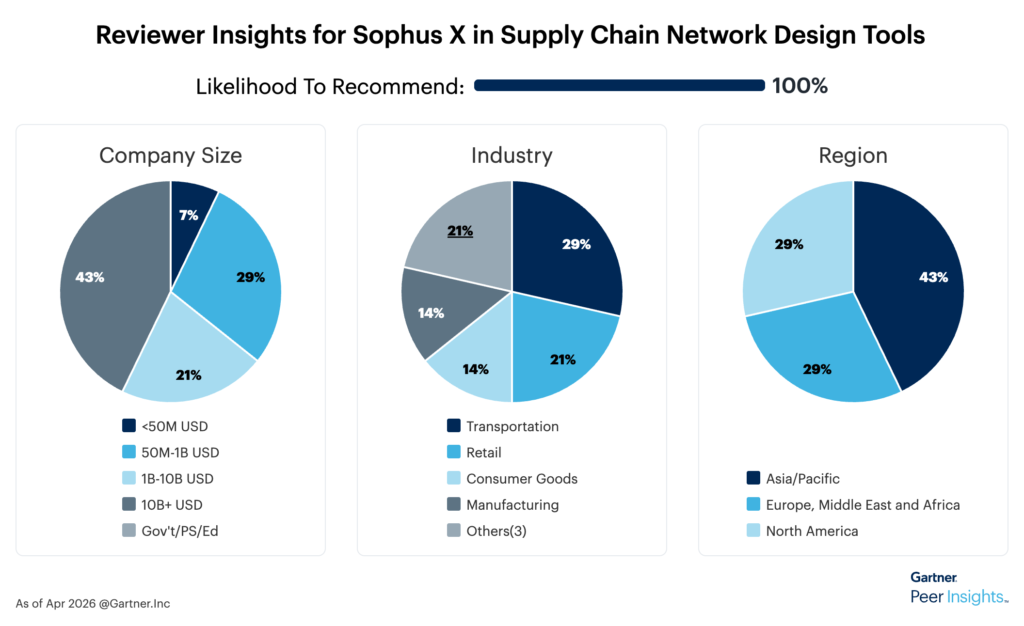
Here’s what people say about Sophus on Gartner Peer Insights:
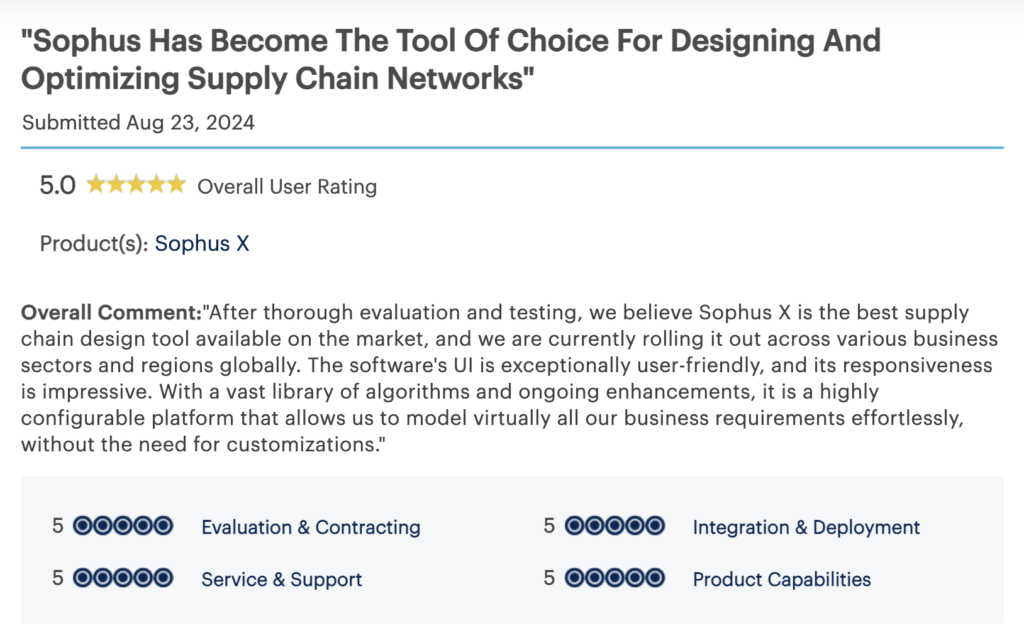
Teams using Sophus X typically see a 3–4x improvement in the number of scenarios they can evaluate in a given project, because the platform handles data preparation, validation, and model setup automatically rather than leaving it to the user.
Implementation is also faster than the industry average. Most teams are running live models within weeks, not months and the rapid baselining feature means you’re working from real network data from day one rather than building a model from scratch.
2. Coupa (LLamasoft)
Coupa Supply Chain (formerly LLamasoft) is one of the most established names in supply chain network design. Its strength is the tight integration with Coupa’s broader procurement and spend management suite. If your organization already runs Coupa for sourcing and purchasing, Supply Chain Guru connects network design decisions directly to supplier and cost data without a separate integration layer.
The platform handles the core network design use cases well including facility location, transportation lane optimization, multi-echelon inventory modeling, and scenario analysis. For large enterprises running complex global networks, it’s a proven choice with a long track record.
Pros
- Deep integration with Coupa procurement suite
- Strong scenario modeling and what-if analysis capabilities
- Established vendor with enterprise-grade support and compliance
- Wide industry coverage including retail, manufacturing, and CPG
Cons
- Algorithm architecture is over 15 years old. Performance on large, complex models lags newer solvers
- One of the more expensive options in the market. Prohibitive for mid-market budgets
- Product update cycle has been slow since the LLamasoft acquisition
- Python-based modeling layer adds performance limitations on large datasets
Pricing
Enterprise tier. One of the higher-cost options in this category. Contact Coupa for a quote.
3. AIMMS
4. Optilogic
Optilogic is one of the newer entrants in supply chain network design, built cloud-first from the ground up. Its Cosmic Frog platform is designed around flexibility and accessibility. Teams can get models running relatively quickly, and the pricing model is more accessible than legacy enterprise tools like Coupa or AIMMS.
Pros
- Cloud-native architecture — no infrastructure setup, faster to get started
- More accessible pricing than legacy enterprise vendors
- Flexible Python-based modeling layer for technical users
- Good for prototyping and exploratory network analysis
Cons
- Python performance has real limits on large, complex network models — run times increase significantly with model size
- Less mature than established vendors — smaller feature set and support network
- Technical users will get more from it than business-side planners
- Fewer native integrations with enterprise ERP systems
Pricing
Mid-market pricing. More accessible than Coupa or AIMMS. Contact Optilogic for current plans.
5. AnyLogistix
AnyLogistix is built on the AnyLogic simulation engine, which gives it genuinely strong capabilities for modeling dynamic, time-dependent supply chain behavior.
AnyLogistix can also simulate how a network performs over time under varying conditions, making it particularly useful for logistics-heavy problems and last-mile network analysis.
Pros
- Powerful simulation engine — models dynamic behavior, not just steady-state optimization
- Strong GIS and geographic visualization capabilities
- Good for complex logistics modeling and last-mile network analysis
- Flexible scenario simulation for stress-testing network decisions
Cons
- Steep learning curve — designed for technically skilled users, not supply chain generalists
- UI is complex and requires significant onboarding time for new users
- Less suited to pure strategic network design compared to dedicated optimization platforms
- Solver performance on large-scale strategic optimization problems lags tools like Sophus X
Pricing
Contact AnyLogic for pricing. Academic and professional licenses available.
How to Choose the Right Supply Chain Network Design Software for Your Business
The right platform depends on your network complexity, your team, and your timeline. These are the key factors that should guide your evaluation, no matter which tools you are considering.
Network Complexity and Scale
Start by understanding how complex your network really is. A tool built for a multi-country network with many facilities and transport modes is very different from one made for a simple regional setup. Think about where your network is today and where it will be in the next few years. Choosing a tool only for your current needs can limit you later.
Solver Speed and Optimization Depth
Speed matters more than most teams expect. When running scenario analysis, faster solvers let you test more options in less time. This leads to better decisions. Always ask vendors how their tool performs on real models, not just demo examples.
Data Integration and Readiness
Your results depend on your data. Check how clean your data is and how many systems you need to connect. Some tools need heavy data preparation outside the platform. Others handle data inside the platform, which can save months of work.
Ease of Use and Ownership
Think about who will use the tool every day. Some platforms need technical experts to run models. Others are designed for planners and analysts. Tools that are easier to use usually see faster adoption and better results because the people closest to the problem can work directly on it.
Deployment and Security Requirements
Check how the tool is deployed. Most platforms run on the cloud, but some businesses need more control. If required, make sure the tool supports private or on-premise setups. Also review security standards before sharing sensitive data.
Implementation Time and Time to Value
Ask how long it takes to get a working model. Some tools take months before showing results. Others deliver value much faster. Faster setup means faster decisions and lower risk.
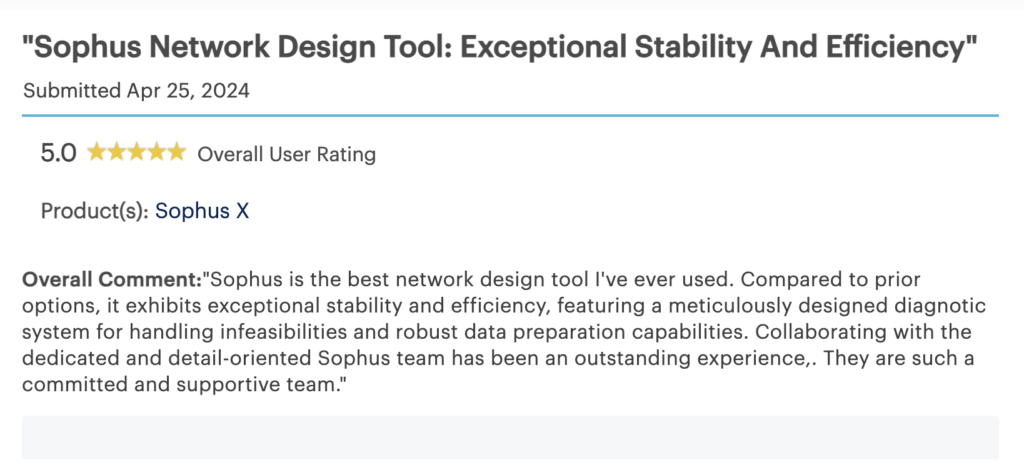
Read Full Review Here: Gartner Peer Insights
Keep reading:
Which Supply Chain Network Design Software Is Right for You?
The five platforms covered in this guide each serve a different buyer. Sophus X is the strongest all-round choice for organizations that need fast, accurate optimization across complex networks with the added advantage of built-in ETL, on-premise deployment options, and an interface designed for supply chain professionals rather than data scientists.
Coupa Supply Chain makes the most sense if you’re already invested in the Coupa ecosystem and want tight procurement integration. AIMMS is the right call if your network has genuinely unusual modeling requirements and you have the technical team to build custom solutions.
Optilogic suits mid-market teams that want a modern, cloud-native tool without legacy vendor costs. AnyLogistix stands apart when simulation — rather than pure optimization is central to your analysis.
The worst outcome is picking a platform based on a demo that looked impressive, only to discover six months in that the solver is too slow for your model size, or the implementation requires more IT resource than you planned for. Use the buying criteria and comparison table in this guide to pressure-test any shortlist before you commit.
Ready to see Sophus X in action?
Book a 30-minute demo and we’ll walk through your specific network design challenge using your data, not a generic example. No commitment required.