

Your shelves are stocked, orders are moving, and service levels look stable. Yet when you review performance, margins keep slipping. Our team has seen this across CPG and FMCG supply chains, and the root cause is rarely execution. In most cases, the network still reflects how the business operated years ago, not how it runs today.
Demand now shifts faster than forecasts can track. Promotions overload DC capacity and force costly workarounds. Retailers change delivery expectations, and logistics costs rise on key accounts. Then you add a DTC channel, and a network built for pallets starts struggling with parcel-level fulfillment. Each change adds pressure, and together they expose a design that no longer fits.
Teams usually revisit supply chain network design only after costs spike or service drops. By then, options shrink and fixes cost more than they should.
Our guide shows how CPG and FMCG leaders should approach network design in 2026, which decisions drive the most impact, and what a strong, adaptable network looks like in practice.
At Sophus, we work with CPG and consumer goods companies around the world on supply chain network design, distribution planning, inventory optimization, and cost to serve analysis. The frameworks in this guide reflect what we see working and what we see failing in real CPG networks today.
Why CPG and FMCG Network Design is Different?
When we work with CPG and FMCG companies, one pattern shows up quickly. Many teams apply network design approaches that worked in manufacturing, then struggle to explain why costs rise and service gaps keep appearing.
Teams don’t realize that CPG networks behave very differently, and the design needs to reflect that from the start.
High SKU count and product variety
We often ask clients how much of their network design reflects the full SKU portfolio versus just the top sellers. In most cases, the design leans heavily toward high-volume SKUs, while the long tail gets treated as an afterthought.
That creates gaps in availability and weakens retailer compliance. In CPG, every SKU plays a role in category presence, so the network must support that complexity.
Demand volatility and promotional spikes
A common mistake we see is treating demand variability as a forecasting problem instead of a network design problem. Promotions, seasonality, and retailer decisions drive sharp swings in volume.
These swings do not stay local, they amplify upstream and create imbalances across the network. When the design does not absorb this volatility, teams rely on costly fixes like expediting or excess safety stock.
Shelf life and freshness constraints
We regularly see shelf life handled as a restriction instead of a design lever. In reality, every decision around inventory placement and transport timing affects freshness at the shelf. Warehouse dwell time, transport lead times, and inventory positioning decisions all directly affect the proportion of product that reaches retailers within acceptable freshness windows. Sophus’s shelf-life optimization capabilitymodels this end-to-end, treating freshness as a variable to optimize rather than just a constraint to respect.
Multi-channel complexity
Many teams still design networks around a single dominant channel, usually retail, then try to layer e-commerce or DTC on top. This rarely works well. Each channel has different order patterns and service expectations. Without structural alignment, the network performs well in one area and struggles in others.
Retailer power and compliance costs
We also see companies underestimate how much retailer requirements shape the network. Delivery windows, service targets, and penalty structures are not flexible. When the network does not align with these constraints, costs increase quickly through chargebacks and reactive decisions. The right design builds around these realities from the beginning instead of adjusting after problems appear.
CPG vs FMCG Supply Chain Priorities
DimensionX
Key Difference
Turnover Speed
FMCG focuses on speed above all. CPG balances speed with quality and margin.
Shelf Life
FMCG products move in days to weeks. CPG products last weeks to months, giving more flexibility in distribution.
Network Design Priority
FMCG prioritizes proximity and throughput. CPG focuses on total cost to serve and channel alignment.
Demand Volatility
Both face high volatility. FMCG demand spikes are sharper and shorter.
SKU Complexity
CPG typically has higher variety. FMCG has fewer SKUs but much higher volume per item.
Channel Mix
CPG is moving toward omnichannel. FMCG remains largely retail driven.
COGS, Cost-to-Serve, and the Financial Case for Network Design
Supply chain network design is a financial decision for companies. The network you operate directly shapes your cost of goods sold (COGS) and your cost-to-serve across channels and customers. For CPG companies working with 5 to 15 percent net margins, even a 3 to 5 percent reduction in supply chain costs can create a meaningful shift in profitability.
In most redesign projects, we focus on a few key cost levers. Transportation consolidation helps reduce empty or partially filled loads. Inventory optimization lowers holding costs by placing stock in the right locations. DC rationalization removes underutilized facilities or adjusts the footprint to match demand. Sourcing consolidation reduces tail spend and improves supplier efficiency.
From our experience, the biggest gap is not identifying these levers, but understanding their full financial impact. That is where cost-to-serve analysis becomes critical. It connects network decisions directly to P&L outcomes at the customer, channel, and SKU level. This allows teams to see not only the cost of making a change, but also the value it delivers across the business.
Digital Solutions and AI in CPG Network Design
The tools available for CPG network design have changed significantly in the last few years. The shift from periodic, project-based network reviews to continuous, AI-supported optimization is the most important trend shaping how leading CPG companies manage their networks in 2026.
Supply chain digital twins
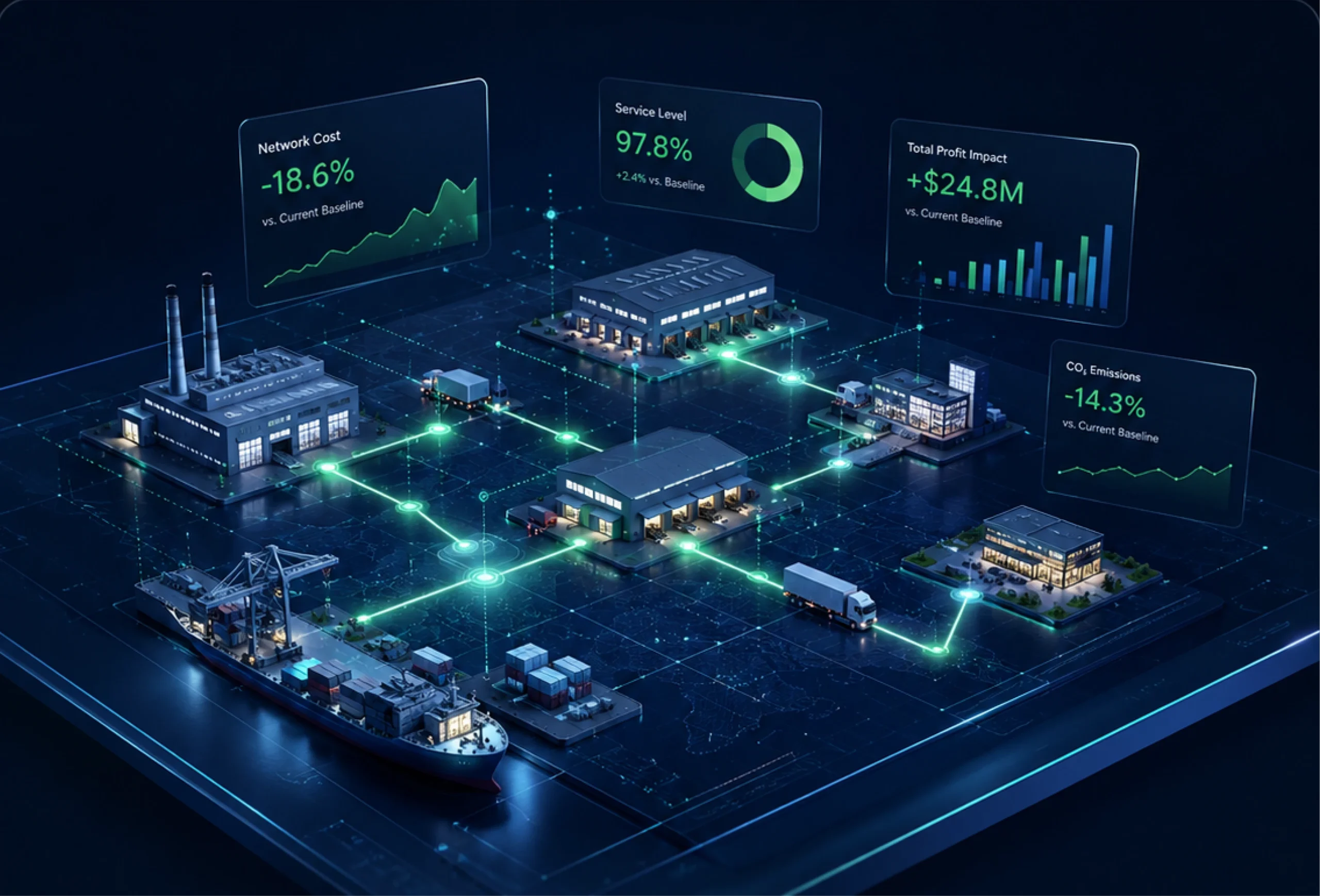
A digital twin is a live model of your supply chain network. It reflects real-world data and can be used to simulate disruptions, test structural changes, and evaluate trade-offs before committing capital.
For CPG companies running complex multi-tier networks, digital twins shift network design from a once-every-three-years exercise into a continuous planning capability. Sophus builds and operates supply chain network digital twinsspecifically for CPG and consumer goods environments.
Scenario modelling and what-if analysis
Scenario planning helps teams test different network choices quickly. For example, what happens if you add a regional DC in the Midwest? What happens if you move a supplier closer? What happens if a key retailer changes delivery rules?
This is where the real value of network design shows up. Teams can compare options, see cost impact, and understand trade-offs before making a decision.
Instead of waiting months for answers, scenario modelling gives results in days. It helps leaders rely on data and financial insight, not guesswork.
Demand forecasting as a network input
Network design decisions are only as good as the demand forecasts they are built on. In CPG, where demand is highly variable and promotional calendars are complex, static historical demand data produces networks that are perpetually out of step with reality.
Connecting demand forecasting directly into network design models is a meaningful capability step for most CPG companies.
Work With Sophus on CPG Network Design
Sophus is a supply chain optimization platform and advisory built specifically for complex, multi-tier networks. We work with CPG and consumer goods companies globally on network design, inventory optimization, distribution planning, and cost-to-serve analysis.
If you are reviewing your CPG supply chain network, whether it is a full strategic redesign, a focused distribution optimization, or a quick baseline to identify key opportunities, request a demo. We will walk you through how we approach it.