
For years, automation has helped businesses streamline repetitive tasks. Rules, scripts, and workflows can execute predefined actions quickly and consistently. But these systems rely on fixed logic and perform well only when conditions stay predictable. When demand spikes, supply routes break, or market conditions shift, traditional automation struggles to respond.
This is the gap many organizations face today. Automation can follow instructions, but it cannot understand context or adjust strategy when things change. That is where agentic AI in supply chain environments becomes critical. It adds the ability to sense, interpret, and respond instead of just executing.
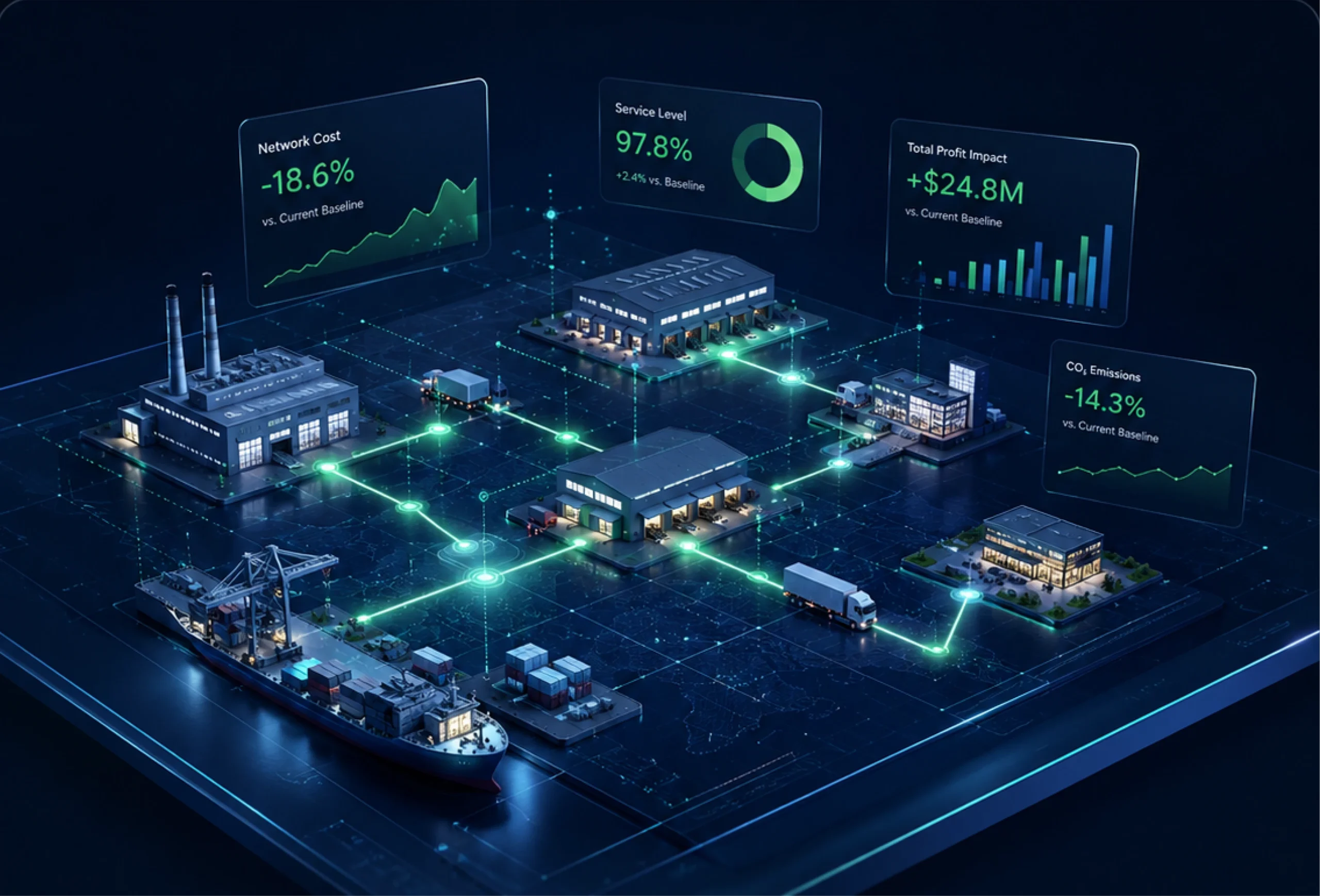
Agentic AI supply chain systems introduce a new way of operating. Instead of following static rules, they observe changes in data, reason through scenarios, plan responses, and take action in real time. This is powered by AI agents in supply chain workflows that continuously evaluate network conditions and make decisions based on current realities, not outdated assumptions.
In this blog, we explore how agentic AI in supply chain environments is shifting businesses from simple automation to bounded autonomy, and how that change is reshaping tactical decision making.
Tactical Optimization: Managing Supply Chain Flow
Tactical optimization focuses on the daily movement of products through the network. While strategic design defines the structure, this layer ensures the flow works efficiently under real conditions. In an agentic AI supply chain, companies can manage inventory levels, supplier reliability, and production allocation by responding to real-time signals instead of relying on static plans.
Instead of fixed planning rules, systems powered by agentic AI in supply chain environments continuously evaluate network data and adjust decisions as conditions evolve.
This intelligence is applied across three critical areas:
Multi-Echelon Inventory Optimization (MEIO)
Inventory is rarely static. It moves across multiple network levels, including central warehouses, regional distribution centers, and local facilities. Agent-driven optimization manages this multi-echelon inventory by calculating the precise amount of safety stock required at each specific level. Rather than requiring planners to manually adjust buffers, agents balance inventory between hubs and spokes to proactively reduce stock-outs while minimizing excess working capital.
Adapting to Lead-Time Variability
Traditional planning systems often rely on fixed assumptions, such as a standard 14-day supplier lead time. In reality, transit times fluctuate constantly due to congestion, weather, or operational disruptions.
Agentic systems monitor real shipment data and automatically update planning parameters when patterns shift. This allows planners to utilize dynamic lead-time estimates that reflect actual, real-world conditions rather than outdated assumptions.
Dynamic Sourcing Decisions
Supplier disruptions represent a constant risk. Instead of waiting for manual intervention, agentic systems monitor supplier performance and trigger alternative sourcing strategies when necessary. If a supplier fails or delays production, an agent can recommend or initiate a shift to secondary suppliers, temporary spot purchasing, or alternative production facilities. Within an agentic AI supply chain, these decisions follow predefined cost, margin, and service thresholds, ensuring the system responds quickly while staying aligned with business goals.
Why Agentic AI in Supply Chain Changes How Optimization Works
To move from theoretical models to tangible operational impact, agentic optimization requires a seamless fusion of data, intelligence, and execution systems. While traditional supply chain optimization tools are capable of generating solid recommendations, their utility typically ends there. Agentic systems, however, push beyond this boundary by functioning as “living” engines that continuously learn from live data and directly link predictive insights to operational execution.
The fundamental shift becomes clear when comparing the static nature of legacy optimization with the dynamic, learning-driven architecture of agentic systems:
Feature
Traditional Optimization
Agentic Optimization
Data Input
Static CSV files or historical datasets used during periodic planning cycles
Real-time data streams from Datalake, external data connections for weather updates, and operational events
Decision Logic
Fixed linear programming models with predefined assumptions
Adaptive models combining optimization with reinforcement learning that evolve as new data arrives
Action Layer
Generates reports or dashboards for planners to review
Directly updates other systems, routing decisions, and purchase orders
Feedback Loop
Requires manual review and model updates by analysts
Has the ability to self-correct by learning from execution outcomes and operational results
This architecture fundamentally transforms optimization from an episodic planning exercise into a continuous decision system. Instead of running a massive model once a quarter or relying on a static annual network redesign, agentic platforms constantly monitor network conditions, evaluate emerging scenarios, and adjust decisions dynamically as the environment changes.
Ultimately, the system continuously refines and improves decisions as new signals ripple across the network.
High-Impact Agentic AI Use Cases in Sophus
Agentic AI in Sophus is not used as a generic AI layer. It is applied directly to the areas where supply chain decisions happen: data preparation, scenario modeling, planning analysis, and execution feedback. The goal is to reduce the time between data, insight, and operational action.
Below are some of the most impactful ways agentic capabilities are being applied within the Sophus platform.
AI-Native Data Automation and ETL
Data preparation is often the slowest part of supply chain modeling. Traditional workflows rely on SQL scripts, Python pipelines, and manual data cleaning before models can even run.
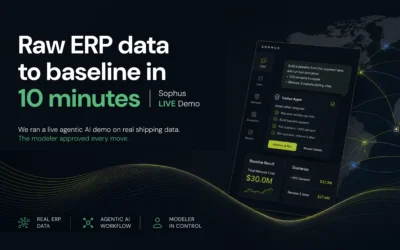
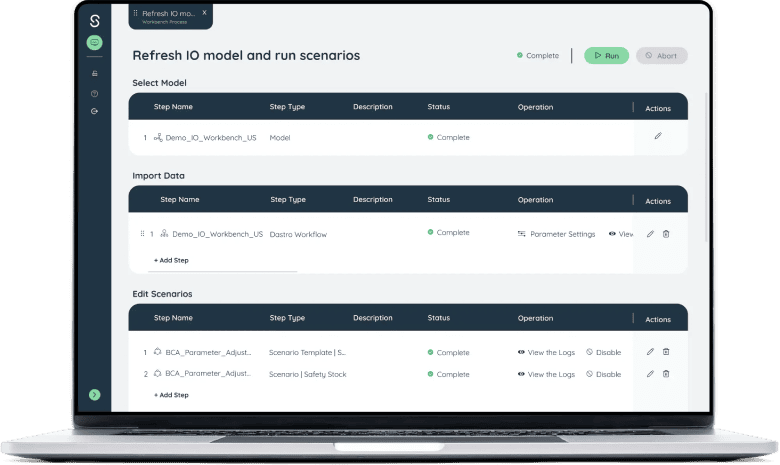
Sophus addresses this with an AI-native ETL agent that allows users to build and manage data pipelines using natural language commands. Combined with its visual pipeline builder, Dastro, users can ingest, clean, and transform large operational datasets without writing code. This approach allows both technical modelers and business planners to build repeatable data workflows faster while reducing the dependency on specialized engineering teams.
Autonomous Planning and Execution Sandbox
Sophus is also developing an AI Decision and Planning Sandbox designed to move supply chain planning toward more autonomous operations.
In this environment, AI agents monitor advanced execution signals across the network. When disruptions occur, such as shipment delays, inventory imbalances, or demand shifts, the system detects anomalies and analyzes potential root causes. Agents can then propose revised plans or optimized network responses.
Over time, this enables companies to move toward continuous re-optimization, where planning decisions can be updated hourly or even per shipment instead of waiting for monthly planning cycles.
Conversational Decision Intelligence
Sophus integrates an embedded generative AI co-pilot that allows users to interact with complex optimization models using natural language.
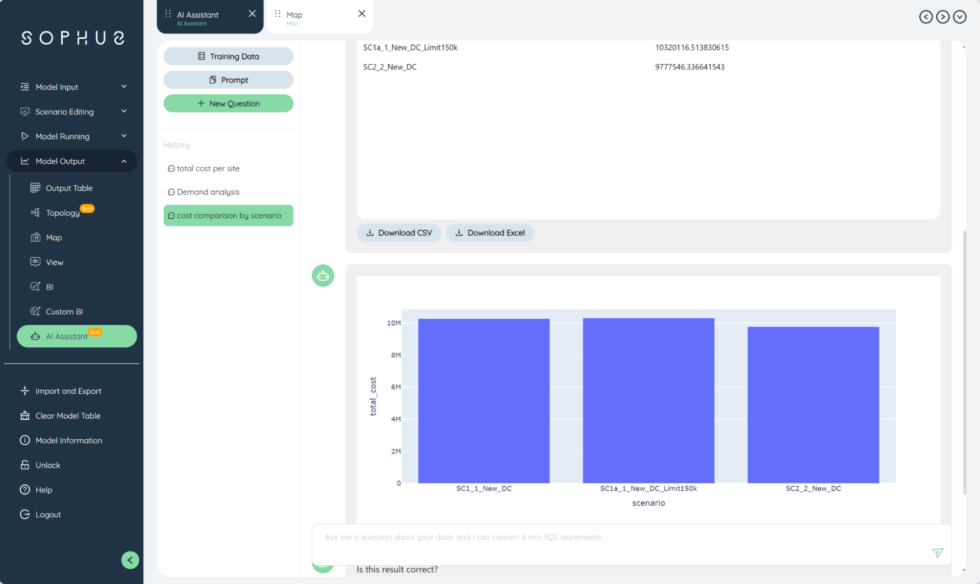
Instead of manually navigating large datasets or interpreting complex model outputs, planners can ask questions such as how network costs changed between scenarios or which facilities are driving service delays.
The system summarizes results, highlights key insights, and guides decision-making through a conversational interface. This lowers the barrier to advanced analytics and allows decision-makers to access insights without needing deep modeling expertise.
Agent-Driven Scenario Generation
Scenario modeling is central to supply chain network design. Organizations must constantly evaluate changes such as new facilities, shifting supplier locations, cost fluctuations, or service constraints.
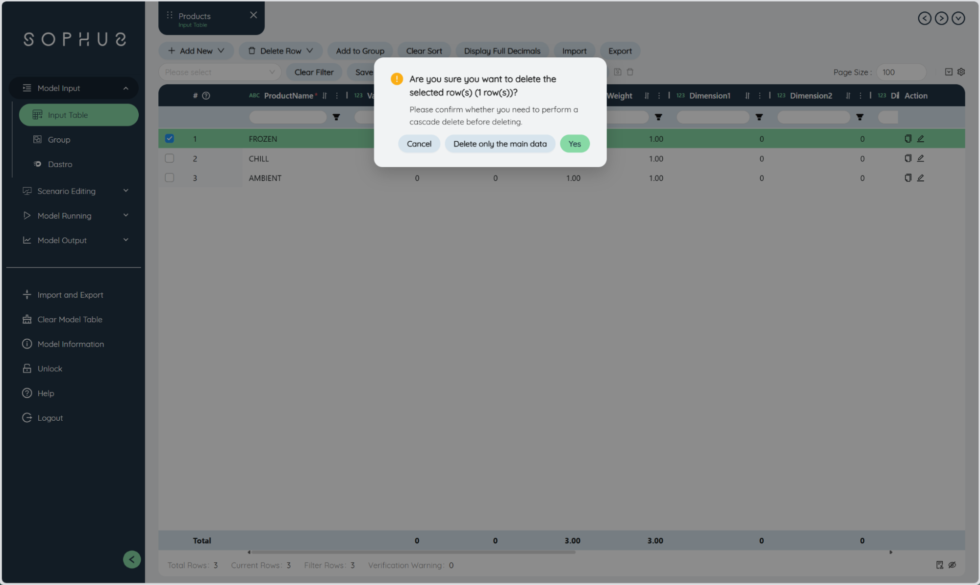
Sophus uses agent-based simulation and optimization to generate and evaluate large sets of potential scenarios quickly. These agents can explore different network configurations, operational constraints, and policy changes to identify optimal strategies. As a result, planners can run extensive what-if analyses and understand the impact of decisions across the entire supply chain network before implementing them.
AI Agents in Supply Chain: Driving Scenario-Based Decision Intelligence
Supply chains are becoming too complex for static automation and periodic planning cycles. Market volatility, supplier disruptions, and shifting demand require systems that can understand changes, evaluate options, and respond quickly. This is where agentic optimization becomes critical.
Sophus is helping organizations move toward this new model of decision intelligence. By combining advanced optimization, a unified digital supply chain model, and agent-enabled automation, the platform allows companies to analyze complex scenarios, respond to disruptions faster, and continuously improve how their supply networks operate.
If your organization is still relying on slow planning cycles and fragmented tools, it may be time to rethink how decisions are made.
Explore how Sophus can help you build a smarter, faster, and more adaptive supply chain network. Book a call with us to see how agent-driven supply chain optimization can turn complex data into real-world operational decisions.