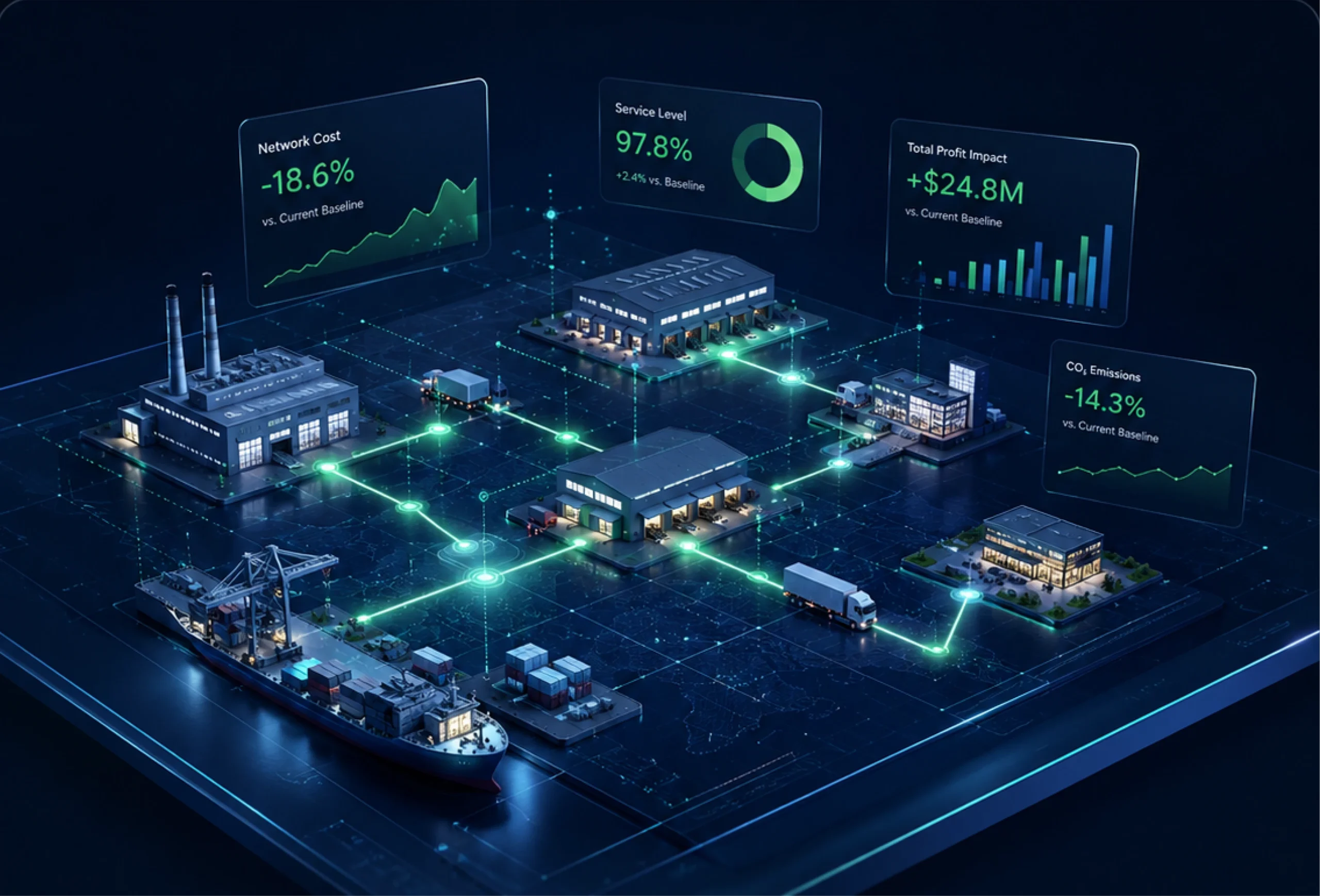

Transportation optimization software uses mathematical algorithms to determine the most cost-effective way to move goods across a network. It coordinates routing, load consolidation, mode selection, and carrier constraints in a single planning engine, replacing manual spreadsheet planning with automated, real-time decision-making that accounts for dozens of variables simultaneously.
The core problem it solves is deceptively complex. How do you move goods from point A to point B, and often C, D, and E, while minimizing cost, time, and environmental impact? The answer involves balancing driver hours, delivery windows, vehicle capacity, traffic patterns, and customer priorities all at once. For most enterprises, freight can account for 40 to 60 percent of total logistics costs. Small planning errors compound quickly across thousands of shipments.
Most teams still plan with disconnected systems and too much manual work. A 2024 survey found supply chain workers spend almost two days a week manually tracking data instead of making better decisions. That is the gap this software category exists to close.
It covers three levels of planning:
- Operational: Day-to-day routing, load building, and dispatch for drivers and fleets.
- Tactical: Consolidation strategy, mode selection, and carrier mix optimization across weeks and months.
- Strategic: Network-level modeling of how facility locations, lane structures, and freight flows interact with total supply chain cost.
Not every tool covers all three levels. Understanding which level your problem lives at is the first step to choosing the right platform.
We have compared the leading tools across capability, fit, and honest limitations. Here is how they stack up at a glance:
Top Transportation Optimization Software in 2026
The following solutions serve mid-to-large enterprises with complex logistics operations.
1. Sophus
Best for: Enterprises that want to optimize transportation as part of a connected supply chain model, not as a standalone freight execution problem.
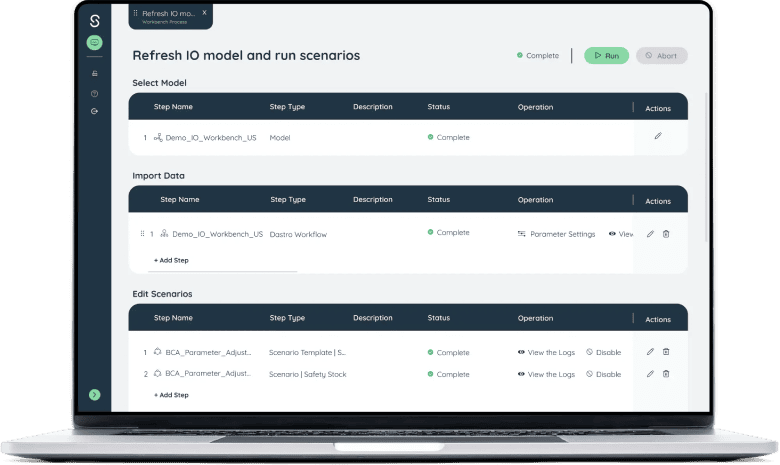
Sophus is a cloud-native supply chain network design and optimization platform that includes transportation optimization as part of a broader planning suite.
Unlike traditional TMS tools, Sophus approaches transportation decisions at the structural level, modeling how routing, mode selection, and freight consolidation interact with inventory positioning, network design, and total landed cost.
The platform uses high-performance mathematical optimization and scenario modeling to let teams test decisions before committing. If you are evaluating whether to shift freight from LTL to FTL on a given lane, consolidate two DCs into one, or reroute inbound flows through a different port, Sophus models the full cost impact across the network, not just the freight line.
Core transportation capabilities:
Vehicle Routes Optimization handles multi-stop fleet routing with constraints including vehicle type, capacity, service time, and cost. Shipment Order Assignment uses mixed integer programming to match orders to transport options, improving consolidation outcomes. Freight Consolidation identifies lane-level opportunities to combine shipments across modes. Mode Optimization evaluates trade-offs between truck, rail, air, and parcel based on cost, service, and capacity constraints. The platform also includes GHG emission modeling, which quantifies the carbon impact of routing decisions alongside cost.
Where Sophus is different from a traditional TMS:
A standard TMS optimizes within the existing network. Sophus also optimizes the network itself. When transportation decisions are modeled alongside inventory levels, production schedules, and facility locations in a single environment, teams avoid the common trap of reducing freight costs while unknowingly increasing holding costs elsewhere.
Sophus builds a fully costed baseline using one month of transactional data in 48 hours. Teams see current cost structure and improvement opportunities before any commitment is made.
2. Blue Yonder
Blue Yonder TMS covers the full transportation lifecycle from planning through freight payment and settlement.
The platform’s strengths are in carrier network connectivity, load optimization, and real-time visibility. Its 3-D container load planning engine is a standout capability, using physics-based modeling to maximize trailer utilization while respecting axle weight and stackability constraints. The Luminate platform provides a unified data layer across its suite, which improves consistency across planning and execution.
Limitations to know:
User feedback consistently flags the interface as dated and complex. Multiple Gartner reviews describe it as having “too much information at a given time” and requiring more clicks than should be necessary to complete common workflows. Implementation timelines are typically long, and the platform has a steep learning curve for teams without dedicated TMS expertise.
The Transportation Modeler (TMOD) tool still requires a separate remote environment rather than running inside the main TMS interface, which adds friction for teams doing scenario analysis.
Blue Yonder is built for large enterprise deployments. Mid-market companies or teams without dedicated implementation support often find the complexity disproportionate to their needs.
3. Coupa
Coupa’s supply chain design and transportation capabilities sit within its broader spend management platform. Its strongest differentiation is in connecting freight procurement decisions to the rest of a company’s spend data. For teams that want to evaluate transportation optimization alongside supplier and procurement optimization, Coupa’s integrated approach offers a broader view of spend than a standalone TMS.
The platform is particularly regarded for network modeling capabilities, giving teams the ability to evaluate transportation cost trade-offs at the strategic level rather than just optimizing individual shipments.
Limitations to know:
Coupa is primarily known as a procurement and spend management platform. Its transportation optimization capabilities are part of a broader suite, which means teams whose primary need is deep routing optimization or day-to-day freight execution may find the transportation modules less specialized than dedicated TMS alternatives.
4. Oracle Transportation Management (OTM)
Oracle Transportation Management covers multimodal planning, freight payment, carrier rate management, compliance, and settlement in a single system. It spans all modes and geographies and is purpose-built for the scale and complexity of global enterprise logistics.
Users in the Oracle ecosystem benefit from automatic population of shipping details from order records, unified visibility across procurement and transportation, and a consistent data model that reduces reconciliation overhead.
The order planning engine is regarded by users as producing high-quality optimization outcomes for complex freight scenarios.
Limitations to know:
OTM consistently draws criticism for its implementation complexity and interface. User reviews on Gartner and G2 describe a steep learning curve, configurations that require significant internal resources to maintain, and an interface that can be difficult to navigate for non-specialist users.
Implementation costs are reported to range from $50,000 annually for smaller deployments to well over $500,000 for large global operations, making total cost of ownership a serious consideration.
4. Descartes
Descartes specializes in routing, mobile, and telematics solutions with a deep carrier network and strong compliance capabilities. Its routing optimization engine handles complex constraint sets including time windows, multi-stop sequences, vehicle types, and driver regulations. The platform also includes freight audit and payment processing, making it a more complete execution system than route-optimization-only tools.
Descartes has a broad carrier network and is particularly strong for organizations managing compliance-heavy freight, including customs documentation and cross-border logistics.
Limitations to know:
User feedback notes that the interface feels dated compared to newer cloud-native platforms. Implementation for non-enterprise users can be complex, and pricing at enterprise scale is reported to be a barrier for mid-market companies. The platform’s depth is a strength for complex operations but can be excessive for teams with simpler routing needs.
Transportation Optimization Software vs Transportation Management Software (TMS)
You’ll often see “transportation optimization software” and “TMS” used interchangeably, but they serve different purposes. A Transportation Management System (TMS) is a broader platform that handles carrier selection, freight audit, compliance, and shipment execution.
Transportation optimization software, on the other hand, focuses specifically on the algorithmic work of route and load optimization.
| Capability | TMS | Transportation Optimization Software |
|---|---|---|
| Route optimization | Limited | Core function |
| Carrier management | Yes | No |
| Load consolidation | Sometimes | Core function |
| Freight audit | Yes | No |
| Dispatch management | Yes | No |
Some organizations use a TMS for overall logistics management. Others use dedicated optimization software for complex routing challenges. Many enterprises benefit from both, or from platforms that integrate optimization directly into broader supply chain planning.
Key Features to Look for in Transportation Optimization Software
Not all solutions offer the same capabilities. Here are the features that matter most when you’re evaluating options.
Route Optimization and Scheduling
This is the foundation. Algorithms calculate the fastest, most efficient paths while respecting time windows, driver hours-of-service regulations, and vehicle capacity limits. For last-mile delivery and field services, route optimization alone can deliver 10–15% cost reductions.
Freight Consolidation
Combining smaller shipments into fewer, fuller loads maximizes vehicle capacity and reduces per-shipment costs. This feature is especially valuable for LTL operations where partial loads are common.
Mode Optimization
If your logistics network includes FTL, LTL, parcel, ocean, and air freight, you need a system that helps you choose the right mode at the right time based on cost, service level, and capacity.
Analytics and Reporting
Dashboards measuring cost-per-mile, on-time delivery, and asset utilization help you identify improvement opportunities. Without visibility into performance, optimization becomes guesswork.
Integration with Supply Chain Systems
Here’s where many standalone tools fall short. When transportation decisions connect to your ERP, WMS, and inventory systems, you can see total supply chain trade-offs rather than just freight savings in isolation. Platforms like Sophus differentiate by linking transportation optimization to network design, production, and inventory planning in a single environment.
If you are evaluating transportation optimization software, it is worth reviewing the core capabilities of supply chain network design software, since transport efficiency is directly shaped by network structure and scenario modeling.
Benefits of Transportation Optimization Software
What outcomes can you actually expect? Here are the benefits of transport optimization tools that matter most to buyers.
Reduced Transportation Costs
Lower fuel consumption, fewer empty miles, and optimized carrier selection typically deliver 5–15% cost savings. For organizations with significant freight spend, this translates to millions in annual savings.
Improved On-Time Delivery
Better routing and scheduling mean more reliable ETAs. Higher on-time performance directly improves customer satisfaction and reduces costly expedited shipments.
Better Asset Utilization
Maximizing trailer fill rates and reducing deadhead (empty return trips) helps you get more value from your fleet and carrier contracts.
Faster Planning and Scenario Analysis
Moving from weeks to minutes for planning cycles changes how you respond to disruptions. The ability to run what-if scenarios—what happens if this DC closes? What if fuel prices spike?—enables proactive decision-making rather than reactive firefighting.
Lower Carbon Emissions
Fewer miles and fuller trucks mean less fuel burned. Some platforms also include GHG emission modeling to quantify environmental impact for sustainability reporting.
How to Evaluate Software for Transportation Optimization
Follow these steps to guide your buying process.
1. Define Your Scope and Use Cases
Are you solving for last-mile routing, strategic network planning, or daily execution optimization? Different tools excel at different problems. Clarity on your primary use cases prevents expensive mismatches.
2. Assess Integration Requirements
Map your existing ERP, WMS, and planning systems. Prioritize vendors that integrate seamlessly without lengthy IT projects. Disconnected tools create data silos and manual workarounds.
3. Evaluate Scalability and Speed
Can the solution handle your current shipment volume and future growth? How fast can it run optimization scenarios? Some platforms solve in minutes what others take hours to compute.
4. Consider Total Cost of Ownership
Look beyond license fees. Factor in implementation, training, and ongoing support costs. A lower upfront price can become expensive if deployment drags on for months.
5. Request a Proof of Concept
Test the software with your actual data before committing. Some vendors, like Sophus, offer a free, fully costed baseline using just one month of transactional data delivered in 48 hours to demonstrate potential value quickly.
Tip: Ask vendors how long it takes to go from data upload to first actionable insight. The answer reveals a lot about implementation complexity.
Real Time Transportation and Supply Chain Optimization Success Stories
Sophus has helped transportation and supply chain organizations optimize inventory positioning and flow across complex networks, reducing excess stock while maintaining high service levels.
European Supply Chain Network Redesign Case Study
Sophus worked with a major global manufacturer to redesign its European inbound and distribution network. The company needed to reduce logistics cost while balancing service levels and regulatory constraints, such as tariffs and customs processing times. Sophus’ platform enabled the team to simulate hundreds of alternative network configurations, evaluating ports, regional distribution center placements, and transport routes against total landed cost (which includes transportation, duties, customs, and service factors).
The analysis led to strategic changes in port usage and distribution strategies that ultimately reduced total logistics cost by about 5% and improved customs process times and service levels.
Parcel Delivery Total Landed Cost & Transport Routing Insight
An international parcel delivery provider partnered with Sophus to model its full end‑to‑end cost structure, including the transportation stages (collection, sortation middle‑mile, and last‑mile delivery). By integrating Sophus vehicle route outputs into a digital twin cost model, the company gained granular insight into which regions and parcel segments were actually profitable, enabling better pricing strategies and service zone decisions
Why Integration with Supply Chain Planning Matters
Standalone transportation tools optimize in a silo. You might reduce freight costs by 10% while unknowingly increasing inventory holding costs by 15%. When transportation decisions connect to inventory, production, and network design, you see the total cost impact.
- Inventory + Transportation: Optimizing replenishment frequency and load sizes together balances inventory holding costs with freight costs.
- Network Design + Transportation: Modeling new facility locations with a true understanding of freight cost impact across the entire network prevents surprises after implementation.
- Production + Transportation: Aligning production schedules with shipping windows minimizes delays and expedited shipments.
This is Sophus’s core thesis: transportation optimization delivers the most value when embedded in end to end supply chain decision intelligence rather than treated as a separate logistics problem.
How Transportation Optimization Software Supports Sustainability
There’s a direct link between route optimization, load consolidation, and reduced carbon emissions. Fewer miles driven and fuller trucks mean less fuel consumed.
For enterprises with environmental targets, some platforms include GHG emission modeling to quantify this impact. You can measure not just cost savings but also the carbon reduction from optimized logistics, which is valuable for sustainability reporting and stakeholder communication.
How to Get Started with the Right Transportation Optimization Software
Choosing the right software transportation depends on your use cases, integration requirements, and whether you want standalone optimization or end-to-end supply chain decision support. The greatest value comes from evaluating how transportation decisions connect to broader network, inventory, and production optimization.
Ready to see how transportation optimization fits into your supply chain strategy? Schedule a Free Demo with the team today.
FAQs About Transportation Optimization Software
How much does transportation optimization software typically cost?
Enterprise transportation optimization platforms are generally priced on a subscription model based on shipment volume, number of users, and deployment scope. Focused route optimization tools for smaller fleets can start from a few hundred dollars per month. Mid-market platforms with broader planning capabilities typically range from $30,000 to $150,000 annually. Enterprise-grade platforms that include network design, transportation spend management, and inventory optimization as part of a unified suite are typically priced on a custom basis based on the scale of your operation. Most vendors will provide a scoped proposal after an initial discovery call. Requesting a proof of concept or pilot before committing to a full deployment is standard practice and any credible vendor will accommodate it.
How long does implementation take?
Timelines range from a few weeks for focused route optimization tools to several months for complex enterprise deployments. Platforms with automated data ingestion and pre-built integrations accelerate time-to-value significantly.
What data is required to get started?
At minimum, you’ll want shipment history, origin/destination data, and vehicle or carrier information. Some platforms generate valuable insights from as little as one month of transactional data.
Can transportation optimization software handle both strategic planning and daily operations?
Some tools focus only on tactical routing, while others support both strategic network modeling and daily execution. Platforms like Sophus cover strategic, tactical, and operational use cases within a single solution.
Which industries benefit most?
Manufacturing, retail, logistics, consumer goods, and any business with significant freight spend or complex delivery networks see major benefits. Field service and courier businesses also achieve strong ROI from route optimization.