
Freight costs keep climbing, yet customer service expectations keep on increasing, and somehow you’re expected to do more with less. Meanwhile, your planning team is still juggling spreadsheets, disconnected systems, and routes that were “good enough” last quarter.
Logistics optimization solutions today use AI and advanced algorithms to cut through this complexity by evaluating thousands of routing, loading, and scheduling scenarios.
This guide covers what logistics optimization actually involves, the challenges driving adoption, and practical best practices for implementing software that connects logistics decisions to your broader supply chain strategy.
What is Logistics Optimization?
Logistics optimization is the process of improving how goods move through your supply chain to reduce costs while meeting delivery requirements. It covers logistics network design, transportation routing, fleet optimization, and delivery scheduling—all working together to move more products with fewer resources. Modern logistics optimization solutions use AI-driven software and real-time data to analyze traffic patterns, vehicle capacity, and delivery constraints at the same time.
Think of it this way: every shipment involves dozens of decisions.
- Which DC to use?
- Which truck?
- Which route?
- What time?
- How full?
Logistics optimization software evaluates thousands of combinations to find the best answer—something manual planning simply cannot do at scale.
The core areas include:
- logistics network design.
- Routing: calculating the most efficient paths between pickup and delivery points. Vehicle route optimization does this against real road distances, not straight-line estimates.
- Fleet utilization: making sure vehicles and drivers are used effectively across shifts
- Delivery scheduling: timing shipments to meet customer windows without excess cost
When one of these areas improves in isolation, the others often suffer. Optimizing routes without considering load capacity, for example, can lead to more trips than necessary. That’s why the best solutions treat logistics as a connected system rather than separate problems.
Related Read: From Cost-Cutting to Value-Creating Logistics Network Design
Why Logistics Optimization Matters for Supply Chain Performance
Logistics cost often represents one of the largest controllable costs in any supply chain. For many organizations, logistics spend accounts for a significant portion of revenue—and even small improvements translate into meaningful savings.
But cost is only part of the picture. Logistics decisions ripple across your entire operation in ways that aren’t always obvious.
- Service levels: on-time delivery directly affects customer satisfaction and retention
- Capital efficiency: reliable logistics reduces the safety stock you carry
- Sustainability: optimized routes and fuller loads lower fuel consumption and emissions
Here’s what often gets overlooked: logistics cannot be optimized in isolation. Where you place inventory, how you design your network, and when you produce goods all influence what’s possible in transportation. The most effective logistics optimization connects to upstream decisions rather than treating shipping as an afterthought.
Key Challenges Driving Optimization in Logistics
Rising Transportation Costs
Fuel price volatility, carrier capacity constraints, and increasing customer expectations for faster delivery have put sustained pressure on logistics budgets. What worked three years ago often doesn’t pencil out today.
Many teams find themselves caught between cost pressures and service demands—asked to deliver more, faster, and cheaper all at once. Without better tools, something has to give.
Inefficient Routing and Asset Utilization
Trucks running partial loads, drivers taking suboptimal routes, and poor scheduling that leaves vehicles idle—inefficiencies like these compound quickly. Even a modest improvement in asset utilization can meaningfully change your cost structure.
The challenge is that manual planning cannot evaluate enough alternatives. There are too many variables: delivery windows, vehicle types, driver hours, traffic patterns, and customer priorities. Spreadsheets hit their limits fast.
Fragmented Tools and Siloed Data
You might recognize this scenario: order data lives in the ERP, shipment tracking in a TMS, carrier performance in spreadsheets, and reporting in a separate BI tool. When systems don’t communicate, teams spend more time gathering information than acting on it.
Fragmentation also prevents holistic decision-making. You can’t optimize what you can’t see clearly.
Limited Visibility and Scenario Planning
Without real-time visibility and what-if capabilities, teams react to problems instead of preventing them. A delayed shipment becomes a customer complaint before anyone knows it’s late.
Scenario planning—asking “what happens if we consolidate these orders?” or “what if this carrier is unavailable?”—remains out of reach for many organizations still relying on static plans.
Best Practices for Implementing Logistics Optimization Software
Implementing logistics optimization software successfully requires a clear strategy, clean data, stakeholder alignment, and a focus on measurable outcomes from day one.
1. Start with Clean and Consolidated Data
Optimization is only as good as the data feeding it. Before evaluating software, take stock of your transactional data: orders, shipments, carrier rates, delivery locations, and service outcomes.
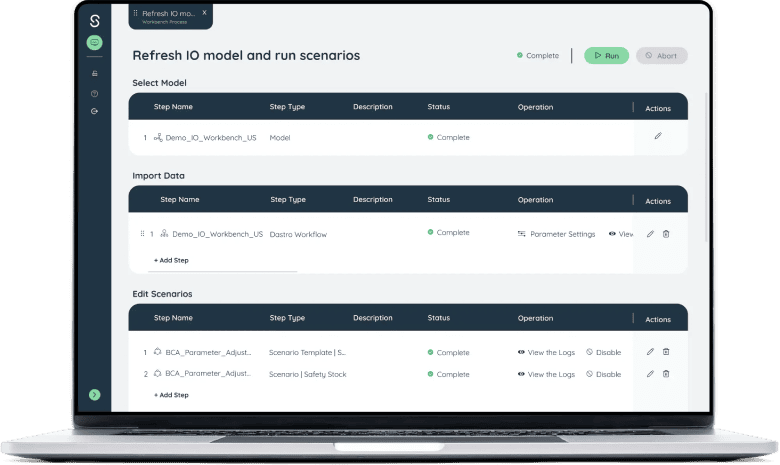
Consolidating information into a single source rather than pulling from five different systems dramatically improves both accuracy and speed. Platforms with automated data ingestion can compress this step from weeks to days, turning raw transactions into a usable baseline quickly.
2. Define Clear KPIs and Success Metrics
What does success look like for your organization? Without measurable goals, it’s impossible to evaluate whether optimization is working.
Common KPIs include cost per shipment, on-time delivery rate, asset utilization percentage, and miles driven per delivery. Establish benchmarks before implementation so you have a clear before-and-after comparison.
3. Integrate with Existing ERP and TMS Systems
Logistics optimization software works best when it connects to your existing systems rather than replacing them. Look for platforms with flexible integration capabilities and API support that allow data to flow seamlessly between planning and execution.
The goal is a single source of truth not another disconnected tool that requires manual data entry.
4. Connect Logistics to Network Design and Inventory Optimization
This is where many implementations fall short. Logistics decisions impact—and are impacted by—facility locations, inventory placement, and production schedules.
If your distribution centers are in the wrong places, no amount of route optimization will fully compensate. End-to-end integration across network design, inventory, and transportation unlocks value that siloed optimization cannot reach.
6. Leverage AI for Route and Load Optimization
AI and advanced algorithms can evaluate thousands of routing and consolidation scenarios in minutes instead of hours or days. This far exceeds what manual planning can accomplish, especially when constraints like delivery windows, vehicle capacity, and driver availability all interact.
The result is better decisions, faster with less effort from your planning team.
7. Build Scenario Planning into Daily Operations
Supply chain What-if scenario planning isn’t just for annual strategic reviews. The most effective teams use scenario planning for tactical and operational decisions: testing alternatives before committing, understanding trade-offs, and building confidence in their choices.
Questions like “What if we consolidate Tuesday and Wednesday shipments?” or “What’s the cost impact if we shift to a different carrier mix?” become routine rather than exceptional.
Essential Features of Logistics Optimization Software
Feature |
What It Does |
Why It Matters |
Route Optimization |
Calculates most efficient delivery paths | Reduces miles, fuel, and time |
Freight Consolidation |
Combines shipments into fuller loads | Lowers cost per unit shipped |
AI-Driven Automation |
Automates planning decisions | Speeds up planning cycles |
System Integration |
Connects to ERP, TMS, WMS | Ensures data flows seamlessly |
Route Optimization and Scheduling
Route optimization algorithms determine the best sequence and timing of stops based on constraints like delivery windows, vehicle capacity, driver hours, and traffic patterns. Multi-stop route optimization handles vehicle type, capacity, service time and restricted zones in one model. The best solutions update dynamically as conditions change throughout the day.
Freight Consolidation and Load Planning
Combining multiple orders into fewer, fuller shipments—sometimes called “cubing”—reduces per-unit transportation costs and improves asset utilization. This is especially valuable for organizations with high shipment volumes and flexible delivery windows.
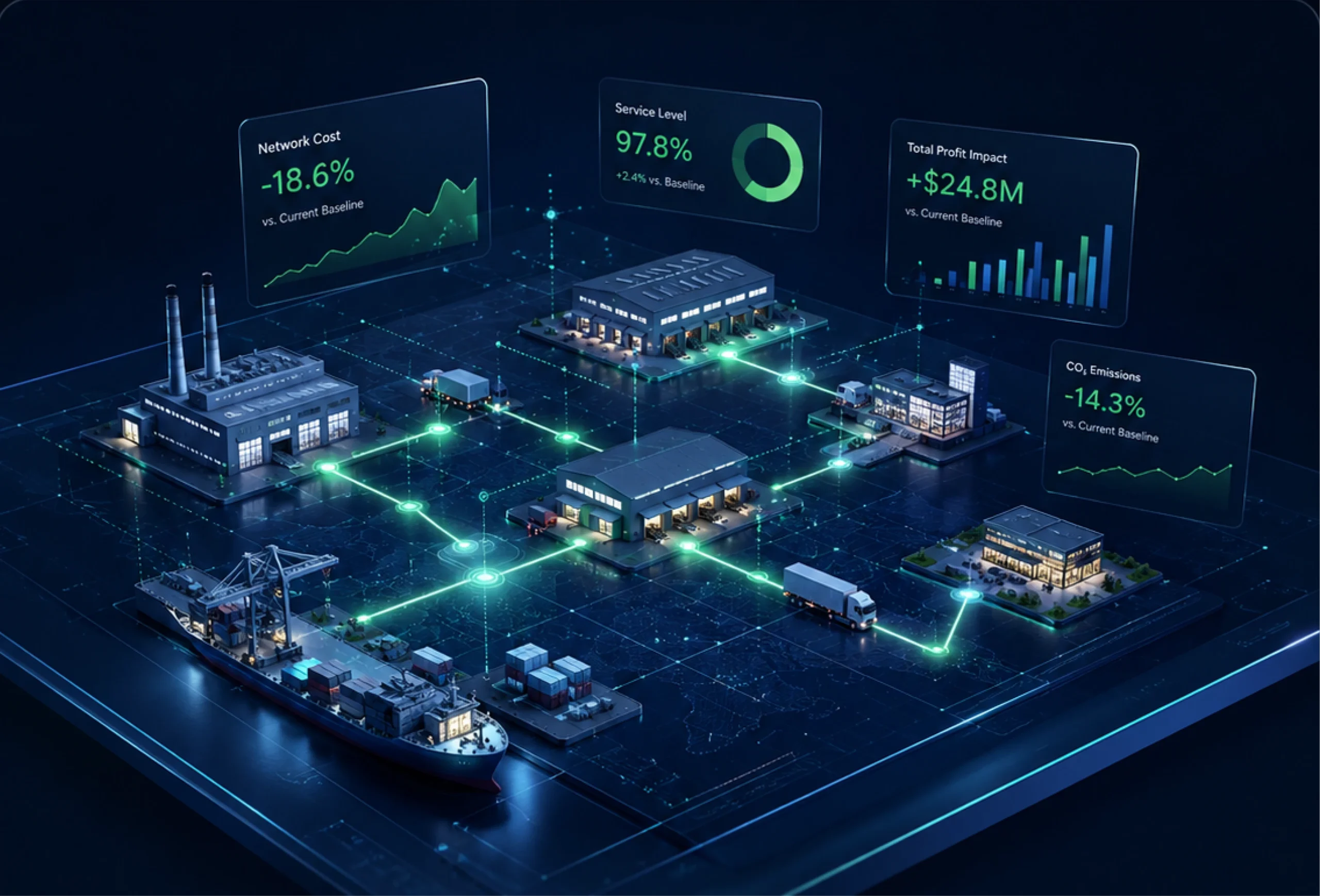
Supply Chain Network Digital Twin
A Supply chain digital twin is a virtual replica of your logistics network that updates quickly with the latest data set. It enables monitoring, simulation, and rapid response showing you not just where shipments are, but how the network is performing overall.
AI-Driven Automation and Forecasting
AI automates repetitive planning tasks and improves demand forecasting accuracy. Instead of reacting to yesterday’s problems, teams can anticipate tomorrow’s needs and plan accordingly.
Integration with Planning and Execution Systems
The best logistics optimization solutions connect seamlessly with ERP, TMS, WMS, and other systems. Decisions made in planning flow directly into execution without manual handoffs or data re-entry.
How AI and Advanced Technology Transform Logistics Optimization
Traditional planning tools hit a ceiling when complexity increases. AI and machine learning break through that ceiling by processing multi-variable scenarios at scale and speed not possible with spreadsheets or legacy systems.
- Continuous learning: models improve as more data flows through the system
- Scale: algorithms evaluate thousands of scenarios simultaneously
- Speed: planning cycles compress from weeks to minutes
Some platforms now incorporate quantum-inspired solving techniques to handle especially large or complex optimization problems enabling scenario runs that would otherwise take days to complete.
Benefits of End-to-End Logistics Optimization
Reduced Transportation Costs
Optimized routes, consolidated loads, and smarter carrier selection lower freight spend. Organizations that implement comprehensive optimization typically see meaningful reductions in transportation costs.
Improved On-Time Delivery and Service Levels
Better planning leads to more reliable, predictable deliveries. Customers notice and so do your retention metrics.
Lower Working Capital and Inventory Costs
When logistics is reliable, you can carry less safety stock. Smarter replenishment and transportation optimization reduce the inventory buffers that tie up working capital.
Greater Resilience and Risk Mitigation
Visibility and scenario planning help organizations anticipate and respond to disruptions before they impact customers. You’re not just reacting—you’re prepared.
Faster Time to Insight and Decision-Making
Modern platforms deliver answers in hours or days rather than months. This speed enables agile, data-driven decisions that keep pace with changing conditions.
How to Choose the Right Logistics Optimization Software
Here’s a quick guide for supply chain experts who come into the market with a question: What are the key factors to consider when choosing the right logistics optimization software, including cost, scalability, and features?
Evaluate Breadth of Optimization Capabilities
Look for platforms that cover routing, consolidation, and load planning—and ideally connect to network design, inventory, and production optimization. End-to-end coverage delivers compounding value.
Assess Data Automation and Integration
Solutions that automate data ingestion and transformation avoid lengthy baseline-building cycles. If getting started takes months, you’ve already lost momentum.
Look for Scalability and Speed
The platform can handle large, complex models and deliver results quickly. If each scenario takes weeks to run, you’ll never build the planning agility you’re looking for.
Consider Security and Deployment Flexibility
Certifications like SOC 2 and ISO 27001 matter, especially for sensitive supply chain data. Flexible deployment options—cloud-native or on-premises—allow you to meet organizational requirements without compromise.
How to Get Started with Logistics Optimization
Getting started doesn’t require a massive upfront investment. Many organizations begin with a baseline assessment of current network costs and flows.
- Gather data: compile one month of transactional shipment and order data
- Map your network: visualize current flows, costs, and inefficiencies
- Identify quick wins: look for freight consolidation and routing opportunities
- Pilot before scaling: test optimization on a subset before full rollout
Some providers offer free, fully costed baseline maps from transactional data—surfacing quick-win opportunities with no upfront commitment. This approach lets you see value before making a larger decision.
Take the Next Step Toward Smarter Logistics Decisions
Logistics optimization isn’t a one-time project—it’s an ongoing capability that compounds over time. The organizations seeing the greatest returns treat optimization as a core part of how they plan and operate, not a periodic exercise.
Is your supply chain ready to move from reactive to proactive logistics planning?
Contact Sophus today to see how quickly you can turn transactional data into actionable insights.
FAQs about Logistics Optimization Solutions
What are the 7 C’s of logistics?
The 7 C’s refer to getting the right product to the right customer at the right cost, in the right condition, at the right place, at the right time, and in the right quantity. This framework helps organizations evaluate logistics performance holistically across multiple dimensions.
What are the 5 P’s of logistics?
The 5 P’s typically refer to product, place, price, promotion, and packaging—factors that influence how goods are moved and delivered. These elements guide logistics strategy to align with broader business and customer objectives.
How long does it typically take to implement logistics optimization software?
Implementation timelines vary based on data readiness and scope. Modern platforms with automated data ingestion can deliver initial insights in days rather than months—organizations with clean, consolidated data often see faster time-to-value.
What data is required to get started with logistics optimization?
Most solutions require transactional data such as shipment records, order details, carrier information, and delivery locations. Starting with one month of historical data is typically sufficient to build an initial baseline and identify improvement opportunities.