

Login

flavicon-sophus.png
March 21, 2024
Logistics Network Optimization: Best Strategies and Software Guide (2026)
What is Supply Chain Network Design and Optimisation

Most logistics networks were not designed. They evolved. A warehouse added for a specific client, a carrier contract signed under pressure, a distribution route that made sense before freight costs shifted. These decisions accumulate into a network few companies would build from scratch today, yet most continue to manage as if it were optimal.

Logistics network optimization is how those supply chain best practices get applied to your physical footprint like warehouses, transport modes, and inventory positioning and redesigning it around current cost structures rather than historical decisions.

It evaluates your physical footprint, warehouses, transport modes, and inventory positioning, and redesigns it around current cost structures rather than historical decisions.

The impact is significant. Companies with optimized networks operate with up to 15% lower costs than unoptimized ones, according to Invesp. For a business spending 50 million dollars on logistics annually, that is 7.5 million dollars per year in avoidable costs.

The pressure to act is higher in 2026. Tariffs have shifted trade lanes, nearshoring is changing distribution footprints, and customer expectations for delivery speed keep rising.

In this guide, we’ll cover the most important strategies for logistics network optimization, the software that makes them practical, and where to start.

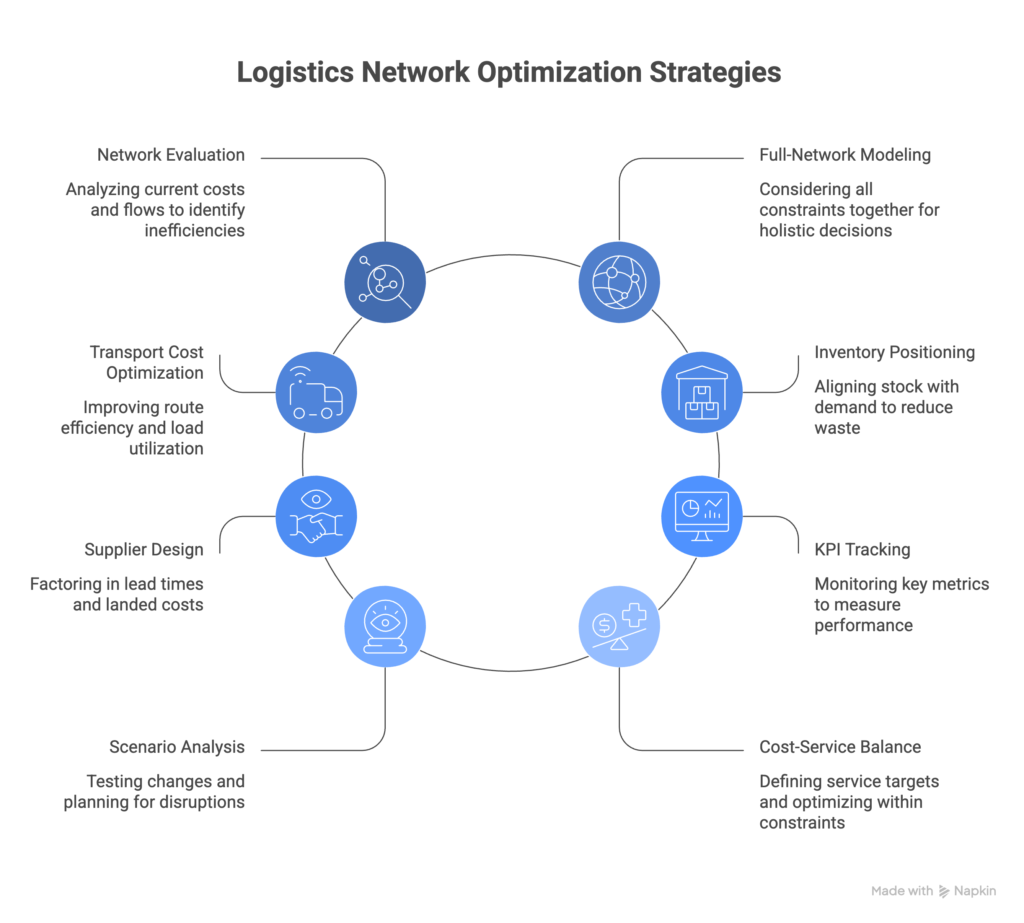
8 Strategies for Logistics Network Optimization

Logistics network problems rarely come from one source. They come from the accumulation of decisions that each made sense individually but were never evaluated together.

These strategies below address that problem systematically, from initial audit through to ongoing optimization.

Strategies for Logistics Network Optimization

1. Evaluate Your Existing Network Before Changing Anything

The starting point for any logistics network optimization project is an honest assessment of what you currently have. Most companies discover that their network has never been evaluated as a whole.

Individual lanes, facilities, and carrier contracts have been reviewed in isolation; however, no one has modeled how all the parts interact. As a result, the total end-to-end delivered cost remains unclear.

A proper network audit covers four key areas. It specifically examines cost per unit by lane and DC, service levels by customer segment and geography, inventory positioning across the distribution network, and facility utilization by location.

The outputs tell you where the structural inefficiencies are and which ones have the biggest financial impact.

Common signals that a network redesign is overdue: freight costs are rising faster than shipment volumes, specific DCs are chronically underperforming on service levels, new markets are being served from facilities that were never positioned to serve them well, or a recent acquisition has created overlapping coverage.

The audit is not the optimization. It is the foundation without which any optimization is guesswork.

2. Use Technology That Models the Full Network, Not Just Parts of It

The most common mistake in logistics network optimization is using technology to fix individual pieces of the network without understanding how those changes affect everything else.

Optimizing a route without considering inventory positioning. Closing a warehouse without modelling the service level impact on customers it was serving. These isolated decisions often create new problems faster than they solve old ones.

Effective logistics network optimization requires network optimization software that models all constraints simultaneously: facility locations, transport flows, inventory levels, demand patterns, and service requirements in a single connected model.

When you change one variable, the model shows you the downstream effect on cost and service across the whole network before you commit to anything.

This is the difference between operational tweaks and genuine network optimization. The first produces marginal improvements. The second produces structural ones.

3. Optimize Transportation Routes and Freight Costs

Transportation typically accounts for 50 to 70% of total logistics costs in most networks. It is also one of the areas where poor decisions compound quickly.

A suboptimal carrier mix, inconsistent load factors, or routes that made sense under previous freight rates can add millions in annual cost to a network that looks operationally efficient on the surface.

Route optimization focuses on minimizing total transport cost while meeting delivery requirements. This means planning routes that maximise vehicle utilisation, consolidate shipments where possible, and choose the right transport mode for each lane.

The FTL versus LTL decision alone can change the economics of a lane significantly depending on volume and frequency.

Freight consolidation is one of the most underused levers in logistics cost reduction. Combining smaller shipments across lanes, sharing transport with complementary businesses, or shifting to hub-and-spoke distribution from direct delivery can reduce per-unit transport cost without degrading service levels.

4. Position Inventory Where It Actually Reduces Cost and Stockouts

Inventory positioning is a network design decision, not just an inventory management one. Where you hold stock across your distribution network has a larger impact on total cost than how much you hold. A company holding the right amount of inventory in the wrong locations will still run out of stock in some markets while accumulating excess in others.

The key principle is that safety stock requirements are driven by demand variability and replenishment lead time at each node.

A DC that receives daily replenishment from a nearby facility needs less safety stock than one waiting a week for ocean freight from overseas. Changing your network design can reduce your total safety stock requirement significantly, often more effectively than any inventory optimization model applied to a fixed network.

Multi-echelon inventory optimization takes this further by determining the right stock levels at every tier of the network simultaneously, rather than optimizing each DC in isolation. Companies that approach inventory this way typically hold 20 to 30% less total stock while maintaining or improving service levels.

5. Build Supplier and Carrier Relationships Into the Network Design

Supplier location and lead time are not just procurement considerations. They are network design inputs that determine where you need to hold inventory, how much safety stock you need, and which distribution configurations are cost-effective.

A supplier that saves 10% on unit cost but adds three weeks of lead time from a distant geography may actually increase your total network cost once you account for the additional inventory you need to carry, the transport cost from that location, and the risk premium of a less reliable supply lane.

Total landed cost analysis, which includes unit cost, transport, duties, inventory carrying cost, and supply risk, gives a more accurate picture than purchase price alone.

In 2026, sourcing strategy has become a network design question more than ever before. Tariff changes have shifted which trade lanes are cost-effective.

Nearshoring and supplier diversification are changing distribution footprints.

Companies that designed their networks around single-country sourcing are now carrying structural risk. Modelling the full network impact of alternative sourcing configurations, before committing to a sourcing change, is how you avoid trading one problem for another.

6. Track the Right KPIs for Logistics Network Performance

Measuring the right things is what separates a logistics network that improves over time from one that drifts. Many companies track operational KPIs (on-time shipments, damage rates, carrier performance) without measuring the network-level metrics that indicate whether the design itself is performing.

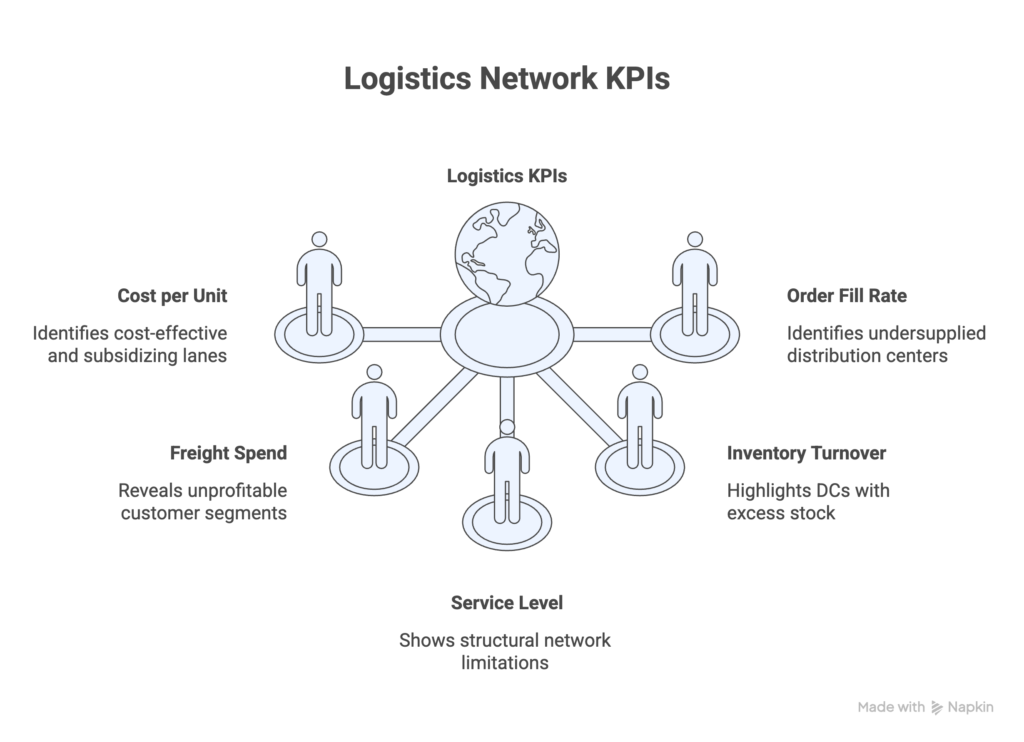
The five most important KPIs for logistics network performance are:

Optimization of Logistics

  1. Cost per unit shipped by lane: Tells you which lanes are cost-effective and which are subsidising others
  2. Freight spend as a percentage of revenue by customer segment: Reveals which segments are unprofitable to serve at current network configuration
  3. Service level by DC and by customer geography: shows where the network is structurally unable to meet commitments
  4. Inventory turnover by node: Highlights DCs holding excess stock relative to demand they are actually serving
  5. Order fill rate by distribution centre: Identifies nodes that are consistently undersupplied

These metrics, tracked consistently, build a picture of where the network is working and where it needs structural attention. A single bad quarter of freight-to-revenue ratio in a specific region often signals that the distribution footprint for that region needs revisiting, not just better carrier negotiations.

7. Run Scenario Analysis Before Committing to Network Changes

Every significant logistics network change carries risk. Closing a distribution centre, reshoring production, changing your primary carrier on a key lane, or adding a new DC to serve a growing market all have second-order effects that are impossible to assess accurately without modelling.

Scenario analysis is the practice of building a model of your current network and then testing proposed changes against it before committing any capital or operational resources.

  • What happens to service levels in the northeast if you close the regional DC and shift volume to the national hub?
  • What is the total cost impact of adding a DC in central Europe if freight rates on the current trans-Atlantic lanes increase by 20%?
  • What does your network look like under three different demand growth scenarios over the next five years?

Companies that run network design software in continuous mode rather than as a one-off project are able to answer these questions in days rather than months.

They go into network change decisions with data rather than intuition, which consistently produces better outcomes and fewer expensive reversals.

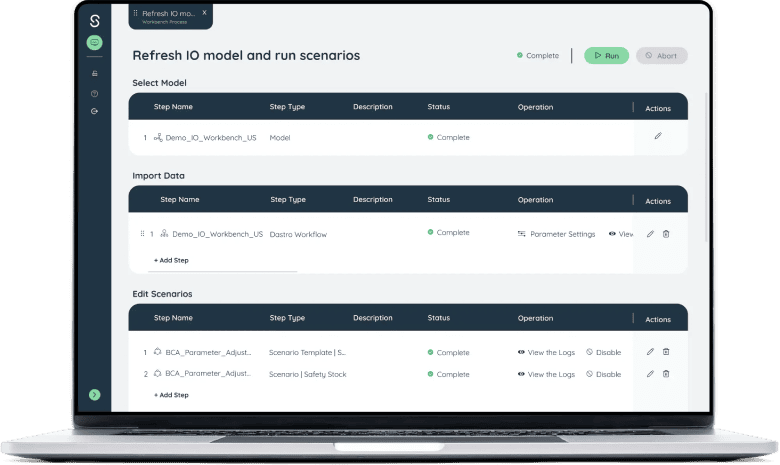
Sophus models hundreds of network scenarios in parallel, comparing cost, service, and resilience trade-offs across each configuration. When conditions change, which they increasingly do quickly, teams can rerun the analysis the same day rather than waiting for a quarterly review cycle.

8. Design the Network Around Service Requirements, Not Just Cost

A logistics network optimized purely on cost, without service level constraints built into the model, will consistently underperform on delivery and customer satisfaction. The right approach is to treat your service commitments as hard constraints in the optimization, not as variables to be traded away when cost pressure increases.

This means defining your service requirements explicitly before modelling begins:

  • What delivery lead times are you committing to by customer segment?
  • What order fill rate are you willing to guarantee?
  • What return handling capability do you need and where?

These become the non-negotiable inputs that the network must satisfy, with cost minimisation happening within those bounds.

Cost to serve analysis connects this principle to financial reality. It tells you the true cost of serving each customer segment, channel, and geography at your current and proposed service levels. Some customers are profitable to serve at high service levels. Others are not, and the network should reflect that rather than applying a uniform standard that cross-subsidises unprofitable segments at the expense of the profitable ones.

Logistics Network Optimization Software: What Actually Helps

There is an important distinction buyers often miss when evaluating tools for logistics network optimization. Most software sold under the logistics optimization label focuses on a single layer of the problem: route planning, warehouse management, or transportation management.

These tools are useful for operational efficiency but they do not address the structural question of whether your network is configured correctly in the first place.

Full logistics network optimization requires a platform that models the whole system simultaneously: facility locations, inventory positioning, transport flows, demand patterns, and service constraints all in one connected model.

When you change one variable, you need to see what happens to cost and service across the entire network, not just in the lane or facility you changed.

What to look for in a logistics network optimization platform:

  • Solver speed matters. Tools that take days to run limit how often you can test scenarios. Faster platforms can evaluate hundreds of scenarios in the time traditional tools run one.
  • Data integration drives usability. If data prep takes weeks, the tool will not be used often. Look for automated connections to ERP, TMS, and demand planning systems.
  • Scenario flexibility defines value. You should be able to test greenfield and brownfield designs, demand growth, and disruption scenarios quickly, without specialist support.

Sophus covers all three. The platform integrates directly with ERP and logistics systems through automated data pipelines, runs complex network models in hours rather than days using its quantum-inspired solver, and supports both strategic network design and tactical logistics planning in the same environment.

A global manufacturer using Sophus redesigned its European distribution network and reduced total logistics costs by 5% while improving service levels and customs process times.

Looking to choose the right supply chain network design software? Read our detailed guide on what capabilities actually matter.

Logistics Network Optimization in Practice: Hisense in Africa

Hisense, one of the world’s largest consumer electronics manufacturers, identified Africa as a strategic growth market. The challenge was not demand. It was logistics. The company relied on third-party providers for distribution across the continent, which meant limited visibility into end-to-end costs, inconsistent service levels, and no clear picture of how the network was actually performing at a lane-by-lane level.

The network had grown to serve expanding demand but had never been systematically designed around the cost and service requirements of the African market specifically. Ocean freight costs, warehouse positioning, last-mile distribution, and regional hub locations had all been handled separately rather than as a connected system.

Sophus worked with Hisense to conduct a comprehensive review of the African logistics network, covering costs from ocean shipping through to warehouse operations and final distribution.

Using transportation route planning and distribution network design modelling, the team identified opportunities to relocate regional distribution hubs, reposition warehouse locations, and restructure transport flows around actual demand concentrations rather than historical convenience.

The result was a 3% reduction in total operational costs and a 15% improvement in productivity across the African network.

Hisense strengthened its competitive position in the market and gained the end-to-end visibility needed to make ongoing network decisions from data rather than assumption.

Your Logistics Network Is Worth Getting Right

The strategies in this guide are not quick fixes. They are the structural decisions that separate logistics networks running at optimal cost from those absorbing millions in unnecessary expense every year.

The companies saving the most on logistics are not the ones with the best operational teams. They are the ones that asked the harder question: is this the right network to be running in the first place?

That question is worth asking regularly. Networks drift. Cost structures change. Demand patterns shift. A network that was well configured three years ago may already be significantly sub-optimal today. The only way to know is to model it.

For a business spending $50 million on logistics, a 15% cost reduction is $7.5 million per year. Stop running a network that was designed for a different world.


See What Sophus Finds in Your Network

Frequently Ask Questions

What is logistics network optimization?

It is the process of evaluating and redesigning your distribution footprint, transport flows, and inventory positioning to reduce costs and improve service levels. Most networks are not designed from scratch. They grow over time and drift away from optimal.

How do I know if my logistics network needs optimization?

The clearest signals are freight costs rising faster than volumes, declining service levels in specific regions, and distribution centres that are underutilised or poorly located relative to current demand. If your network has not been reviewed in the last two to three years, it almost certainly has room for improvement.

What is the difference between route optimization and logistics network optimization?

Route optimization improves how goods move within your existing network. Logistics network optimization questions whether the network itself is configured correctly in the first place. The two address different problems at different time horizons.

How long does a logistics network redesign take?

A focused network review with modern software can produce a working model and initial scenario results within two to four weeks. Full implementation of network changes depends on the scale of the redesign, but most structural changes are phased over three to twelve months.

What software is used for logistics network optimization?

Full network optimization requires a platform that models facility locations, inventory positioning, and transport flows simultaneously rather than optimising each in isolation. Sophus covers all three in a single environment and connects directly to ERP and logistics data through automated pipelines.
Supply chain design information and tips from Sophus

Delivered straight to your inbox.

Author

Byron Song
Byron Song has over a decade of experience in supply chain network design and optimization, working with manufacturers, retailers, and 3PLs worldwide. At Sophus.ai, he leads the development of AI-powered tools that help organizations design, simulate, and optimize logistics networks faster and with greater accuracy. His work has enabled clients to cut network-design lead times by 50% and achieve double-digit cost reductions through smarter scenario planning.

Supply chain design information and tips from Sophus

Delivered straight to your inbox.

Recent posts