
Freight markets are tightening again, costs are rising, and transportation routes are shifting faster than most teams can respond. A lane that worked last quarter may no longer be viable today, and costs that once felt predictable can quickly move out of range. Many organizations can see these changes happening, but only a few are prepared to respond with clarity.
What sets these companies apart is how their supply chain is designed. Flexibility is already built into the network, so teams can adjust without starting from scratch.
When supply chain disruptions hit, there is no time to step back and redesign the network. Teams rely on what is already in place, including existing routes, supplier relationships, and operational constraints.
And that is where most companies begin to lose control.
In this blog, we will look at why traditional network design struggles in volatile markets, what it means to build a supply chain that can adapt, and how companies can use supply chain network design as a practical way to keep their supply chain resilient when things change.
The Real Problem: Supply Chains Are Built to Last, Not to Adapt
Most supply chains were designed for stability. The goal was to build a network that performs well under expected conditions and then improve it gradually over time. In reality, this means networks are often designed once and then left to evolve without regular, structured redesign.
Over time, decisions get tied to assumptions that no longer reflect what is actually happening in the market. Demand changes, costs shift, and service expectations grow, but the network continues to operate on outdated logic.
A few common patterns show up across most organizations:
- Networks are designed once and rarely revisited in a structured way
- Decisions rely on static assumptions instead of current data
- Different teams use different network design tools, which creates gaps in visibility
- Data needs to be manually aligned before any meaningful analysis can begin
This fragmentation slows everything down. Many teams end up using five to ten tools every day just to answer basic questions, which adds friction to even simple decisions .
As a result, decision-making takes far longer than it should. What could be evaluated in a few days often stretches into weeks or even months.
The impact is direct. When the network cannot adjust in time, delays turn into higher costs, missed service targets, and shrinking margins.
Why Volatility Exposes Weak Network Design
Volatility acts as a real stress test for supply chains. It exposes what works, but more importantly, it reveals what was never built to handle change. Most traditional networks were designed for stable conditions, where demand patterns, costs, and supply routes stayed relatively predictable. That environment no longer exists.
When disruption hits, these networks do not adapt. They start to break under pressure.
1. Static Networks Break Under Dynamic Conditions
Most supply chains are built around fixed structures. Routes are predefined, suppliers are locked in, and product flows follow a set pattern. This approach was designed to optimize cost under stable, average conditions.
But volatility does not follow averages. When demand shifts or costs change, these static setups cannot adjust in time. Networks that were heavily optimized for efficiency lose their ability to respond, and teams are forced into reactive decisions that increase both cost and complexity.
2. Assumptions Replace Reality
Traditional network design often relies on simplified assumptions. Cost-to-serve is estimated at a high level, and decisions are based on expected demand rather than real-time conditions.
In a volatile environment, these assumptions quickly become outdated. Hidden costs start to build across regions, products, and customers. At the same time, service trade-offs remain unclear, which makes it difficult to balance profitability and service levels in a meaningful way.
3. Operational Lock-In
Over time, supply chains become rigid. They depend on specific suppliers, fixed contracts, and centralized production or distribution setups. This creates efficiency under normal conditions but becomes a major limitation when disruption occurs.
When routes are blocked, costs rise, or regions become unstable, switching to alternative options is not easy. Instead of adapting, organizations fall back on what is already built, even if it no longer fits the situation. This leads to bottlenecks, higher costs, and slow response times.
4. Inability to Handle Demand Swings
Demand is no longer predictable. Sudden spikes, sharp declines, or regional shifts can happen without warning. Networks designed for steady growth struggle to handle these changes.
Without built-in flexibility, companies are forced into extremes. They either carry excess inventory to stay safe or face stockouts that impact service and revenue. In both cases, margins take a hit.
The Shift: From Cost Optimization to Flexibility Design
For a long time, supply chain network design focused on one primary goal: reducing cost. Companies built networks that performed well under expected conditions, often optimizing for efficiency at scale. That approach worked when markets were stable and disruptions were rare.
Today, that approach is no longer enough. Conditions change too quickly, and networks that are optimized only for cost struggle to keep up.
What leading companies are doing differently is changing the goal itself.
Instead of asking, “How do we minimize cost?” They are asking, “How quickly can we adapt when things change?”
This shift introduces a different way of designing supply chains:
- Flexibility is built into the network from the start
- Multiple sourcing, routing, and distribution options are considered
- Trade-offs between cost, service, and risk are evaluated continuously
- Decisions are tested through scenarios, not just fixed plans
The focus moves from a single “optimal” design to a network that can support multiple paths forward. This creates room to respond without needing to rebuild the system each time conditions shift.
An adaptive network design is defined by how quickly and effectively it can adjust when those conditions no longer hold.
What “Built to Bend” Actually Means
Designing a supply chain that can handle volatility requires more than small adjustments. It calls for a shift in how the network is built and managed over time. Instead of relying on fixed designs, companies need a system that can adjust as conditions change.
This idea can be broken down into a few clear pillars:
1. Actively Designed, Not Passively Evolved
Supply chain networks should not be treated as one-time projects. They need continuous attention and regular updates based on changing conditions.
- Ongoing network design replaces one-time optimization efforts
- Scenario testing becomes part of regular planning cycles
- Decisions are revisited as inputs change, not left unchanged for years
This approach keeps the network aligned with current realities instead of past assumptions.
2. Clear Visibility into Cost-to-Serve
Without a clear view of cost, it is difficult to make the right decisions. Many organizations operate with averages, which hide important differences across the network.
- True cost is understood at the product, customer, and channel level
- Hidden costs across transportation, inventory, and service are identified
- Decisions are based on actual impact, not high-level estimates
This level of visibility helps teams make trade-offs with confidence.
3. Scenario-Driven Decision Making
Instead of reacting to disruption, companies can prepare for it. Scenario-based planning allows teams to test different outcomes before making a move.
- Disruptions are modeled before they occur
- Multiple options are evaluated side by side
- Trade-offs between cost, service, and speed are assessed quickly
This reduces uncertainty and improves the quality of decisions under pressure.
4. Flex Across the Network
Flexibility needs to exist across the entire network, not just in one area. This includes sourcing, transportation, and distribution.
- Suppliers, routes, and modes can be adjusted when conditions change
- Dependency on a single path or region is reduced
- The network supports multiple ways to fulfill demand
This ensures the supply chain can respond without breaking when disruptions occur.
The Impact: Flexibility Drives Real Financial Outcomes
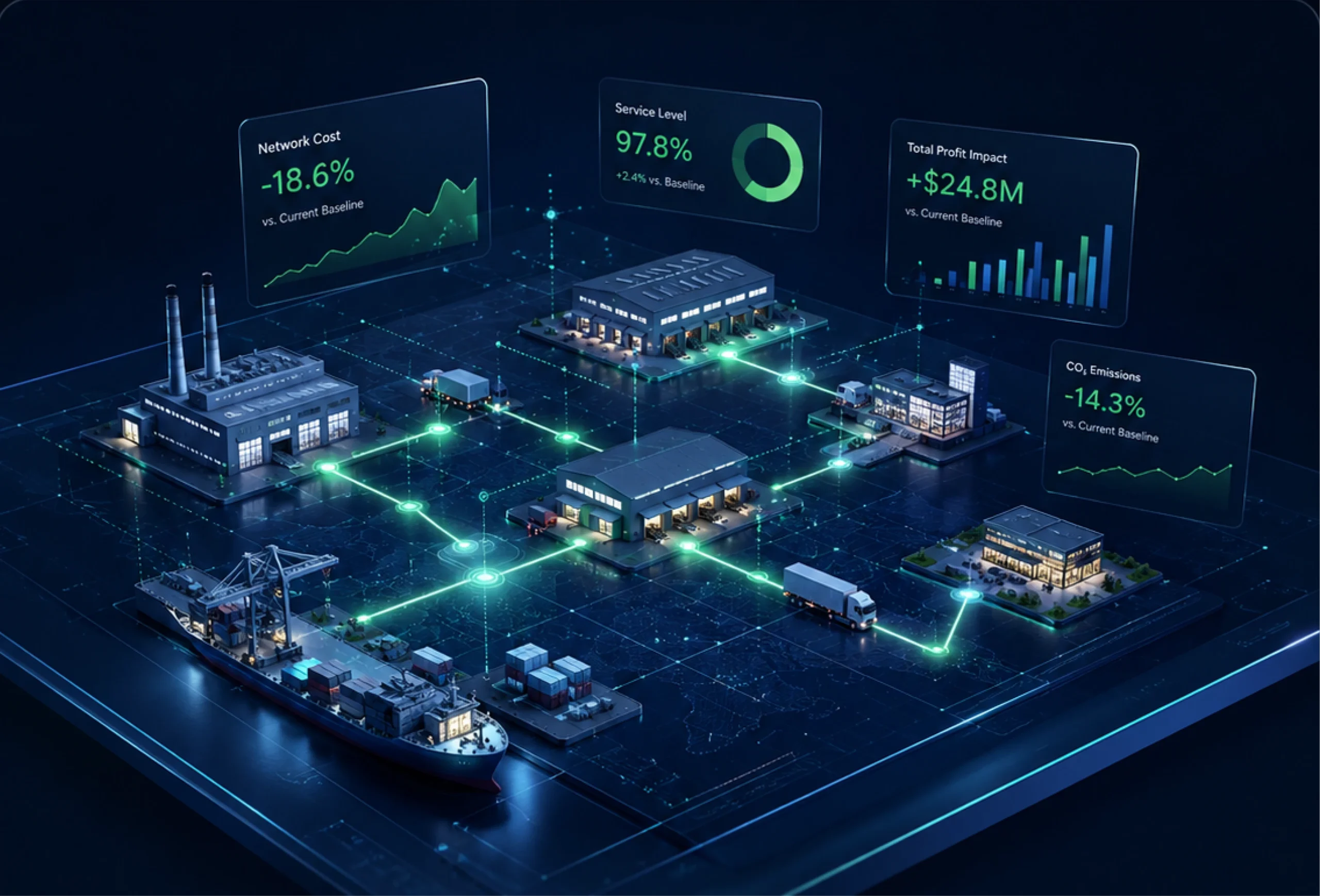
When a global manufacturer like LonGi redesigned their supply chain network with Sophus, they achieved a 40% reduction in logistics costs. This did not come from cutting headcount or reducing service. It came from building a network that could allocate resources more intelligently across a complex, multi-region footprint.
A similar story played out at Hisense. By optimizing their distribution network across Africa, they reduced logistics costs by 5%. At their scale, this is a meaningful impact, driven by better network decisions instead of constant firefighting.
For a global food and beverage manufacturer, the impact was even more direct. They achieved 30 million dollars in savings by replacing static assumptions with scenario-driven supply network planning.
The pattern across all three is clear. When companies can evaluate trade-offs across their network in real time, testing cost, service, and risk together, they stop leaving money on the table. They make fewer reactive decisions and more deliberate ones.
The financial case for flexibility shows up in the numbers when companies stop treating network design as a one-time project and start treating it as a continuous capability.
Why Traditional Tools Fail to Deliver Flexibility
Traditional supply chain tools were not built for constant change. They were designed for structured analysis, not continuous decision making, which limits their ability to support real world volatility.
- Legacy Planning Systems: Slow to implement and expensive to maintain. They rely on rigid architectures, and models often take hours or overnight to run. This delays decisions by days when teams need answers in hours. By the time the analysis is ready, the window to act has often already closed.
- Point Solutions: Each tool focuses on a single function, such as inventory or transportation, but remains disconnected from others. This creates data silos and makes it difficult to evaluate end to end trade offs. Teams are forced to stitch together outputs manually, which introduces errors and wastes time that should be spent on decisions.
- Custom Models: Require ongoing technical expertise and are difficult to scale. Even small updates can become complex projects. This slows down response times when conditions change, which means the teams who need flexibility most are often blocked by the tools they rely on.
How Sophus Enables “Built to Bend” Supply Chains
A more modern approach removes these limitations by combining speed, flexibility, and usability into a single system. This allows teams to design and adjust their supply chain continuously instead of relying on static models.
Rapid Baseline of Your Current Network
Building a baseline is often the most time-consuming step in traditional tools. Sophus simplifies this by allowing teams to create a digital twin of their network quickly using real data. Instead of spending weeks preparing and aligning inputs, teams can start analyzing their current state in a matter of days.
Scenario Planning at Speed
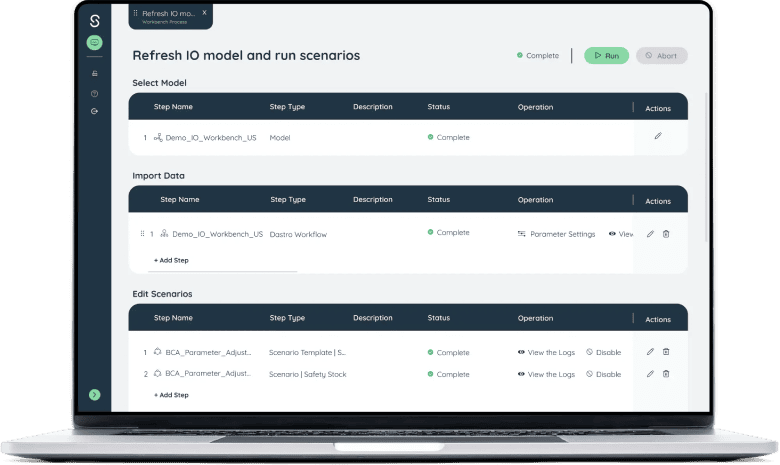
Flexibility depends on how quickly different options can be tested. Sophus enables teams to run multiple “what-if” scenarios without rebuilding models each time. This allows for faster evaluation of trade-offs across cost, service, and risk, making scenario planning part of regular decision-making.
Unified Decision Platform
Rather than switching between disconnected tools, Sophus brings network design, inventory, and transportation decisions into one platform. Using a unified data model improves visibility across the supply chain and removes the need for manual data alignment.
Continuous Optimization
As conditions change, decisions need to keep up. Sophus allows teams to re-evaluate and optimize their network quickly without being blocked by rigid constraints. With solving speeds up to 50x faster, teams can move from analysis to action in days instead of months.
Real-World Signal: Why Network Design Demand is Rising
The demand for supply chain network design is increasing as companies deal with more complexity, faster disruptions, and higher expectations around cost, service, and resilience. What was once treated as a periodic exercise is now becoming a continuous priority.
- Growing network complexity and M&A activity: As companies expand across regions or go through mergers, networks become harder to manage. Redundant facilities, overlapping capacities, and unclear flows push organizations to redesign their networks to improve efficiency without affecting service.
- Macro-economic volatility: Changes in freight rates, tariffs, and regional demand are happening more frequently. Companies are now stress-testing their networks to understand how they will perform under different scenarios instead of waiting for disruptions to occur.
- Balancing cost and service: There is constant pressure to reduce total logistics costs while maintaining or improving service levels. This requires a more detailed understanding of trade-offs across transportation, warehousing, and inventory.
- Sustainability goals: Many organizations are now factoring carbon emissions into their network decisions. This adds another layer of complexity, as companies aim to reduce environmental impact while still operating efficiently.
- Need for scalability and speed: As supply chains grow in size and complexity, older tools struggle to keep up. Companies are looking for faster, more scalable solutions that allow them to run multiple scenarios and make decisions quickly.
What Leaders Should Be Asking Right Now
To stay prepared for volatility, leaders need to move beyond static planning and start stress-testing their networks with practical “what-if” questions.
- How resilient is our network to sudden shocks? What happens if freight rates rise or tariffs change?
- Can we handle unexpected demand shifts? How does the network respond to regional spikes or drops?
- Are we balancing cost, service, and risk effectively? Do we understand the real trade-offs across the network?
- How do sustainability goals impact our decisions? Are we factoring emissions into network design choices?
- Do we have the right inventory strategy? Can we buffer against disruptions without overstocking?
If any of these are hard to answer, your network design process may be the gap. See how Sophus helps teams answer these questions in days, not months.
Built on scenario planning, supply chain digital twin modeling, and advanced logistics network modeling, Sophus enables faster, data-driven decisions.
Most organizations still rely on slow, fragmented planning processes. Sophus changes that.
Conclusion: The Teams That Act Early Will Win
Volatility is no longer a one-time disruption. It has become a constant part of how supply chains operate. Companies that wait for stability will continue to react, while those that prepare in advance will stay in control.
The advantage now belongs to teams that invest in their network design before disruption hits. They are able to respond faster, make better decisions, and protect both cost and service when conditions change.
You don’t rise to the level of your strategy in a crisis. You fall back to the level of your network design.
With Sophus, you can move from slow, reactive planning to continuous network design and make decisions with speed and clarity. If you want to stay ahead, the next step is to understand how your network performs under real-world volatility, build a digital twin, and start testing scenarios in days instead of months.
Book a call with the Sophus team to see how your network can adapt faster and perform better under real-world conditions.