
Login

flavicon-sophus.png
April 24, 2026
Supply Chain Network Design for Retail: How to Optimize Across Channels and Regions

Retail supply chain network design is the process of deciding where to place DCs, regional hubs, and inventory to serve customers profitably across stores, ecommerce, and direct channels. Unlike single channel networks, retail networks must balance speed to customer, fulfillment cost, and service levels across locations with different demand patterns and replenishment cycles.

Retail supply chains were built for a world that no longer exists. The distribution centers, inventory positioning logic, and replenishment rhythms that most retailers operate today were designed for a business that was 80 or 90& in-store. Beside this, it was also predictable, volume-driven, and operating on a weekly cadence. That business is gone for most retailers, and the network is still catching up.

The shift to omnichannel didn’t just add a new channel. It fundamentally changed the physics of the network. Ecommerce demand is unit-level, geographically diffuse, speed-sensitive, and return-heavy. Store replenishment is pallet-level, regionally concentrated, margin-thin, and cyclical. Running both off the same DC infrastructure, with the same inventory positioning logic, means the network is permanently suboptimal for at least one of them and during peak, usually both.

Most retailers know this. The harder question is what to do about it. Redesigning a live supply chain network is operationally complex, capital-intensive, and disruptive enough that it rarely gets prioritized until a crisis forces the issue; a DC at capacity, a last-mile cost that won’t stop climbing, a promotional season that borrowed from store replenishment to survive.

This guide is about getting ahead of that crisis. It covers why retail network design is structurally different from other industries, where the common design failures are, what an omnichannel network optimization actually involves, and what to look for in software that can model your specific network.

Key takeaways
  • Retail networks must model channel split demand. Store and ecommerce should be analysed separately by region, not as one combined demand. Aggregated models lead to decisions that fail at the channel level.
  • Omnichannel fulfilment requires simultaneous modelling of stores, DCs, and dark stores. Optimising each node type in isolation leads to conflicting decisions across the network.
  • The biggest cost opportunity in most retail networks comes from DC positioning and last mile node selection. Carrier rate changes are visible, but network structure is where hidden costs sit.
  • Promotional demand stress testing should be part of the network model. Treating it as a separate exercise hides weak points that appear during demand spikes.
  • Network redesign creates the most value when triggered by changes in channel mix. Waiting for capacity issues or lease deadlines delays better decisions.

Why Retail Supply Chain Networks Are Structurally Different

Manufacturing networks optimize for production efficiency. Distribution networks optimize for cost per unit moved. Retail networks have to optimize for three simultaneous objectives that frequently conflict: cost, speed, and availability across multiple channels serving different customer expectations.

Store replenishment is predictable, volume-driven, and margin-thin. Ecommerce fulfilment is unpredictable, unit-driven, and return-heavy. Both run off the same DC infrastructure.

A network designed to do one well almost always does the other poorly.

Three things make retail network design harder than other industries:

  • Demand is location-specific and channel-split. The same SKU has different velocity in-store in Manchester vs online nationally. A network model that uses aggregate demand misses this entirely and positions stock in the wrong places.
  • Returns create reverse logistics complexity. In fashion and electronics, 20–30% of ecommerce units come back. A network designed without reverse flows builds in cost that shows up later as unexplained shrinkage in logistics P&L.
  • Promotional spikes are planned but still destabilise network assumptions quarterly. The network has to absorb demand that is 3–5x baseline for short windows, then reset. Unlike most network models that depend on stable demand assumptions and predictable scenario planning, retail demand is not stable.

The Four Network Decisions Retailers Get Wrong

Rather than bad logistics execution, most retail network problems come from design decisions that made sense earlier but were never updated.
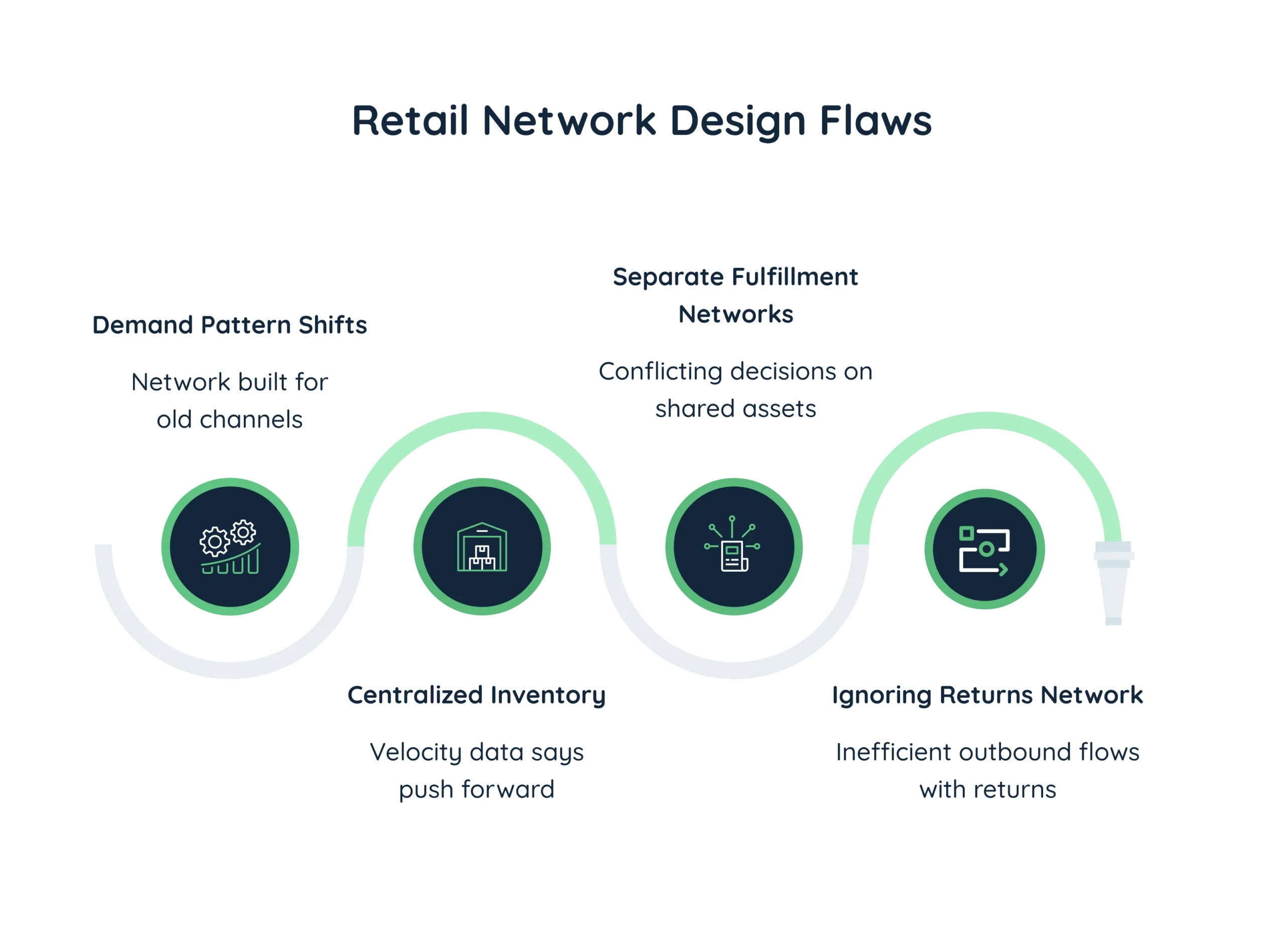
 

1. Treating the DC network as fixed when demand patterns have shifted

Many networks were built for a different channel mix. A DC that worked in 2018 for mostly in store demand will not work the same way in a balanced online and offline model. The cost of this mismatch spreads across fulfilment, last mile delivery, and service levels, so it often goes unnoticed until someone analyzes the full network.

2. Positioning inventory centrally when velocity data says push it forward

Keeping fast moving SKUs at a central DC may look flexible in theory. In reality, it adds one to two days to delivery time and increases last mile cost on every order. That flexibility is rarely used, but the added cost shows up every day. Moving inventory closer to demand often delivers better service and lower cost.

3. Modelling store replenishment and ecommerce fulfilment as separate networks

Retailers often treat store and ecommerce flows as separate systems. But they use the same physical assets. When each is optimized on its own, decisions start to conflict. DC space, labor, and inbound capacity get allocated in ways that may work during low demand but break during peak periods.

4. Ignoring the return network in forward network design

Returns are often treated as an afterthought. A DC that works well for outbound flows may become inefficient once returns are included. Return processing costs, transit time, and restocking effort all impact the real performance of the network. In high return categories, this can even change the best DC location by a large margin.

Omnichannel Network Design: Store, DC, and Dark Store Trade-offs

The most consequential network decision for an omnichannel retailer is how to assign fulfilment responsibility across node types. Moreover, this decision changes by SKU category, region, and season. There is no single right answer. There is a right answer for your specific demand structure.

The three fulfilment node types, and when each one is the right call:

Node Type
Right When
Wrong When
Central DC

Slow moving, high value, or wide SKU range that does not justify regional stocking

Speed sensitive categories where 2 day fulfillment
creates a competitive disadvantage

Regional DC/ forward stocking

Demand density by region justifies the fixed cost, especially for fast moving categories

Demand is too sparse or unpredictable to justify committed regional capacity

Dark stores / urban fulfillment

Grocery and same day categories in dense urban markets

General merchandise with irregular demand where unit economics do not hold outside dense urban
areas

The modelling question most retailers avoid: what is the actual cost of serving a customer from each node type for each SKU category?

Most retailers know their DC network cost in aggregate. Very few know the true cost differential between serving a customer in Leeds from a central DC versus a regional forward stocking location, by SKU category, at different demand densities. That calculation is what network design software exists to answer.

What omnichannel network digital modelling actually requires is the ability to model demand by channel and region simultaneously.

Most legacy tools aggregate demand before optimization. The node placement that results is wrong for at least one channel, and usually both.

What a Supply Chain Network Design for Retail Actually Looks Like in Practice

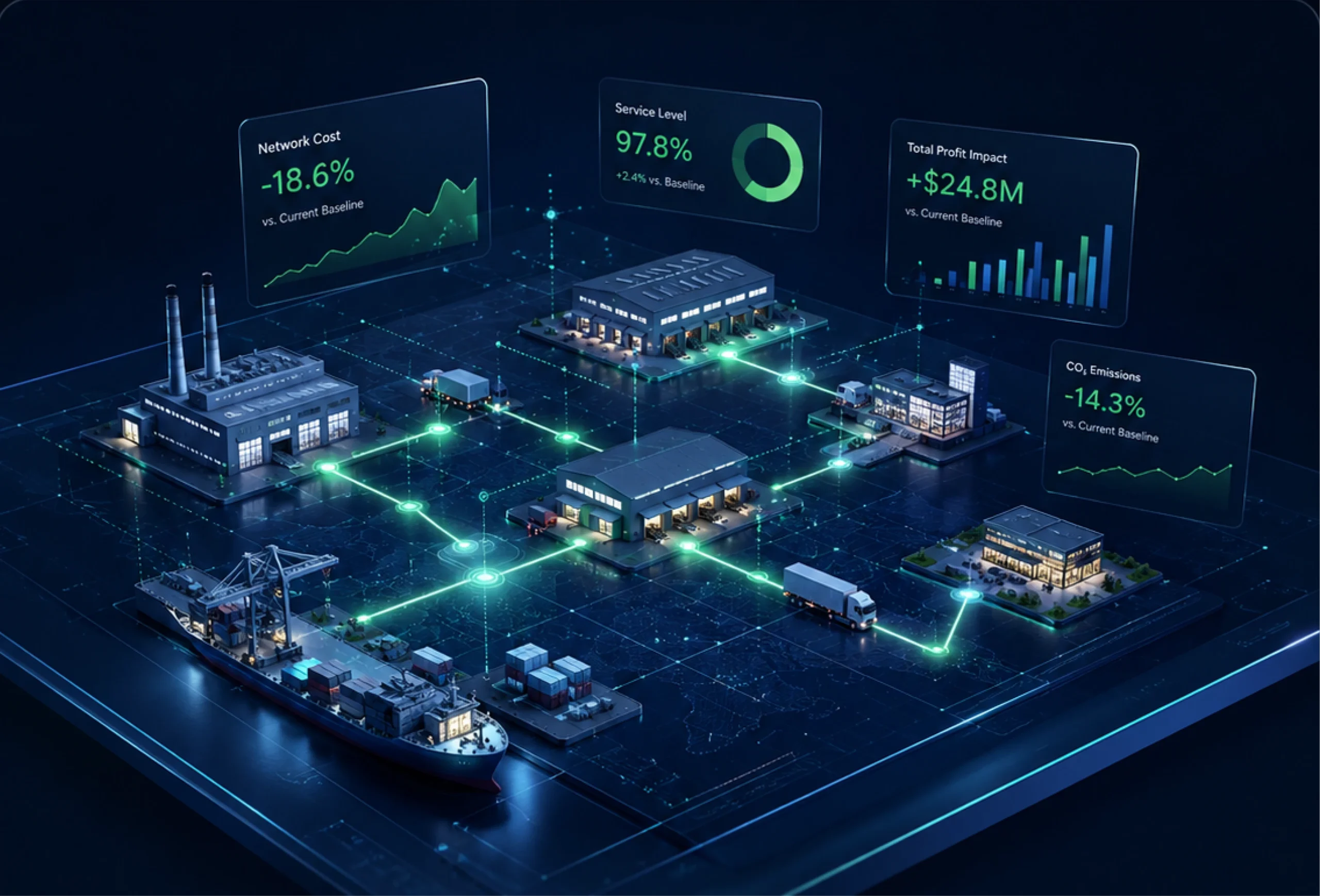
A retail network optimization is a five-stage process. The output is a set of network configuration recommendations with modeled cost, service level, and carbon implications for each.

Sequencing the transition from the current to the recommended network requires a separate operational workstream.

Data consolidation

Pulling actual demand by SKU, channel, and region; current DC costs and utilization; inbound and outbound lead times; and service level performance by node. Most retail networks have this data spread across four or five systems. Cleaning and unifying it typically takes 30 to 50% of the total project time.

Baseline network model

Building a model that reproduces actual costs and service levels from the current network. If the model does not match reality, its output for redesign scenarios is not reliable. Validation against two to three historical periods is standard practice before any redesign work begins.

Scenario modeling

Testing alternative network configurations such as fewer DCs, more forward stocking locations, different channel splitting logic, and alternative carrier strategies. Retailers typically evaluate 20 to 50 scenarios before reaching a recommendation. The value is in understanding the trade-off surface, not just finding the best-looking configuration.

Trade-off analysis

Presenting the efficient frontier: what does each service level improvement cost at each network configuration? What does each cost reduction sacrifice in speed or resilience? The decision is a business decision, not a technical one. The model informs it, not makes it.

Implementation roadmap

Sequencing DC openings, closures, and transitions based on lease commitments, capital availability, and operational risk. This is where most retailers slow down. The network analysis is fast, but the transition plan is slow.

Retailers running this process typically find 8 to 15% logistics cost reduction opportunities and one to two DC consolidation opportunities that were not visible before modeling. The range is wide because it depends heavily on how old the current network design is and how much the channel mix has shifted since it was last reviewed.

What Retail Supply Chain Network Design Software Should Actually Do?

Most supply chain software categories, planning, TMS, WMS, were designed around a single-channel model. Supply chain network design software for retail needs to do something different: model the full demand picture by channel and region, not just aggregate it, and then optimize node placement against that channel-split reality.

Five capabilities that actually matter for retail network design, versus capabilities that sound useful but rarely move the decision:

Channel-split demand modeling

The platform must accept demand inputs by channel and region separately, and model fulfillment from each node type against the correct demand signal. Tools that aggregate demand before optimization produce recommendations that are wrong for at least one channel.

Multi-scenario comparison

Can you run 30 to 50 network configurations simultaneously and compare them on cost, service level, and carbon? Single-scenario tools force you to run analyses sequentially, which means you see far fewer options before making a decision.

Cost-to-serve modeling at node level

What does it actually cost to serve a customer from each DC, store, or dark store, including inbound, outbound, last-mile, and returns? Platforms that model only outbound logistics systematically understate the cost differential between node types.

Promotional and seasonal demand stress-testing

Can the tool run the network model against a promotional demand scenario that is 3x baseline to identify which nodes fail under load? This is where most retail network designs have undetected fragility.

Returns network integration

Reverse logistics flows should be modeled alongside forward flows, not as a separate analysis. The optimal forward network and the optimal reverse network are not always the same network. Understanding the gap is a design input, not an afterthought.

One thing to watch for: tools that optimize the DC network in isolation without modeling last-mile cost will reliably recommend fewer, larger DCs.

That’s often the wrong answer for retail, particularly for speed-sensitive or high-return categories, but it’s the answer you’ll get from any tool that treats last-mile as someone else’s problem.

For a full comparison of platforms that handle retail specific network complexity including channel split modelling, scenario comparison, and cost to serve analysis, see our guide to 5 best supply chain network design software.

How to Evaluate Whether Your Current Network Needs Redesigning?

Most retail network redesigns are triggered by a crisis such as a lease expiry, a capacity failure during peak, or a cost overrun that finally gets someone’s attention. They are rarely triggered by proactive modeling. Companies that redesign proactively often find the opportunity was larger than the crisis that would have forced the decision later.

Five signals that your retail supply chain network has outgrown its current design:

  • Ecommerce has grown your channel mix by more than 20% points since the network was last reviewed. The physical asset base is no longer aligned with your actual demand split.
  • You are running promotional peaks by borrowing capacity from store replenishment. This is a structural signal, not an operational one. It means the network cannot serve both channels at peak.
  • Last-mile cost per order is increasing despite volume growth. Normally, volume growth should reduce cost through consolidation. Rising cost with rising volume means the forward stocking locations are misaligned.
  • Regional service level variance is consistently high with no clear demand explanation. When performance differences persist without demand differences, the issue is usually network positioning.
  • DC decisions are being made reactively due to lease expiry, capacity crisis, or cost pressure rather than based on modeled demand. Reactive decisions are made under time pressure and rarely produce an optimal network.

Conclusion

Retail supply chains are being asked to do something they were never designed for: serve multiple channels, at different speeds, from the same physical infrastructure, without the cost showing up in a way that is easy to trace. The reason most retailers struggle with this is not execution. It is network design. The network was built for a business that no longer exists.

The good news is that the modeling tools to fix this have improved significantly.

For retailers that have experienced meaningful channel mix shifts in the last three to four years, that analysis almost always finds an opportunity. The question is whether you find it before a capacity crisis forces the issue, or after.

If your network was last reviewed before your ecommerce share crossed 20%, or if you are running peaks by borrowing from store replenishment, it is worth understanding what the right network looks like for your current business, not the one you had in 2019.

See what your retail network could look like

Sophus models omnichannel retail networks with channel split demand, cost to serve by node, and scenario comparison across DC configurations so you know exactly where cost and service opportunities exist before making a network decision.

Supply chain design information and tips from Sophus

Delivered straight to your inbox.

Author

Byron Song
Byron Song has over a decade of experience in supply chain network design and optimization, working with manufacturers, retailers, and 3PLs worldwide. At Sophus.ai, he leads the development of AI-powered tools that help organizations design, simulate, and optimize logistics networks faster and with greater accuracy. His work has enabled clients to cut network-design lead times by 50% and achieve double-digit cost reductions through smarter scenario planning.

Supply chain design information and tips from Sophus

Delivered straight to your inbox.

Recent posts