
When economies shake, supply chains are the first to feel the impact. From unexpected tariffs and interest rate swings to full-blown geopolitical conflicts, supply chain disruptions test operations fast.
Supply chains today must respond quickly to demand shocks, supplier interruptions, and rising input costs without missing a beat.
This is why resilience, flexibility, and proactive risk management are essential. A supply chain designed solely for cost efficiency will struggle when supply chain issues today escalate. In contrast, a supply chain built with optional pathways, contingency planning, and diversified sourcing can absorb shocks.
Supply chain network design is critical for tackling these challenges. Done well, it transforms uncertainty into data-backed strategy, making organizations more agile, resilient, and cost-aware. According to NCBI, integrating network design principles is now essential for mitigating supply chain issues today and building resilience in a world where volatility is the rule, not the exception.
Understanding Supply Chain Disruptions: Key Issues Businesses Face Today
Supply chains today are facing unprecedented challenges. From sudden demand crashes to sharp spikes, global supply chain disruptions are testing operations worldwide, and companies are feeling the impact.
Market Volatility
The days of predictable demand patterns are gone. Businesses face wild swings in consumer behavior, making it hard to balance cost-effectiveness with service levels. One month, your warehouse sits like a museum; the next, your logistics teams can’t breathe.
These fluctuations strain network design—forcing supply planners to constantly toggle between lean operations and robust capacity. Add rising tariffs and unstable raw material pricing to the mix, and optimization becomes the only viable path forward.
Geopolitical Risks
Tariffs, sanctions, and border delays aren’t footnotes—they’re central plot points. The Ukraine conflict, China-U.S. tensions, and regional unrest continue to throw up supply roadblocks.
The result? Limited supplier access, increased lead times, and the real risk of single-source dependencies morphing into business continuity nightmares. To keep freight moving and factories humming, companies need a redefined strategy—one that includes diversified supplier bases and dynamic sourcing models.
As noted in this analysis from the National Center for Biotechnology Information, global risks are waking corporations up to the need for resilient network design, not just efficient one-lane supply chains (NCBI).
Sustainability Pressures
It’s no longer a “nice-to-have.” ESG regulations and carbon-reduction goals are actively reshaping how supply networks are built. But here’s the catch—going green often means added complexity.
Renewable packaging, electric fleets, and regional warehousing all affect cost, speed, and scalability. At the same time, companies are expected to maintain resilience in the face of storms, floods, and fires literally. The challenge is clear: how do you keep operations lean while aligning with both climate goals and resilience requirements?
The short answer: smart design, smarter trade-offs.
Proven Strategies for Tackling Supply Chain Issues Today
When uncertainty is the norm, reaction time becomes your worst enemy. Building supply chain resilience starts with one uncomfortable truth: you can’t plan for everything, but you can be ready for anything.
1. Build a Digital Twin of Your Supply Chain
Most supply chain issues today escalate because teams lack a clear, end-to-end view of their network. A supply chain digital twin solves this by creating a virtual replica of your supply chain, allowing you to test decisions before executing them in the real world.
With this approach, companies can simulate supplier failures, demand spikes, or transportation delays and immediately see the impact on cost and service. Instead of reacting after damage is done, they can act early with confidence.
2. Move from Static Plans to Scenario Planning
Static plans fail the moment conditions change. Today’s supply chains require continuous scenario testing to stay resilient.
With a proper scenario planning of their supply chain operations, businesses can evaluate different outcomes before making a move. This allows them to compare trade-offs across cost, service, and risk instead of relying on assumptions.
In practice, companies using advanced modeling platforms have reduced planning cycles from months to days by running scenarios in parallel and selecting the best option quickly. This shift alone can significantly reduce disruption impact.
3. Replace Rigid Rules with Flexible Constraints
Traditional supply chain models often fail because they rely on strict, all-or-nothing rules. If one condition cannot be met, the entire model breaks.
A more effective approach is to use flexible constraints with defined penalties. This allows the system to find the best possible solution even when ideal conditions are not achievable.
For instance, instead of failing due to a 100% service requirement, the system can recommend a slightly lower service level while clearly showing the trade-offs. This keeps decision-making moving, even during disruption.
4. Optimize Inventory Across the Entire Network
Inventory decisions made in isolation often lead to excess stock in one location and shortages in another.
A network-wide approach, such as multi-echelon inventory optimization, ensures inventory is placed where it delivers the most value. It balances service levels with working capital and demand variability.
Within a large food distribution network, Sophus identified $20 million in untapped savings by reviewing how inventory was allocated across multiple distribution centers. MEIO highlighted areas of duplicated safety stock and mismanaged service buffers. By redistributing inventory across tiers, the company minimized excess stock while sustaining service levels in high-demand locations.
5. Improve Decision Speed Across the Organization
The biggest hidden risk in supply chains is slow decision-making. Even the best strategy fails if it takes too long to act. In many organizations, teams still rely on multiple disconnected tools, which creates delays in data gathering, analysis, and alignment. This leads to decision cycles that take weeks or even months.
Modern platforms solve this by bringing data, modeling, and decision-making into a single environment. Companies that adopt this approach move from insight to action in days instead of months, reducing the impact of disruptions significantly.
6. Integrate Planning Across Functions
Global supply chain disruptions do not stay confined to one function. A delay in supply affects inventory, production, transportation, and customer service at the same time. However, many organizations still plan these areas separately, which leads to conflicting decisions.
A unified planning approach connects all functions within a single model. This ensures that decisions made in one area support the overall network instead of creating new bottlenecks.
For example, companies using integrated platforms have been able to align production, distribution, and inventory decisions simultaneously, leading to better service levels and lower costs.
Implementing Supply Chain Network Design to Support These Strategies
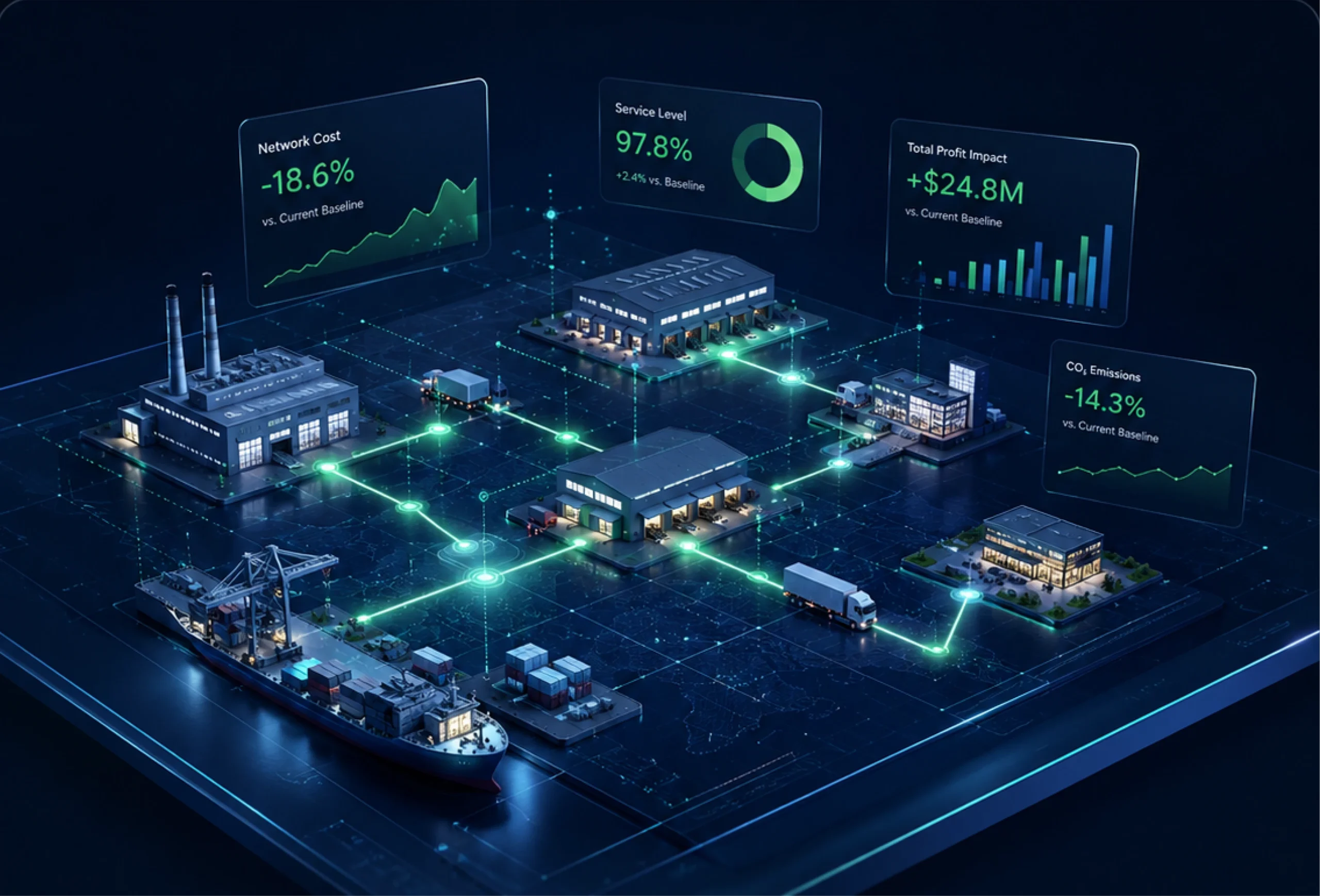
Dynamic supply chain network design is how leaders get ahead of volatility. Traditional supply chain network design models can’t keep pace with today’s disruption cycles. With modern data pipelines and ETL capabilities, networks can now be updated in near real-time. This means your decision-making is no longer based on outdated snapshots but live analytical views. It also unlocks advanced disruption analytics, allowing quick shifts in sourcing paths, transport lanes, or inventory routes—all before an impact cascades through your operations.
Scenario planning used to be a theoretical exercise. Not anymore. With a robust supply chain network model, businesses can simulate both known and unknown risks. Think short-term knowns—like an approaching hurricane. A dynamic model should tell you exactly which sites will be affected and what actions will minimize hits to cost and service levels. For long-term unknowns, it’s about building optionality. You can’t predict every shock, but you can design a network that flexes with uncertainty baked in.
Still, there’s a cost to resilience and this is where network design earns its keep. It’s not just about adding suppliers; it’s about selecting the right ones in the right regions with built-in contingencies. According to a recent study, agile supply chain network design enables adaptability without ballooning operational budgets (AIMS Sciences). Ultimately, it’s a balancing act: minimize risk while keeping costs lean. The endgame?
A network that doesn’t just survive chaos but thrives in it.
Tools for Optimizing Supply Chain Network Design
Resilience does not come from guesswork. It comes from data, visibility, and the ability to act quickly. Modern supply chains are too complex for manual planning or disconnected tools. Companies now need platforms that bring data, modeling, and decision-making into one place so teams can respond faster and with confidence.
Solutions like Sophus X are built to handle the complex supply chain issues today. Instead of relying on fragmented systems, the platform brings multiple supply chain capabilities into a single cloud-native environment. This allows teams to move from slow, reactive planning to fast, data-driven decision-making.
What makes Sophus effective for network design and disruption management:
1. Faster optimization at scale
Built using the Julia programming language, Sophus solves complex models 5 to 20 times faster than traditional tools. This speed allows teams to run more scenarios and make decisions in days instead of months.
2. End-to-end network design in one platform
The platform supports network configuration, inventory planning, production, and transportation decisions together. This removes the need to switch between tools and ensures all decisions are aligned.
3. Advanced inventory optimization (MEIO)
Sophus determines the right safety stock levels across the entire network. It places inventory where it delivers the most value while balancing cost and service levels.
4. Flexible modeling with soft constraints
Instead of failing when strict rules cannot be met, Sophus uses soft constraints with penalty logic. This allows the model to adjust and still provide the best possible solution while clearly showing trade-offs and bottlenecks.
5. Cost-to-serve visibility across the network
The Network Path capability provides detailed cost breakdowns across multi-echelon flows and bills of materials. This helps teams understand true profitability and make better trade-offs during disruptions.
6. Built-in data automation with Dastro
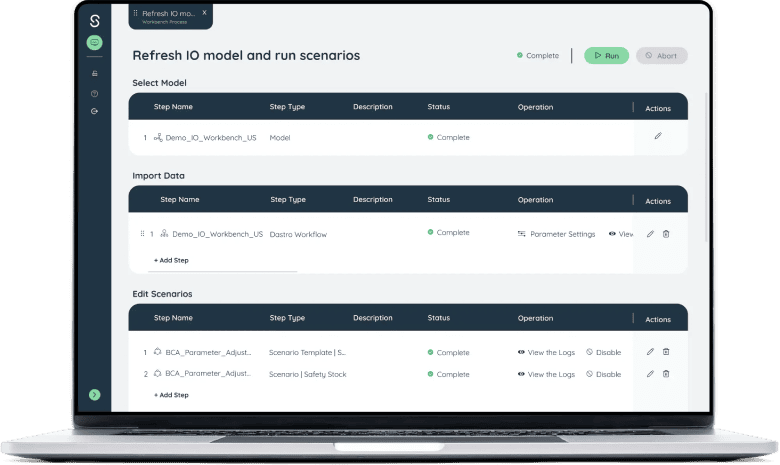
Sophus includes an embedded ETL tool that automates data preparation and workflow creation. This reduces manual effort and ensures clean, reliable inputs for modeling.
7. Rapid baselining for faster insights
Teams can quickly build a digital model of their current supply chain and start testing scenarios without long setup times. This accelerates time to value.
8. Interactive scenario testing
Users can adjust parameters directly within the model and visualize the impact on a supply chain map. This makes it easier to explore options and align decisions across teams.
With these capabilities, companies move from reacting to disruptions after they happen to planning for them in advance. The focus shifts from firefighting to controlled, informed decision-making. In an environment where uncertainty is constant, this level of agility becomes essential for maintaining both service levels and profitability.
Turning Global supply Chain Disruptions into a Competitive Advantage With Sophus
Supply chain disruptions are no longer rare events. They are happening more often and with greater impact.
This shift means businesses need systems that help them understand what is happening, test different responses, and act quickly with confidence. The goal is not just to survive disruptions, but to stay in control when they happen.
By focusing on supply chain network design and optimization, companies can build networks that adjust to change instead of breaking under pressure. They can evaluate trade-offs, protect service levels, and maintain profitability even during uncertainty.
Sophus make this possible by bringing data, modeling, and decision-making into one place, so teams can move faster and make better decisions.
If your team is still struggling to respond to disruptions with speed and clarity, it may be time to rethink your approach. Book a call with Sophus to see how you can build a more resilient and adaptable supply chain network.