

Supply chain network optimization software helps logistics and supply chain companies keep complex operations running smoothly. With many moving parts, choosing the right model can be a game changer.
About 45% of supply chain professionals already use these tools for supply chain optimization, and many more plan to adopt them in the next two years.
We’ve explored the market to bring you the seven best network optimization software tools designed to simplify, optimize, and transform your supply chain network. These tools are not just about keeping things moving; they’re about moving smarter, faster, and more efficiently.
Whether you’re looking to cut costs, boost efficiency, or just get a better overview of your operations, these tools are your ticket to a streamlined supply chain.
See also
Looking specifically for network design software?
See our 5 best supply chain network design software picks →
Supply Chain Network Optimization Explained
Supply chain network optimization is the process of finding the best setup for your suppliers, warehouses, and distribution network using data and mathematical models. It helps companies reduce costs while still meeting service and sustainability goals. Instead of relying on guesswork or spreadsheets, it uses advanced solvers to test many scenarios and identify the most efficient network structure.
Companies use it to answer key questions like how many warehouses they need, where to place them, which plants should serve specific markets, and how the network will react to disruptions like losing a supplier.
Comparison Table: 7 Best Tool for Network Optimization at a Glance
Here is a quick comparison of the most popular supply chain network optimization tools so you can understand their strengths and choose the right platform.
TOOL

Sophus X
BEST FOR
Companies wanting a single end-to-end platform for network design, inventory, S&OP & transportation optimization
KEY STRENGHTS
• Complete optimization suite
• Fast scenario modelling
• AI-driven & user-friendly
• Cloud & on-premise support
WHY SOPHUS WINS
Companies wanting a single end-to-end platform for network design, inventory, S&OP & transportation optimization
TOOL
Coupa Supply Chain Design
BEST FOR
Large corporations already using the Coupa ecosystem
KEY STRENGHTS
• Complete optimization suite
• Fast scenario modelling
• Desktop application & cloud
WHY SOPHUS WINS
Sophus offers more modern optimization, greater flexibility & end-to-end scope
TOOL
BEST FOR
Companies wanting a cloud end-to-end platform for network design
KEY STRENGHTS
• Flexible, Python-based modelling
• Cloud native
WHY SOPHUS WINS
Sophus delivers speed + usability without needing deep coding skills
TOOL

AIMMS SC Navigator
BEST FOR
Analysts who prefer customizable modelling environments
KEY STRENGHTS
• Powerful scenario modelling
• Highly adaptable
WHY SOPHUS WINS
Sophus is easier to use for business users, faster to implement & more intuitive
TOOL
BEST FOR
Logistics-heavy operations focused on transport & forecasting
KEY STRENGHTS
• Strong analytics
• Demand forecasting & routing
WHY SOPHUS WINS
Sophus covers full network + inventory + planning in one unified system
TOOL
Supply Chain 360
BEST FOR
Companies needing operational SCM visibility
KEY STRENGHTS
• ERP integration
• Unified operational visibility
WHY SOPHUS WINS
Sophus delivers strategic + tactical + operational optimization in one platform
TOOL
BEST FOR
Businesses focused primarily on inventory planning
KEY STRENGHTS
• AI-driven inventory forecasting
• Stock optimisation
WHY SOPHUS WINS
Sophus includes inventory + network + scenario planning in one complete tool
TOOL
BEST FOR
KEY STRENGHTS
WHY SOPHUS WINS
Sophus X
Companies wanting a single end-to-end platform for network design, inventory, S&OP & transportation optimization
• Complete optimization suite
• Fast scenario modelling
• AI-driven & user-friendly
• Cloud & on-premise support
Most comprehensive + modern architecture with fastest time-to-value
Coupa Supply Chain Design
Large corporations already using the Coupa ecosystem
• Complete optimization suite
• Fast scenario modelling
• Desktop application & cloud
Sophus offers more modern optimization, greater flexibility & end-to-end scope
Companies wanting a cloud end-to-end platform for network design
• Flexible, Python-based modelling
• Cloud native
Sophus delivers speed + usability without needing deep coding skills
AIMMS SC Navigator
Analysts who prefer customizable modelling environments
• Powerful scenario modelling
• Highly adaptable
Sophus is easier to use for business users, faster to implement & more intuitive
Logistics-heavy operations focused on transport & forecasting
• Strong analytics
• Demand forecasting & routing
Sophus covers full network + inventory + planning in one unified system
Supply Chain 360
Companies needing operational SCM visibility
• ERP integration
• Unified operational visibility
Sophus delivers strategic + tactical + operational optimization in one platform
Businesses focused primarily on inventory planning
• AI-driven inventory forecasting
• Stock optimisation
Sophus includes inventory + network + scenario planning in one complete tool
1. Sophus X
Sophus X emerges as one of the best supply chain network optimization tools, engineered to meet the complex demands of modern global supply chains. Its development leverages cutting-edge mathematical languages and database technologies, ensuring businesses can navigate the complexities of supply chain management with unparalleled precision and efficiency.
WHY SOPHUS X LEADS ON NETWORK OPTIMIZATION
- Quantum-inspired solver: up to 20× faster than traditional optimization engines, delivering answers in hours instead of weeks without sacrificing solution quality.
- Transparent, explainable AI: every recommendation is traceable back to its inputs and business rules. No black-box outputs, no dependency on a consultant to interpret results.
- Works with imperfect data: most tools require months of data preparation. Sophus X is designed to start modeling from raw, incomplete transactional data from day one.
48 hrs
TIME TO MODEL
From raw data to fully costed network model
Most supply chain modeling projects take 3–6 months before the first scenario runs. Sophus X's rapid baselining engine gets you to a working, fully costed current-state network in 48 hours. Decisions happen in days, not quarters.
Key Features
INTEGRATED BUSINESS PLANNING
- Annual Budget Planning: Streamlines financial forecasting and aligns it with operational strategies.
- Long-Term Capacity Planning: Ensures infrastructure and resources meet future demand.
- Integrated S&OP: Merges sales forecasts with production planning for balance.
- Distribution Planning: Optimizes the flow of goods to meet customer demands efficiently.
- Sourcing Plan: Develop strategies for procuring goods and services effectively.
INVENTORY PLANNING & MANAGEMENT
- Multi-Echelon Inventory Planning: Optimizes inventory across various levels in the supply chain.
- Aftermarket Spare Parts: Balances stock levels for spare parts to meet service commitments.
- Shelf-Life Simulation:Manages and optimizes products’ shelf life across the supply chain
- Raw Material Optimization:Ensures optimal levels of raw materials and intermediate goods.
- Replenishment Planning: Strategizes inventory replenishment to avoid stockouts and overstocks.
SUPPLY CHAIN NETWORK DESIGN
- Site Selection: Identifies optimal locations for facilities based on various factors.
- Distribution Network Design:Plans the structure of the distribution network to enhance efficiency.
- Omni-Channel Network Design: Designs supply chains that integrate multiple sales channels.
- Supply Chain M&A Integration: Harmonizes supply chains of merged or acquired entities.
- Aftermarket Spare Parts Network Design: Creates efficient networks for distributing spare parts.
OPERATIONS & SUSTAINABILITY
- Transportation Routes Planning: Identifies the most efficient and cost-effective transportation routes.
- Order-Shipment Assignment: Aligns orders with the best shipping options to maximise efficiency.
- GHG Emission Modeling: Assesses the carbon footprint of supply chain activities.
- GHG Emission Optimization: Identifies strategies to reduce greenhouse gas emissions throughout the supply chain.
Why Sophus X
Sophus is a leading choice in supply chain network optimization because it combines speed, flexibility, and ease of use in one platform.
Built on Julia, it solves complex models much faster than many older tools, while its cloud-native design helps teams scale without added friction. It also stands out for its soft constraint logic, which helps models find workable answers instead of failing when rules conflict.
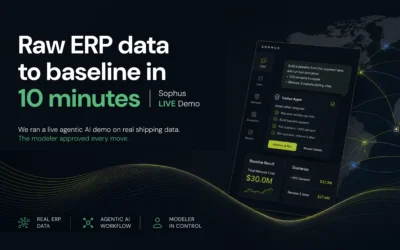
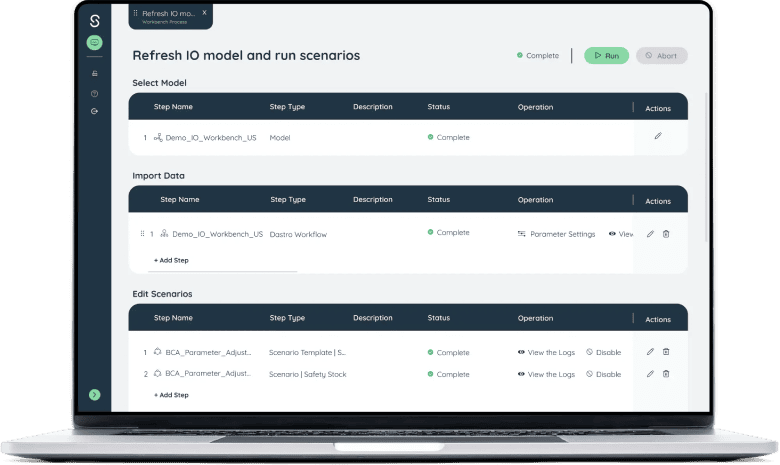
On top of that, Sophus brings data automation, rapid baselining, conversational AI, and advanced capabilities like network design, inventory optimization, and cost-to-serve analysis into one connected system.
Ready to turn cost insight into measurable profit?
Book a Sophus demo and see how fast you can move from analysis to action.
2. Coupa Supply Chain Design
Coupa Supply Chain Design is a network optimization platform built for large enterprises already using the Coupa procurement ecosystem. It connects supply chain modeling with financial and sourcing workflows, making it a practical choice for teams that want tighter alignment between procurement decisions and network design.
That said, its solver technology is built on older foundations. When exploring Coupa alternatives, this is often where the differences become more noticeable, especially against newer platforms built with modern optimization architectures.
Best for: Large corporations already embedded in the Coupa ecosystem who want network design connected to procurement and financial workflows.
Key strengths:
- Covers greenfield optimization, network design, inventory optimization, and transportation optimization within one ecosystem
- Unified spend management connects procurement, invoicing, and expense data to network decisions
- Available in both desktop and cloud formats for organizations with existing on-premise infrastructure
Limitations to know:
- Solver speed lags behind purpose-built supply chain network design and optimisation platforms built on modern optimization engines
- Best value only if you’re already a Coupa procurement customer, weak ROI as a standalone evaluation
- Less flexible for complex multi-echelon inventory optimization scenarios that require advanced solver configuration
- Higher price point limits accessibility for mid-market teams
Quick Pick — Coupa vs. Sophus X
CHOOSE COUPA IF…
✓ You are already a Coupa procurement customer
✓ Your focus is linking network design with sourcing and spend workflows
✓ You have a large IT team and long implementation timelines
✓ You are comfortable with ecosystem lock-in
CHOOSE SOPHUS X IF…
✓ You need faster solver performance and modern optimization architecture
✓ You want end-to-end planning in one platform
✓ You need results in weeks, not months
✓ You want flexible deployment without lock-in
3. Optilogic
Optilogic is a cloud-native supply chain optimization platform built on Python, designed for teams that want developer-level flexibility in their modeling environment. It supports network design, inventory optimization, and transportation modeling, but relies on a code-heavy interface that often requires strong technical expertise.
For teams evaluating Optilogic competitors, the key trade-off usually comes down to flexibility versus usability, especially when compared with platforms that offer faster deployment and more intuitive interfaces.
Best for: Technical teams and analysts who are comfortable writing Python to build and maintain custom optimization models, and who prioritize flexibility over speed-to-first-result.
Key strengths:
- Highly flexible Python-based modeling — users can build custom optimization logic tailored to unique business constraints
- Cloud-native infrastructure with scalable architecture and no on-premise hardware requirement
- Covers the core supply chain network design use cases: greenfield analysis, network optimization, inventory, transportation, and simulation
Limitations to know:
- Python dependency means most business users can’t self-serve — a technical resource needs to build and maintain every model
- Performance speed is constrained by Python’s execution overhead compared to compiled solver engines
- Longer time-to-first-model than no-code platforms, which matters when decisions need to move fast
- Limited no-code scenario planning for supply chain managers who don’t have a coding background
Quick Pick — Optilogic vs. Sophus X
CHOOSE OPTILOGIC IF…
✓ You run network studies once in a while
✓ Your models are smaller and easier to solve
✓ You only need basic network modeling and simulation
✓ Your team prefers working with code
CHOOSE SOPHUS X IF…
✓ You want to plan often, not just once
✓ You need fast solves, even with large models
✓ You want everything in one place (network, inventory, transport)
✓ You need results quickly, not after long setup
✓ You want to scale without extra cost or tech burden
4. AIMMS SC Navigator
AIMMS SC Navigator is a supply chain optimization platform built for analysts and modelers who need a high level of control over their models. It uses a low-code approach with SQL-based data handling. This makes it a strong fit for teams working on complex or highly customized supply chain scenarios.
However, that level of flexibility often comes with added setup effort and longer implementation time.
When considering AIMMS alternatives, this is where the differences start to show, especially with newer platforms that focus on faster deployment, easier usability, and more streamlined optimization workflows.
Best for: Analysts and operations research teams who need a customizable modeling environment for complex mathematical optimization challenges and are willing to invest significant time in model configuration.
Key strengths:
- SC Navigator lets teams visualize and test supply chain scenarios, assess strategic decision impacts, and model resilience across different network configurations
- Low-code platform makes it more accessible than fully coded environments like Optilogic — though business users will still find it complex
- Supports greenfield optimization and basic multi-echelon inventory optimization with manual configuration options
Limitations to know:
- Steeper implementation curve than business-user-friendly platforms — expect a long setup phase before running your first model
- Manual seeding for greenfield optimization adds significant time to modeling cycles
- Higher price point limits mid-market accessibility
- Less intuitive for supply chain managers without a modeling background — decisions often depend on the analyst, not the planner
Quick Pick — AIMMS vs. Sophus X
CHOOSE AIMMS IF…
✓ You build and manage custom solver logic
✓ You have in-house optimization experts
✓ Network design is not your main focus
CHOOSE SOPHUS X IF…
✓ Network design and re-planning are core to your operations
✓ You want automation instead of manual model setup
✓ You need teams beyond specialists to use the platform
✓ You want faster results with lower long-term effort
5.Logistics Pro
Logistics Pro is an analytics-driven platform focused primarily on logistics operations. It uses big data analytics and machine learning to surface insights for day-to-day operational decisions across distribution and last-mile delivery networks.
Best for: Logistics-heavy operations focused on transport efficiency and demand forecasting at an operational level particularly companies without a need for strategic network design.
Key strengths:
- Advanced demand forecasting algorithms to help teams adjust inventory and production plans — a key input for effective safety stock optimization
- Transportation route recommendations to reduce costs and improve delivery times, complementing broader transportation optimization in supply chain design
- Machine learning models that surface actionable operational insights for distribution managers
- Scalable architecture designed to handle growing data volumes as operations expand
Limitations to know:
- Does not cover strategic supply chain network design and optimisation — no greenfield analysis, footprint optimization, or network redesign capability
- No integrated S&OP or financial planning — decisions are siloed from broader business planning
- Limited scenario modeling depth for multi-echelon or multi-facility strategic decisions
- A point solution, not an end-to-end platform — you’ll need separate tools for every other supply chain function
Quick Pick — Logistics Pro
Choose Logistics Pro if your focus is on daily logistics tasks like routing, forecasting, and distribution visibility, and your network design is handled separately.
To see how these tools fit into a broader supply chain strategy, explore See the full Sophus X vs. AIMMS breakdown →
6. Supply Chain 360
Supply Chain 360 is a cloud-based platform that focuses on visibility and ERP integration. It brings data from different systems into one place, so teams can track inventory, supplier performance, and daily operations from a single dashboard.
It works well for monitoring, but it is not built for optimization. You cannot use it to redesign your network, run scenario planning, or test major supply chain decisions. For those needs, teams usually look at broader supply chain strategy and optimization tools.
Best for: Companies needing operational supply chain visibility and ERP integration — particularly those focused on execution monitoring rather than strategic network planning.
Key strengths:
- Seamless ERP integration provides a unified view across procurement, inventory, and distribution
- Advanced inventory algorithms to reduce excess stock and prevent out-of-stocks at the operational level
- Real-time supplier collaboration tools for improving lead time reliability
- Fully cloud-native with customizable dashboards for supply chain managers and executives
Limitations to know:
- Not a network optimization tool — does not support supply chain network redesign, scenario planning, or solver-based optimization
- Insights are descriptive, not prescriptive — it shows you what’s happening, not what you should change
- No footprint optimization or strategic modeling for multi-echelon or multi-facility decisions
- Better suited for operational monitoring than the kind of strategic decisions that drive long-term cost reduction
Quick Pick — Supply Chain 360
Choose Supply Chain 360 if your main need is visibility and ERP-linked reporting across daily operations. But if you also need to design your network, lower total costs, or run scenario planning for growth and disruptions, you will need a more advanced optimization tool like Sophus.
7. Inventory IQ
Inventory IQ is an AI-powered tool for inventory optimization. It uses machine learning to forecast demand and automate replenishment, making it a strong fit for teams focused on managing stock levels.
But inventory is only one part of the bigger picture. It does not cover network design or broader supply chain planning, where decisions like warehouse locations and distribution strategy come into play.
Best for: Businesses focused primarily on inventory planning and replenishment — particularly those with large SKU counts, high demand variability, or complex aftermarket spare parts requirements.
Key strengths:
- AI-driven demand forecasting prevents overstocking and stockouts — a critical input for effective safety stock optimization and service level management
- Automated replenishment generates orders based on forecasted demand, current stock, and lead times — covering the same function as Sophus’s broader replenishment optimization capability
- Inventory health analytics identifies slow-moving items, excess stock, and at-risk SKUs with recommended actions
- Integrates with ERP and SCM systems for a connected view of inventory within existing operations
- Handles growing SKU complexity across spare parts inventory optimization and aftermarket networks
Limitations to know:
- Inventory-only scope — no network design, greenfield analysis, or supply chain footprint optimization
- No strategic scenario planning, S&OP, or multi-facility network modeling
- Does not address the network layer — where warehouses sit, how many DCs you need, or which suppliers to use
- A point solution that requires separate tools for every other supply chain function, increasing total cost and complexity
Quick Pick — Inventory IQ
Choose Inventory IQ if your main focus is demand forecasting and replenishment and your network design is already handled. But if you want inventory planning as part of a complete end to end supply chain platform that also covers network design, scenario planning, and S&OP in one place, Sophus X is a better fit.
What to Look for When Choosing Supply Chain Network Design Tools
Choosing the right tool can directly impact cost, service levels, and decision speed. Focus on these key areas:
1. Data Integration
Your tool should connect easily with systems like ERP, WMS, and CRM. It should handle different data formats and support regular updates so your model reflects real operations.
2. Modeling Capabilities
Look for flexibility to model your network as it is. The tool should handle complex supply chains and allow you to adjust constraints and scenarios as needed.
3. Optimization Power
Strong algorithms are essential. The platform should solve large problems quickly and align with your goals like reducing cost or improving service.
4. Scenario Analysis
You should be able to test what-if scenarios like demand changes or disruptions. This helps you plan better and reduce risk.
5. Visualization and Reporting
Clear dashboards, maps, and reports make results easier to understand and share. Interactive tools help teams explore insights faster.
6. Ease of Use and Support
The platform should be simple to use, even for non-technical users. Good support, guides, and documentation are important for smooth adoption.
7. Data Security and Deployment
Look for strong security standards like ISO27001. Also consider if you need cloud, on-premise, or hybrid deployment based on your data needs.
Conclusion: Elevating Supply Chain Network Optimization with Sophus
Modern supply chains need more than basic tools. They need speed, flexibility, and clear decision-making. While many options exist, Sophus stands out as a complete platform for network design, inventory planning, and optimization.
It helps businesses simplify complexity, run better scenarios, and make faster decisions. If you are looking to improve how your supply chain operates, book a Demo with Sophus and explore next steps.