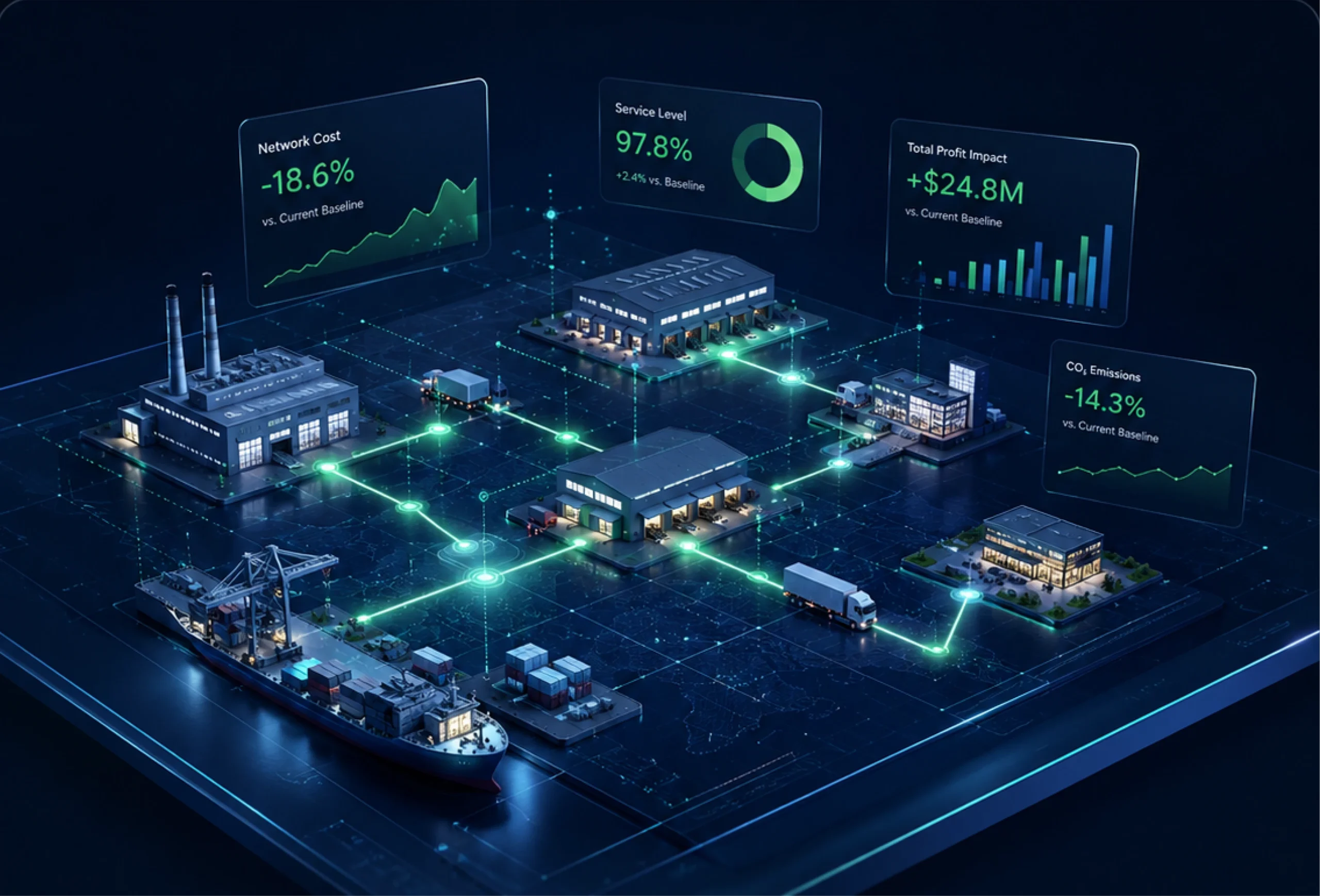

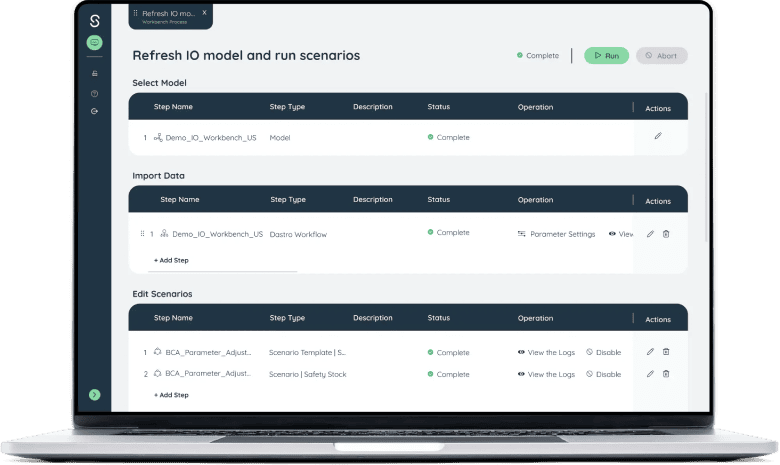

Most supply chain networks were not designed for flexibility. They were built for efficiency under stable conditions. When those conditions change, which they are doing faster in 2026, rigid networks add cost, delay decisions, and struggle to respond in time.
Many teams treat supply chain network design and optimization is a one-time project, but it’s a continuous capability. Companies that manage supply chain disruptions well do not react after the fact. They build networks that can model change, test responses, and adapt before the impact reaches the P&L.
This guide outlines the seven steps to build a flexible supply chain network. It also connects these steps to proven supply chain best practices, including what flexibility means structurally, what it requires technically, and where most design efforts fail to deliver results.
What a Flexible Supply Chain Network Actually Means
Flexibility in supply chain network design is about being able to model the cost and service implications of those options quickly enough to act on them.
A rigid network has rules that break when conditions change. A flexible network has constraints that adjust. The difference is structural.
When a supplier fails, a tariff shifts, or demand spikes in an unexpected region, a rigid model produces infeasible results or requires weeks of manual rework. A flexible model reruns the scenario in hours and surfaces the best available response.
The core features that define a genuinely flexible supply chain network design:
- Adaptable Constraints: Ability to adjust rules instead of breaking when conditions change.
- Scenario Testing: Test different network setups before making real decisions.
- End-to-End Visibility: Clear view across the each echelon of the supply chain
- Scalable Network Design: Support growth in SKUs, locations, and demand complexity.
- Resilience to Disruptions: Ability to adjust quickly when risks or disruptions occur.
Seven Steps to Build a Flexible Supply Chain Network
Moving from a rigid, static model to a flexible, data driven network requires a structured approach. These seven steps address the most common points of failure in sequence.
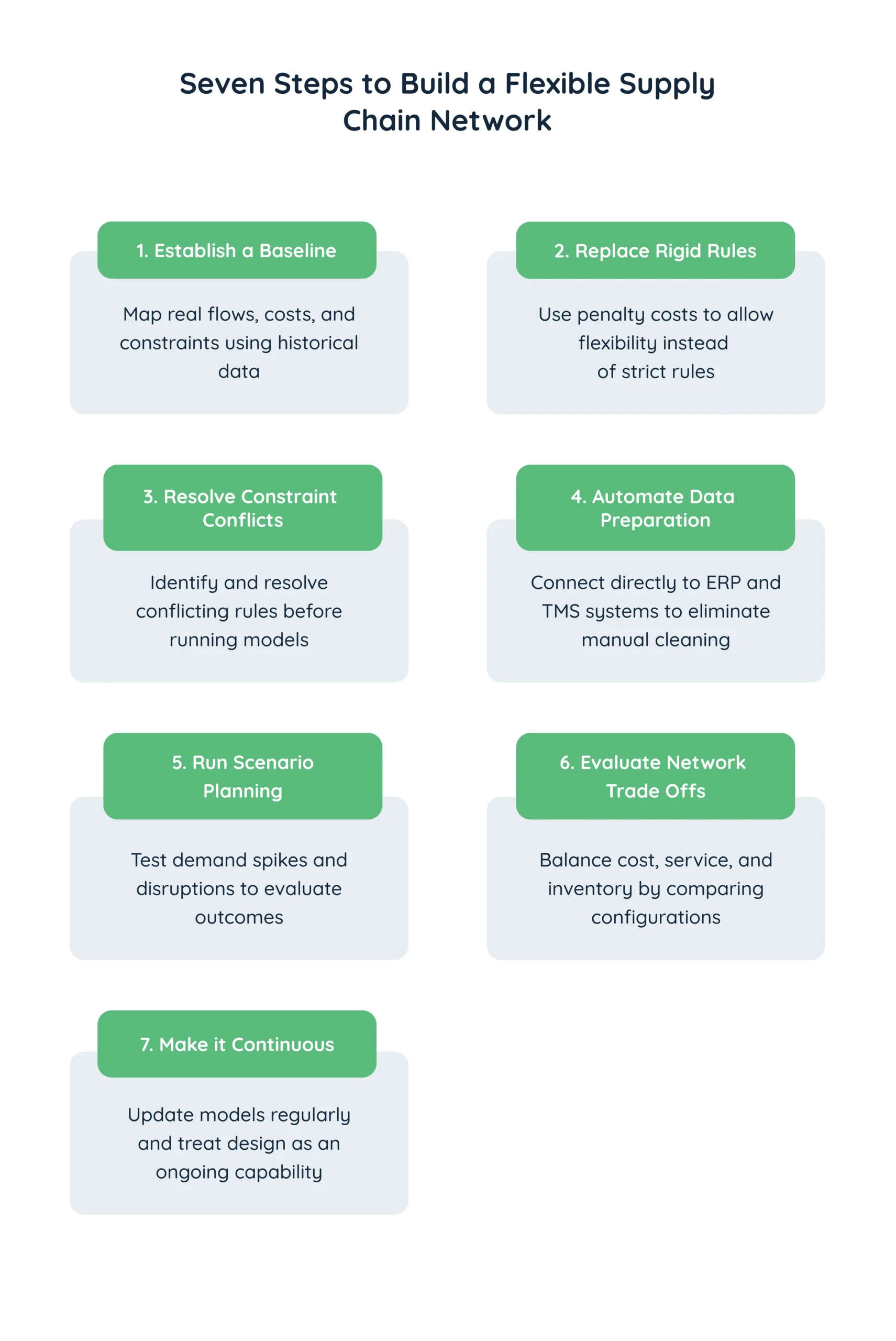
Step 1: Establish a Baseline of Your Current Network
Before redesigning anything, you need an accurate view of your current network. This means mapping real flows, actual costs, and verified constraints.
The baseline is the reference point for all future scenarios. Poor data leads to misleading comparisons. Many organisations underestimate the time this takes when done manually. Automated data pipelines can reduce this from weeks to days.
Step 2: Replace Rigid Rules with Soft Constraints
A common cause of model failure is over constrained design. Strict rules work in stable conditions but break when one requirement cannot be met.
Using soft constraints with penalty costs allows the model to find the best available solution. If a supplier cannot meet full demand, the model finds the next best option and shows the cost of that decision.
Step 3: Identify and Resolve Constraint Conflicts Early
Conflicting constraints often cause projects to stall. Two valid rules, such as a minimum service level and a maximum transport cost, can make a model unsolvable together.
Diagnostic tools that highlight these conflicts early save time. They reduce repeated cycles of running, failing, and adjusting the model.
Step 4: Automate Data Cleaning and Validation
Data quality determines how useful the model will be. Missing values, inconsistent costs, and incorrect units lead to poor outcomes.
Automated data pipelines that connect to ERP, TMS, and planning systems remove the need for manual preparation. This enables continuous use instead of one time modelling.
Step 5: Run Scenario Planning and Stress Tests
A model tested only on historical averages is not reliable. Flexibility comes from understanding performance under new conditions.
Supply chain scenario planning should include demand spikes, supplier failures, freight cost changes, tariff shifts, and new market entry. Each scenario should produce clear cost and service outcomes.
Step 6: Evaluate Trade Offs Across the Full Network
Every decision involves trade offs. Centralised inventory reduces cost but increases lead time. Adding a distribution centre improves service but raises fixed cost.
Optimizing for one metric creates imbalance. A proper evaluation considers cost to serve, service levels, inventory, resilience, and sustainability together.
Step 7: Treat Network Design as a Continuous Process
A network designed a few years ago may already be sub optimal. Demand, costs, suppliers, and regulations change.
High performing companies treat network design as a continuous process. They run scenarios regularly, update models as inputs change, and adjust structure before costs build up.
Why Speed Is the Difference Between Analysis and Action
All of this depends on how fast you can run scenarios. If models take days or weeks, teams run fewer scenarios and accept more risk.
Faster models change behaviour. Teams test more options, challenge assumptions, and make better decisions with more confidence.
This is not a small improvement. The difference between hours and days determines whether network design is used actively or treated as a yearly exercise.
Sophus runs complex supply chain network optimization models 50 to 100 times faster than traditional solvers. A model that takes over an hour elsewhere can run in seconds on Sophus. Teams that once tested a few scenarios can now run hundreds, leading to better decisions.
Reaspns Why Supply Chain Network Design Projects Fail
Understanding where flexible network design efforts break down is as important as knowing how to get them right. The same issues appear across organisations of all sizes.
1. Over Reliance on Rigid Constraints
Strict rules make the model fragile. When one requirement cannot be met, the model fails instead of finding a workable solution. This is a common cause of infeasible results.
2. Poor Data Quality
Incorrect or incomplete data leads to wrong outputs. Missing values, inconsistent formats, and unclear cost structures reduce model accuracy. Automated validation helps prevent these issues.
3. Limited Computational Capability
Traditional tools struggle with large and complex networks. Teams are forced to simplify data, which reduces accuracy and limits the scenarios that can be tested.
4. Trying to Replicate Historical Data Exactly
Forcing the model to match past performance adds unnecessary constraints and increases runtime. The goal is to find the best configuration for current and future conditions, not to recreate the past.
5. Treating Network Design as a One Time Project
A network redesigned in 2022 and not revisited since is already running behind current demand patterns, cost structures, and tariff realities. The supply chain network design factors that determine optimal configuration change continuously. The model needs to change with them.
What to Look for in Supply Chain Network Design Software
Not all supply chain network design software handles flexibility the same way. Some tools are built for one-off strategic studies. Others support continuous network planning as an ongoing capability.
The features that determine whether a tool supports genuine flexibility:
- Solver speed: How quickly the tool evaluates complex models with hundreds of facilities and thousands of demand points
- Automated data integration: Whether it connects directly to ERP and TMS systems or requires manual data preparation before every run
- Scenario flexibility: Whether planners can run and compare scenarios without specialist support
- Constraint handling: Whether the tool supports soft constraints with penalty costs or only hard rules
- Greenfield analysis: The ability to identify optimal facility locations from scratch, not just optimise an existing footprint
Sophus connects directly to ERP and logistics systems through automated data pipelines, building a working baseline model in 48 hours. Its solver runs complex network scenarios much faster than traditional tools, which is what makes continuous scenario planning practically achievable rather than theoretically desirable.
Most Supply Chain Costs Are Locked In by Design
A flexible supply chain network is not achieved by adding more options to a rigid structure. It is achieved by redesigning the structure itself, the constraints, the data foundations, the modeling capability, and the planning cadence, so the network can respond before change becomes a crisis.
The seven steps in this guide address each layer of that redesign. Organisations that complete them do not just have a better model. They build a planning capability that creates a structural advantage over competitors still relying on static, annual reviews.
If most of your costs are locked in by design, how often are you actually redesigning your network?
Bring your network data. We will show you what Sophus finds in it.