

Most supply chain leaders face a constant disconnect. Their dashboards show a clear “plan,” but the day to day reality is filled with late shipments, sudden cost changes, and unexpected delays.
In legacy environments, resolving a single supply disruption, like rerouting freight or rebalancing inventory, can take weeks of manual coordination across 5 to 10 disconnected systems.
Because legacy tools were built for a slower, more stable world, they cannot adapt when conditions change quickly. When a disruption strikes, planners are forced to manually override the system and reach for the “next easiest answer,” like paying for expensive expedited freight or borrowing stock from a nearby warehouse. While this reactive fix patches the immediate gap, it is rarely optimal. The result is trapped working capital, excess costs, and network wide imbalances.
The missing piece is the ability not just to react, but to think proactively about what can be changed and restructured to make the entire network work. Instead of treating supply chains as fixed problems to be solved occasionally in isolation, organizations need to achieve continuous supply chain optimization by continuously evaluating the full network to find the true optimal path.
The Quantum Solver and Continuous Planning
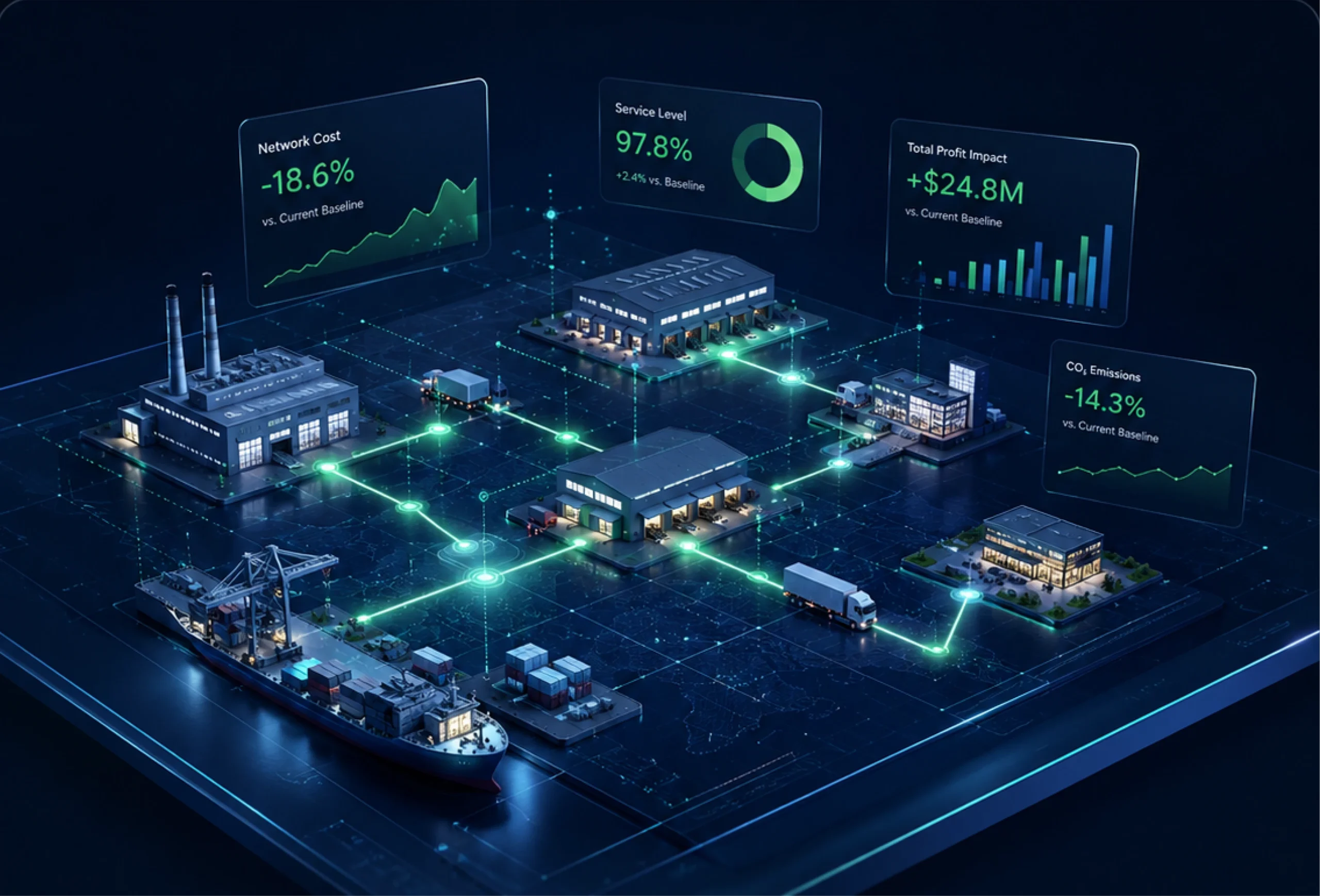
Sophus is built for continuous supply chain optimization, removing decision latency from months to minutes. What is available right now is a unified, cloud-native platform that creates a living digital twin of your supply chain network. Powered by a “Quantum Solver” that uses Artificial Intelligence, Sophus improves optimization solving speeds by 20 times compared to legacy systems.
How This Differs From Legacy Platforms
Tools like AnyLogistix, AIMMS, and Blue Yonder were built for periodic, project-based optimization. You run a model, get an answer, and move on.
Sophus operates differently: a single unified data model means forecasting, inventory, network design, and transportation optimization are optimized together, not in sequence. The Quantum Solver’s speed improvement is what makes continuous re-optimization economically viable instead of a theoretical ideal.
Moving Toward the Agent-Driven Era of Supply Chains
Sophus is actively integrating “regenerative AI agents” and machine learning to push optimization further. Instead of manual exploration, machine learning agents are increasingly taking over repetitive tasks like replenishment calculations and schedule adjustments.
These AI agents can simulate thousands of supply chain scenarios simultaneously, exploring multiple trade-offs in cost, capacity, demand, and time in parallel.
Operating with built-in guardrails, these self-optimizing algorithms learn what “optimal” looks like as conditions evolve, ensuring that every automated decision contributes meaningfully without conflict.
By shifting from periodic iteration to system-wide agentic intelligence, outcomes are proactively discovered rather than constructed step-by-step, effectively closing the gap between insight and execution.
Coordinated Intelligence with Built-In Guardrails
Running multiple agents requires precise coordination to handle the massive scale of modern logistics. Sophus manages this through rule-based configurations, where each agent operates within defined roles and boundaries. Because Sophus brings forecasting, inventory optimization, network design, and transportation optimization together under a single, unified data model, the agents do not work in isolated silos.
This prevents overlap and ensures that every agent — whether focused on routing, replenishment, or production — contributes meaningfully without conflicting with another agent’s objectives. Loop detection adds another layer of control, identifying repetitive or circular behaviors before they affect outcomes.
From Insight to Execution: Closing the Gap
Continuous supply chain optimization is only valuable if it leads to action. Sophus is designed to bridge that gap by shifting the planning paradigm from episodic, quarterly reviews to continuous, real-time “micro-optimizations.”
The AI Decision and Planning Sandbox
As part of its roadmap, Sophus is building an autonomous planning environment where regenerative AI agents actively monitor supply chain execution. Acting as an AI-powered control tower, these agents continuously monitor live data across suppliers, warehouses, and transport networks to detect anomalies.
By utilizing Supply Chain Digital Twins, the agents can run risk-free, real-time simulations to explain root causes and recommend plan adjustments instantly when disruptions like port delays or weather events occur. Over time, this evolves into autonomous execution — where plans are not just suggested but implemented dynamically. This enables a shift toward continuous re-optimization, even at the level of individual shipments, moving operations from reactive firefighting to predictive orchestration.
AI-Native Data Automation
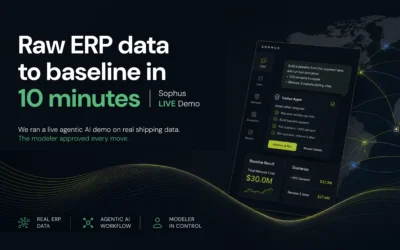
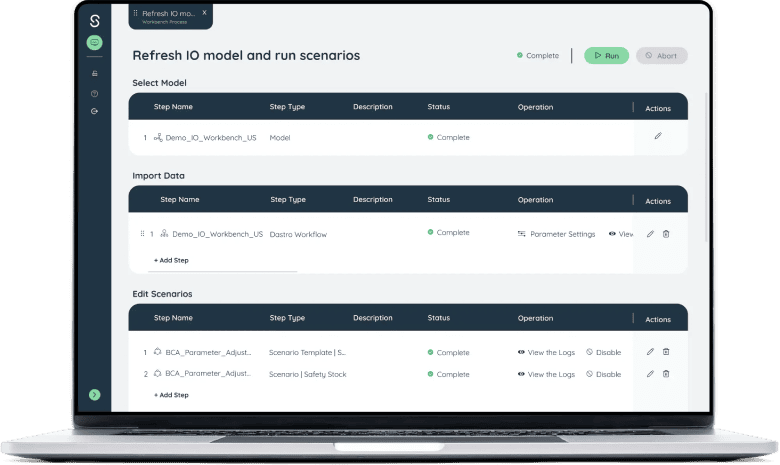
Execution depends on data; and traditionally, data workflows are slow, siloed, and technical, often operating under a “garbage in, garbage out” reality. Sophus simplifies this with an embedded, AI-driven ETL (Extract, Transform, Load) agent and a visual pipeline builder. Instead of writing SQL or Python scripts, users can define workflows in natural language. The system automatically ingests, cleanses, and harmonizes disparate data from existing ERP, TMS, and WMS platforms.
This becomes especially critical during trade disruptions — when tariff changes require rapid scenario re-modeling, manual data workflows become the bottleneck. Sophus translates intent into action, allowing both technical and non-technical users to build, run, and repeat complex data processes with ease — ultimately enabling rapid baselining that turns months of manual setup into days or hours.
Built for Control: Guardrails in an Autonomous System
Autonomy without control creates risk, especially in enterprise environments. Sophus addresses this with strict operational guardrails to ensure that AI acts as decision augmentation, rather than a complete replacement of human judgment.
- Human-in-the-Loop by Design: AI agents cannot take external actions, such as modifying ERP systems or triggering communications, without explicit configuration and approval. By automating repetitive, low-impact tasks, the AI frees skilled human planners to focus on strategic, long-term horizon planning and complex exception management. For critical workflows, human validation is mandatory.
- Least Privilege Access and Explainability: Each AI agent operates under tightly controlled permissions. Most default to read-only access, and all interactions are governed by scoped API keys. This limits exposure and ensures that agents only interact with the data and systems they are authorized to access. The platform also prioritizes output transparency, so planners can clearly trace the logic behind any AI recommendation and build organizational trust.
Why This Matters Now
The shift to agentic systems is a fundamental change in how supply chains operate — not an incremental improvement on top of legacy planning tools.
For supply chain leaders dealing with port delays, demand shocks, or geopolitical shifts, the difference between reacting and anticipating comes down to how fast your planning loop runs. Traditional tools run that loop quarterly. Sophus runs it continuously — evaluating thousands of supply chain scenarios in parallel before a disruption becomes a crisis.
Sophus moves beyond dashboards and recommendations to a model where:
- Decisions are made holistically, not incrementally
- Optimization happens continuously, not periodically
- Actions are executed intelligently, not manually
In a world where disruption is constant and speed is critical, that shift defines the difference between reacting to change and staying ahead of it.
A New Operating Model for Modern Supply Chains
Supply chains are no longer something you plan and revisit later. They demand constant awareness, faster decisions, and the ability to act without delay.
This is where the shift truly happens. Sophus makes continuous supply chain optimization a reality — not a quarterly event. Instead of reacting to change, teams can stay ahead of it with a system that is always working in the background, continuously re-evaluating every node, route, and inventory position across the network.
If you’re evaluating supply chain optimization platforms or questioning whether your current tools can keep up with continuous disruption, see how Sophus compares on network design, inventory optimization, and safety stock planning.