

Login


Author
Actionable Insights
Real-world strategies
No spam, ever
Recent posts

Why Annual Supply Chain Network Design Cycles No Longer Work

Why Annual Network Design Cycles Are No Longer Enough – Sophus
Postal Networks Were Never Simple. Now They Are Changing Faster Than Ever

AI in Supply Chain Design: Hype vs. Reality (Webinar Recap)
The gap between what AI software vendors promise and what happens in the real-world supply chain is widening. While the industry hypes autonomous decision-making, supply chain experts know the truth: AI is a powerful tool for acceleration, but it is not a replacement...

Raw ERP data to baseline in 10 minutes | Sophus LIVE Demo
We ran a live agentic AI demo on real shipping data. The modeler approved every move. Ask any senior supply chain modeler where their time actually goes and you'll get the same answer. Eighty percent of it disappears into data prep. The strategic work, the scenarios,...

Continuous Micro-Optimisation in Retail Operations
Elevate your business with Sophus
About us
Industries
Solutions
Annual Budget Planning
CAPEX Planning
Supply Network Planning
Weekly/Daily Supply Network Planning
Sourcing Optimization
Cost to Serve
Multi-Echelon Inventory Optimization
Holistic Inventory Optimization
Shelf-Life Optimization
Safety Stock Optimization
Replenishment Optimization
Greenfield/Brownfield Analysis
Supply Chain Network Design
Rapid Baselining
Tax and Duties Optimization
GHG Emission Modeling
Vehicle Routes Optimization
Freight Consolidation
Supply Chain Network Digital Twin
Demand Forecasting
Supply Chain Risk and Resilience
© 2026 | All Rights Reserved by Sophus Technology Inc | Privacy Policy | Terms of Use | Designed by Ivana Vyšná
Request a demo
Retail supply chain network design is the process of deciding where to place DCs, regional hubs, and inventory to serve customers profitably across stores, ecommerce, and direct channels. Unlike single channel networks, retail networks must balance speed to customer, fulfillment cost, and service levels across locations with different demand patterns and replenishment cycles.
Retail supply chains were built for a world that no longer exists. The distribution centers, inventory positioning logic, and replenishment rhythms that most retailers operate today were designed for a business that was 80 or 90& in-store. Beside this, it was also predictable, volume-driven, and operating on a weekly cadence. That business is gone for most retailers, and the network is still catching up.
The shift to omnichannel didn’t just add a new channel. It fundamentally changed the physics of the network. Ecommerce demand is unit-level, geographically diffuse, speed-sensitive, and return-heavy. Store replenishment is pallet-level, regionally concentrated, margin-thin, and cyclical. Running both off the same DC infrastructure, with the same inventory positioning logic, means the network is permanently suboptimal for at least one of them and during peak, usually both.
Most retailers know this. The harder question is what to do about it. Redesigning a live supply chain network is operationally complex, capital-intensive, and disruptive enough that it rarely gets prioritized until a crisis forces the issue; a DC at capacity, a last-mile cost that won’t stop climbing, a promotional season that borrowed from store replenishment to survive.
This guide is about getting ahead of that crisis. It covers why retail network design is structurally different from other industries, where the common design failures are, what an omnichannel network optimization actually involves, and what to look for in software that can model your specific network.
Key takeaways
- Retail networks must model channel split demand. Store and ecommerce should be analysed separately by region, not as one combined demand. Aggregated models lead to decisions that fail at the channel level.
- Omnichannel fulfilment requires simultaneous modelling of stores, DCs, and dark stores. Optimising each node type in isolation leads to conflicting decisions across the network.
- The biggest cost opportunity in most retail networks comes from DC positioning and last mile node selection. Carrier rate changes are visible, but network structure is where hidden costs sit.
- Promotional demand stress testing should be part of the network model. Treating it as a separate exercise hides weak points that appear during demand spikes.
- Network redesign creates the most value when triggered by changes in channel mix. Waiting for capacity issues or lease deadlines delays better decisions.
pWhy Retail Supply Chain Networks Are Structurally Different
Manufacturing networks optimize for production efficiency. Distribution networks optimize for cost per unit moved. Retail supply chain networks have to optimize for three simultaneous objectives that frequently conflict: cost, speed, and availability across multiple channels serving different customer expectations.
Store replenishment is predictable, volume-driven, and margin-thin. Ecommerce fulfilment is unpredictable, unit-driven, and return-heavy. Both run off the same DC infrastructure.
A network designed to do one well almost always does the other poorly.
Three things make retail network design harder than other industries:
- Demand is location-specific and channel-split. The same SKU has different velocity in-store in Manchester vs online nationally. A network model that uses aggregate demand misses this entirely and positions stock in the wrong places.
- Returns create reverse logistics complexity. In fashion and electronics, 20–30% of ecommerce units come back. A network designed without reverse flows builds in cost that shows up later as unexplained shrinkage in logistics P&L.
- Promotional spikes are planned but still destabilise network assumptions quarterly. The network has to absorb demand that is 3–5x baseline for short windows, then reset. Unlike most network models that depend on stable demand assumptions and predictable scenario planning, retail demand is not stable.
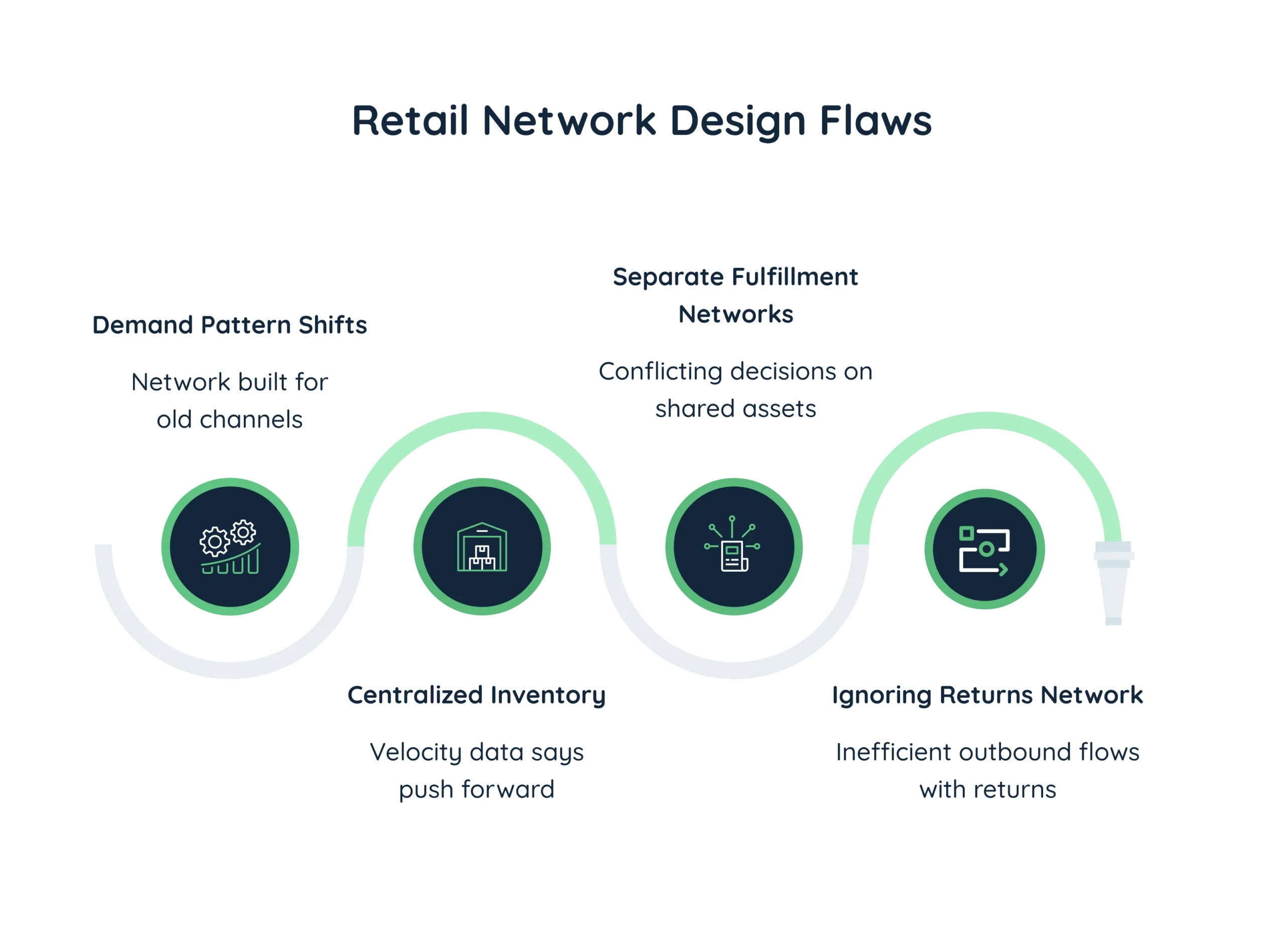
The Four Network Decisions Retailers Get Wrong
Rather than bad logistics execution, most retail network problems come from design decisions that made sense earlier but were never updated.
Node Type
Right When
Wrong When
Slow moving, high value, or wide SKU range that does not justify regional stocking
Speed sensitive categories where 2 day fulfillment
creates a competitive disadvantage
Demand density by region justifies the fixed cost, especially for fast moving categories
Demand is too sparse or unpredictable to justify committed regional capacity
Grocery and same day categories in dense urban markets
General merchandise with irregular demand where unit economics do not hold outside dense urban
areas
For a full comparison of platforms that handle retail specific network complexity including channel split modelling, scenario comparison, and cost to serve analysis, see our guide to 5 best supply chain network design software.
See what your retail network could look like
Sophus models omnichannel retail networks with channel split demand, cost to serve by node, and scenario comparison across DC configurations so you know exactly where cost and service opportunities exist before making a network decision.